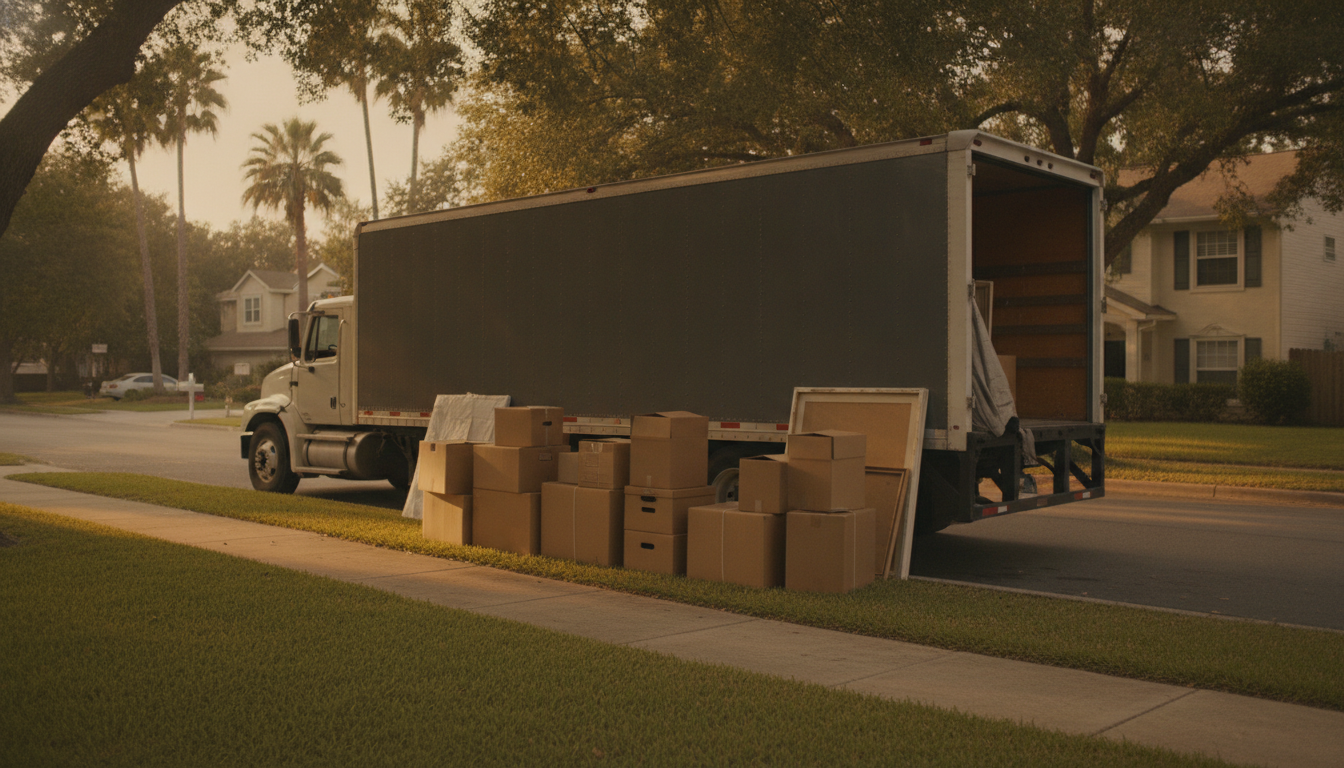
Moving from Indiana to Florida is an interstate relocation spanning roughly 1,000 to 1,300 miles, with professional moving costs typically ranging from $2,500 to $7,500+ depending on the size of your home, the season you move, and the services you choose. The single biggest lifestyle shift for most Hoosiers isn't financial — it's trading cold, snowy winters and spring tornado risk for year-round heat, high humidity, and Atlantic hurricane season. Here's everything you need to plan this move well.
What does an interstate move from Indiana to Florida cost?
Long-distance moving costs are driven by four main variables: shipment weight, distance, time of year, and add-on services (packing, storage, specialty items). For a move between Indiana and Florida — one of the more popular Sun Belt corridors — here are realistic ballpark ranges by home size:
These are estimates only. Actual costs vary significantly based on your specific origin and destination, floor access, the volume of belongings, packing materials, and whether you need short-term storage. Peak season (May through September) typically commands higher rates — and Florida-bound moves are extremely popular in summer, so book early.
Full-service packing, specialty item handling (pianos, artwork, antiques), and long-carry fees for elevator buildings or long driveways can all add to the base rate. Ask your mover for an itemized quote so nothing surprises you at delivery.
How does the cost of living and tax picture compare?
This is where the Indiana-to-Florida move gets interesting. On the surface, Florida feels more expensive — and in many housing markets, it is. But the elimination of state income tax changes the math considerably for working-age movers and retirees alike.
Indiana vs. Florida: Side-by-side comparison
On the federal price index for 2024 (U.S. = 100), Indiana sits at 93, comfortably below the national average. Florida's 103 puts it just above the national baseline — not dramatically expensive, but a noticeable step up, especially in housing. Median rent on a two-bedroom jumps from $1,050 in Indiana to $1,850 in Florida, and median home prices nearly double from $231,000 to $415,000.
The counterweight is Florida's zero state income tax. If you're earning $70,000 a year, eliminating Indiana's 3.05% flat rate puts roughly $2,135 back in your pocket annually. For retirees drawing Social Security and investment income, the savings can be even more meaningful. Run the full numbers for your household — property taxes, homeowners insurance (which runs higher in Florida due to hurricane risk), and utility costs (air conditioning runs hard May through October) all factor in.
How does the climate and lifestyle change?
Indiana has a humid continental climate: four distinct seasons, hot and humid summers, and cold winters with regular snowfall. Tornado risk is serious, particularly during spring and early summer across central and southern Indiana.
Florida operates on an entirely different weather calendar. The state has a humid subtropical to tropical climate, meaning winters are mild and largely frost-free, but summers are long, intensely hot, and saturated with humidity. If you're moving to a coastal area — and most of Florida is near a coast — hurricane season runs June through November, with the statistical peak in September. This isn't a reason not to move, but it requires preparation: understanding your flood zone, securing appropriate insurance, having an evacuation plan, and knowing your new community's emergency protocols.
The lifestyle shift goes beyond weather. Florida is nearly four times Indiana's population, with major metro areas (Miami, Tampa, Orlando, Jacksonville) that operate at a different pace and scale than Indianapolis or Fort Wayne. That said, Florida also has quieter inland communities, small Gulf Coast towns, and retirement-oriented enclaves that feel decidedly unhurried.
How does an interstate move actually work?
Any mover crossing state lines is an interstate move regulated by the Federal Motor Carrier Safety Administration (FMCSA). Here's what that means practically:
Licensing requirements
Every legitimate interstate mover must hold a USDOT number and an MC (Motor Carrier) number issued by the FMCSA. You can verify both at the FMCSA's online search tool before signing anything. If a company can't produce these numbers, walk away.
Binding vs. non-binding estimates
- Non-binding estimate: The quote is an approximation. Your final bill is based on actual shipment weight and may be higher or lower than the estimate.
- Binding estimate: The price is locked in for the services listed. You won't pay more even if the shipment weighs more than estimated — but additions to your move (new items, extra services) will adjust the price.
- Binding not-to-exceed estimate: You pay the binding price or the actual weight cost, whichever is lower. This is often the most consumer-friendly option on long hauls.
Always get your estimate in writing and read it carefully before signing.
Valuation (not insurance)
Federal law requires movers to offer two valuation options. Released value (the free basic option, available only if you sign a written waiver choosing it) covers only $0.60 per pound per item — almost nothing for electronics or antiques. Full value protection holds the mover responsible for repair, replacement, or cash settlement at current market value. For a 1,000+ mile move, paying for full value protection is almost always worth it.
Delivery windows
Interstate movers rarely guarantee a specific delivery date — they provide a delivery window, often 3 to 14 business days depending on the distance and route. Build flexibility into your plans, especially if you're starting a new job. Don't schedule your first day of work for the morning after your estimated delivery date.
How do you find and vet a licensed long-distance mover?
Start your search with movers in Indiana to get quotes from your origin city, and cross-reference with movers in Florida if you want local agents familiar with your destination. You can also find movers by filtering for interstate-licensed carriers or browse by state to compare options across the route.
Once you have a short list, do this:
- Verify the USDOT and MC numbers on the FMCSA website.
- Get at least three written estimates — ideally after an in-home or virtual walkthrough, not a phone guesstimate.
- Check verified review platforms for patterns in complaints, not just star ratings. Look specifically for mentions of delivery delays, surprise charges, and claims handling.
- Ask directly: How is my shipment handled if it needs to transfer to a second truck? Will you use a carrier agent in Florida or your own fleet?
- Read the Bill of Lading before signing at pickup. This is your legal contract — confirm the services, the delivery window, and the valuation coverage are exactly what you agreed to.
Avoid any mover who asks for a large cash deposit upfront, can't provide licensing numbers, or won't give you a written estimate.
Frequently asked questions
How far in advance should I book a mover for an Indiana-to-Florida relocation?
For peak-season moves (May through September), booking 8 to 12 weeks in advance is strongly advisable. Florida-bound moves are consistently high-demand during summer. Off-season moves (October through March) may give you more flexibility, sometimes 4 to 6 weeks out, and can come with lower rates.
Is it cheaper to move yourself vs. hiring a full-service mover?
A DIY move using a rented truck or portable container can reduce costs, but factor in truck rental fees, fuel (Indiana to Florida is 1,000+ miles), lodging, and the physical toll of a multi-day drive with a loaded truck. For larger households, the cost gap between DIY and professional narrows considerably. Many people find a hybrid approach — renting a container and doing their own packing — hits a reasonable middle ground.
Will my homeowners or renters insurance transfer to Florida?
Not automatically, and Florida's insurance market is notably different. Homeowners insurance premiums in Florida are among the highest in the country due to hurricane and flood risk. Start shopping for Florida-specific coverage before your move date, and confirm your flood zone status — standard homeowners policies do not cover flood damage.
What items won't movers transport across state lines?
Interstate movers are federally prohibited from transporting hazardous materials, including propane tanks, gasoline, certain cleaning chemicals, and ammunition. Most movers also decline perishables and plants. Your mover will provide a specific non-allowables list — review it before packing.
Does Florida's no-income-tax status apply immediately when I move there?
Yes — once Florida is your state of legal domicile (your permanent home), you stop owing Indiana state income tax on future earnings. You'll want to update your driver's license, vehicle registration, and voter registration to establish Florida residency. If you work remotely for an Indiana employer, consult a tax professional about how your transition year is handled.
What's the best time of year to move from Indiana to Florida?
Fall (October–November) is often the sweet spot: hurricane season is winding down, Florida temperatures are more manageable for moving day, and demand for moving services drops after the summer peak. Winter moves (December–February) also work well for climate reasons, though the holidays can compress availability. Avoid late spring and summer if you can — it's the most expensive and logistically competitive window on this corridor.