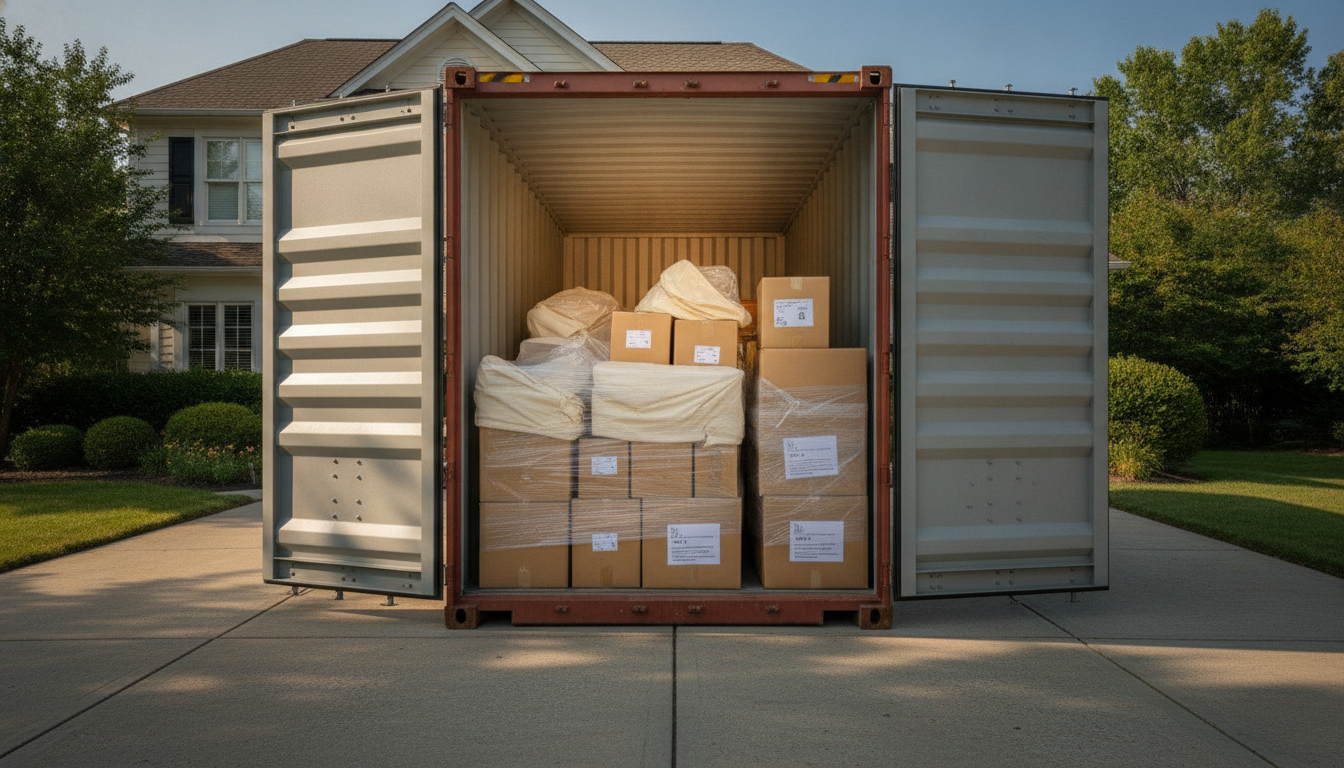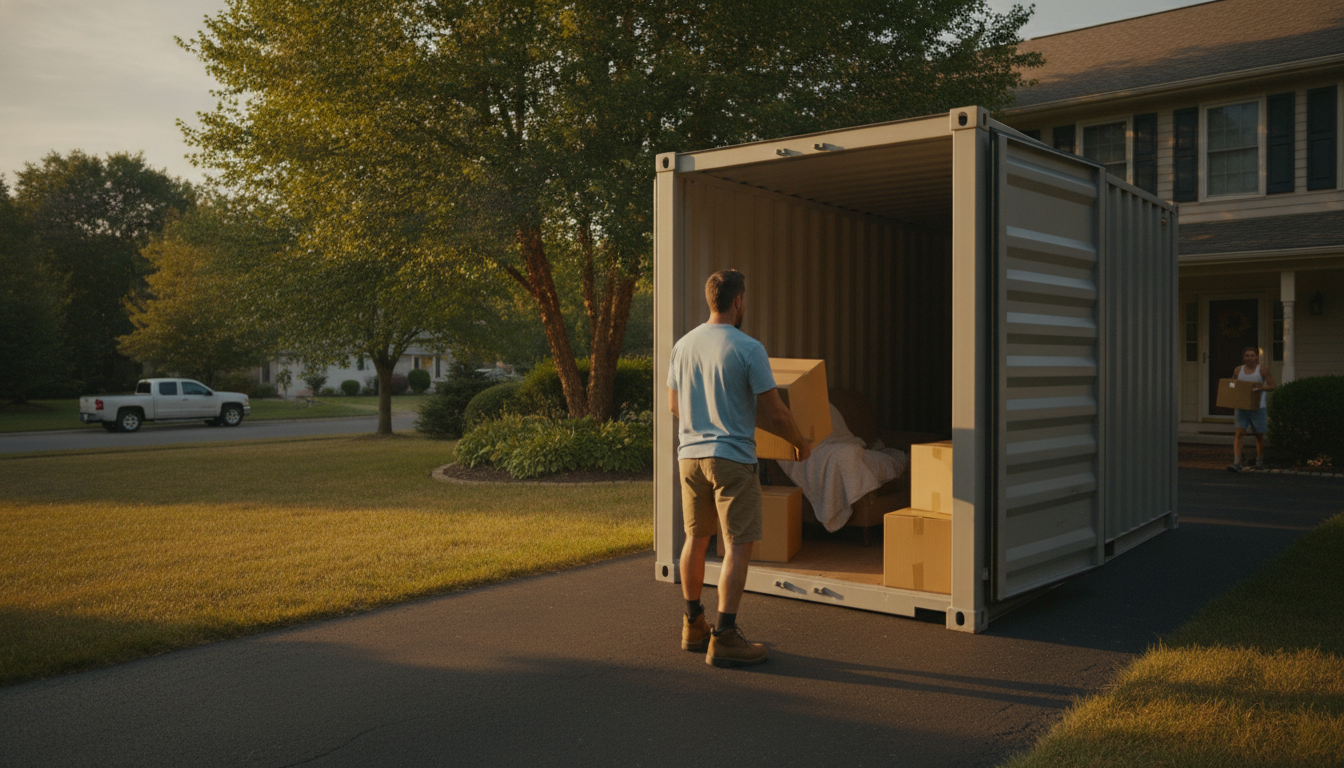
Container and freight moving lets you pack on your own schedule and pay for only the space and weight you use, rather than a full truck — which typically makes it 20–40% cheaper than hiring full-service movers for a long-distance move. The tradeoff is real: you do the loading and unloading, delivery windows are wider, and damage claims work differently than they do with a licensed household goods carrier. Here's everything you need to know before you book.
What's the difference between a portable container move and freight shipping?
These two terms get used interchangeably, but they're distinct products.
Portable moving containers (brands like PODS, 1-800-PACK-RAT, and U-Haul U-Box) drop a steel or wood container at your address. You load it over several days, the company picks it up and hauls it to your destination, then drops it again so you can unload. Containers typically come in 8-foot, 12-foot, and 16-foot sizes.
Freight shipping (also called LTL — less-than-truckload) moves your belongings on a shared commercial truck. You pack your items onto a pallet or into a crate, a freight carrier picks it up at a terminal or from your home, and it travels alongside other shippers' cargo to a destination terminal where you pick it up — or pay a delivery fee.
| Feature | Portable Container | LTL Freight |
|---|---|---|
| Loading location | Your driveway | Home or freight terminal |
| You load/unload? | Yes | Yes (pallets/crates) |
| Pricing basis | Container size + distance | Weight + distance (cwt) |
| Typical cost, 2BR cross-country | $2,500–$5,000 | $1,200–$3,500 |
| Delivery type | Door-to-door | Terminal or threshold |
| Transit time | 3–14 business days | 3–10 business days |
| Best for | Families, full-home moves | Light loads, partial moves |
How much does a container move actually cost?
Pricing varies by provider, distance, container size, and how long you keep it. Here's a realistic breakdown for 2026:
- Local container rental (under 50 miles): $150–$350 per month for the container, plus a delivery/pickup fee of $75–$150 each way.
- Long-distance container move (1,000+ miles): $2,500–$5,000 for a standard 16-foot container, all-in. A 2-bedroom load typically fits one 16-foot container.
- Extended storage: Most companies charge $150–$250/month if you need the container held at their facility before delivery — useful when your new place isn't ready yet.
- Overweight fees: Watch for these. Some providers charge per hundred pounds (cwt) over a base weight. Always ask for the weight limit and overage rate in writing.
For LTL freight, pricing is quoted per hundred pounds. A 2,000-lb partial load moving 1,500 miles might run $800–$1,800 depending on freight class and whether you're going terminal-to-terminal or door-to-door.
If you're trying to figure out whether a container move undercuts full-service movers for your specific situation, our complete 2026 moving cost breakdown gives you benchmarks by move size to compare against.
What does FMCSA regulation cover — and what does it leave out?
This is where people get burned. The Federal Motor Carrier Safety Administration (FMCSA) regulates household goods carriers — companies that physically transport your belongings. Under 49 CFR Part 375, licensed HHG movers must provide a binding or non-binding estimate, a bill of lading, and released-value or full-value protection options.
Portable container companies occupy a gray zone. Because you load and unload the container yourself, many providers classify themselves as storage companies rather than household goods carriers — which means standard FMCSA consumer protections may not apply in the same way. Always read the contract to see:
- Whether they carry cargo liability coverage
- What the per-pound or per-item liability limit is (often as low as $0.10/lb without an upgrade)
- Whether disputes go to FMCSA or are handled through binding arbitration
LTL freight carriers are regulated by the Surface Transportation Board and operate under a released rate, typically $0.10–$0.25 per pound unless you declare a higher value and pay a higher freight rate.
Bottom line: For both options, purchase additional declared-value or third-party moving insurance. Our guide on moving valuation vs. insurance coverage explains exactly what those terms mean and what's worth paying for.
Step-by-step: how to execute a container move
- Get quotes from at least three container providers. Confirm the all-in price: container rental, delivery, pickup, transport, and any fuel surcharges. Ask specifically about weight limits and overage fees.
- Reserve early — especially in summer. Containers book out 3–6 weeks in advance during peak season (May–September). For tips on timing, see how to choose a moving date.
- Confirm your driveway clearance. A 16-foot container needs roughly 60 feet of linear clear space and a flat, hard surface. Gravel driveways and tight urban streets can be problems — call your provider before booking.
- Check local permit requirements. Some cities and HOAs require a street-placement permit for containers on public property. Fees typically run $25–$100 and take 2–5 business days to process.
- Load heaviest items first, against the front wall. Use furniture blankets on all wood surfaces. Fill every box fully (partial boxes crush). Strap furniture and appliances to the container's built-in anchor rings.
- Photograph everything before the doors close. Date-stamped photos are your best evidence if a damage claim arises. Our guide on how to file a moving damage claim walks through exactly what documentation you'll need.
- Confirm your delivery window in writing. Most providers give a 3–7 day delivery window for long-distance moves. If you need a guaranteed date, ask about express delivery — it typically adds $200–$600.
- Unload and return the container promptly. Most contracts include a set number of "on-ground days" (often 3–5). Exceeding that triggers daily fees of $15–$30.
While you're reading
Skip the research — let Robert match you with movers.
Get real quotes from vetted movers in your area, free.
When a container move makes sense — and when it doesn't
Container moves work well when:
- You want to load at your own pace (great for families, seniors, or anyone packing room by room)
- You need temporary storage while closing on a new home
- You're moving 500+ miles and want to save vs. full-service movers
- You have a driveway or accessible parking for delivery
Container moves are the wrong call when:
- You live in a high-rise apartment or urban area with no accessible delivery point
- You have a large volume of very heavy items (pianos, safes, gym equipment) — specialty movers handle those better
- Your timeline is fixed and you cannot absorb a 5–7 day delivery window
- You have irreplaceable items that need full-value protection from a licensed HHG carrier
If you're weighing all options — container, freight, truck rental, or full-service — our guide to DIY truck rental vs. full-service movers lays out the full comparison with honest pros and cons.
Finding reliable container companies in your area
Not all container providers operate nationwide. Coverage varies significantly by region. If you're moving within a single state or metro area, local operators often undercut the national brands by 15–25%. When vetting any container or freight company, confirm they have a valid USDOT number (searchable at safer.fmcsa.dot.gov) even if they're not classified as a full household goods carrier — it's a basic indicator of legitimate operation.
To find movers and container services near you, browse our directory — or search by state to see which providers serve your specific route. You can also read verified mover reviews to see how companies handle deliveries, pickup timing, and damage resolution before you commit.
Frequently asked questions
How far in advance should I book a moving container?
For local moves, 2–3 weeks is usually sufficient. For long-distance moves during peak season (May through September), book 4–6 weeks out. Popular providers in high-demand corridors — like Florida, Texas, and California — fill up faster. If your move is urgent, see our emergency and short-notice moving guide for alternatives.
Is a container move cheaper than hiring movers?
Typically, yes — for long-distance moves. A 2-bedroom container move covering 1,000 miles often runs $2,500–$4,500. The same move with full-service movers typically costs $4,000–$7,500. The savings come from you supplying the labor. For local moves under 100 miles, hourly-rate movers are often comparable in cost and far less hassle.
What happens if my new home isn't ready when the container arrives?
Most container companies will hold your container at their facility for $150–$250 per month. Confirm this option and the exact rate before you book — it's one of the most common scenarios we see, especially when closings get delayed. This is also where containers have a real advantage over traditional movers, who cannot hold your belongings indefinitely.
Do I need insurance for a container move?
Yes — strongly recommended. Most container providers offer released liability at $0.10–$0.60 per pound, which pays almost nothing on a damaged flat-screen or broken antique. Third-party moving insurance (available from specialty insurers for roughly $100–$300 for a typical household) fills that gap. Our guide on moving valuation vs. insurance explains your options in plain language.
Can I put a car in a moving container?
Generally, no. Most portable container providers explicitly prohibit vehicles in their containers. If you need to move a car during a long-distance relocation, enclosed or open auto transport is the standard approach — our car shipping guide covers costs and what to watch out for.
How heavy can I load a container?
Weight limits vary by provider and container size. A standard 16-foot container typically has a weight limit of 4,000–4,500 lbs. A 2-bedroom household load averages 3,000–5,000 lbs — so it's possible to go over. Ask your provider for the exact limit and overage rate, and consider weighing your heaviest items before loading if you're close to the edge.
Ready to compare container services and full-service movers side by side? Browse moving companies in our directory or ask Robert, our AI moving assistant, to help you figure out which option fits your move, your budget, and your timeline.
Tagged