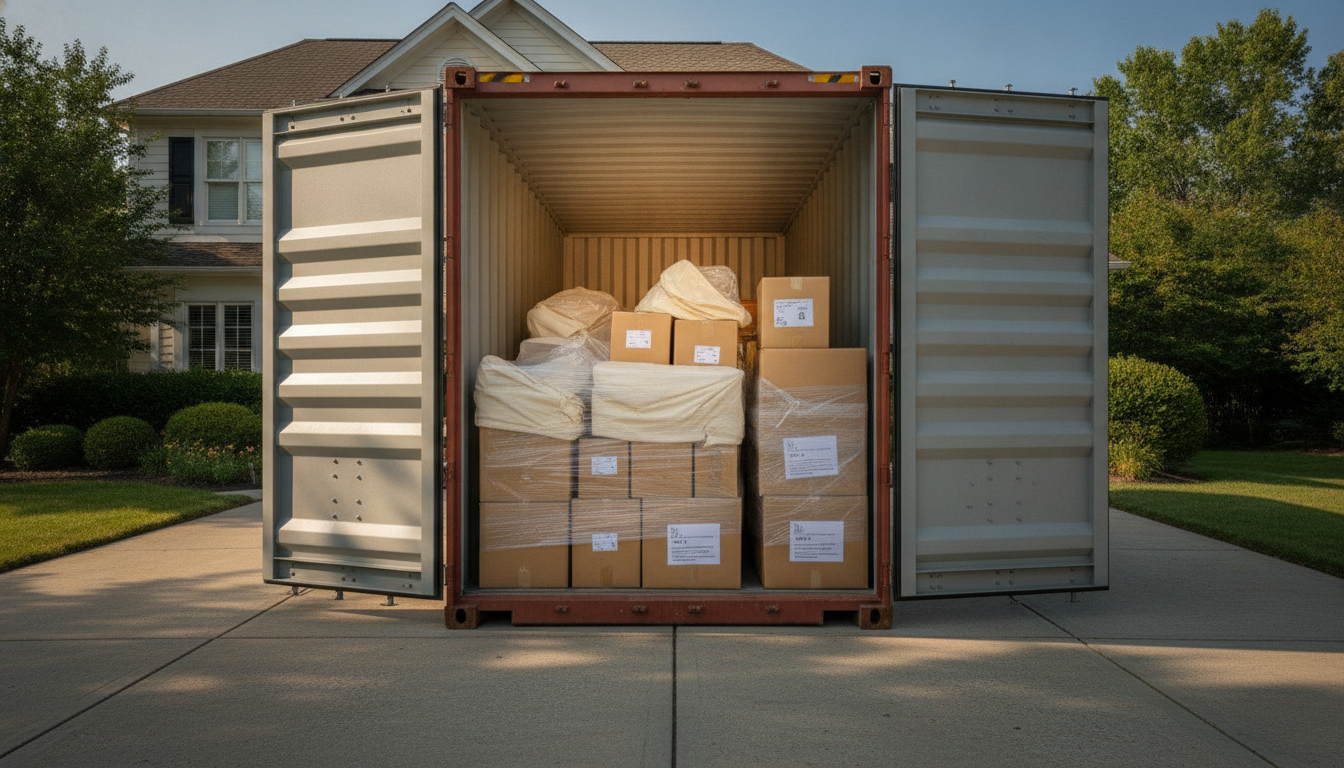
A portable moving container is a weather-resistant steel or wood-framed storage unit — typically 7, 8, or 16 feet long — that a carrier drops at your home, lets you load at your own pace, then hauls to your destination or a storage facility. For moves where timing flexibility matters more than speed, containers often beat both truck rental and full-service movers on stress — though not always on price.
How does a portable moving container actually work?
The process is simpler than most people expect:
- Order and schedule delivery. You book a container online or by phone, pick a drop-off date, and confirm your driveway (or street) has clearance — typically at least 40–50 feet of straight, level space.
- Container is delivered. The carrier uses a hydraulic tilt system (no crane, no trailer swing) to set the unit on your driveway. You receive a lock.
- You load at your pace. The standard rental window is 3–7 days for local moves; many carriers allow up to 30 days. You control packing, loading order, and timing.
- Carrier picks up and transports. Once you call it ready, the carrier hauls it to your new address or a secure facility.
- You unload. Another rental window applies at the destination — often 3–5 days. After that, the carrier retrieves the unit.
The entire process is driver-free on your end. You provide the labor; they provide the box and the haul.
What does a portable container move cost in 2026?
Cost depends on distance, container size, rental duration, and your region. Here are realistic ranges — not quotes, since actual pricing varies by carrier and market:
| Move type | Container size | Typical cost range |
|---|---|---|
| Local (under 50 mi) | 7–8 ft | $300–$700 |
| Local (under 50 mi) | 16 ft | $500–$1,100 |
| Regional (50–500 mi) | 16 ft | $1,200–$2,800 |
| Cross-country (500+ mi) | 16 ft | $2,500–$5,500 |
| Monthly storage (on-site or facility) | 7–16 ft | $100–$250/mo |
What drives the bill higher:
- Extra rental days beyond the included window (often $25–$75/day)
- Overweight fees — most containers have a 4,000–5,000 lb limit; exceed it and surcharges apply
- Fuel surcharges, which fluctuate and are sometimes buried in quotes (read the fine print)
- Inaccessible drop locations requiring a permit or special delivery method
For a full picture of what moving services cost across methods, our 2026 US moving cost breakdown is a useful reference point.
How does a container compare to other moving options?
| Factor | Portable container | Truck rental (DIY) | Full-service movers |
|---|---|---|---|
| You do the driving? | No | Yes | No |
| You do the loading? | Yes | Yes | No |
| Flexible loading schedule | ✅ Days to load | ❌ One day, return truck | ❌ One moving day |
| Best for cross-country? | ✅ Good option | ⚠️ Exhausting | ✅ Best option |
| Storage built in? | ✅ Yes | ❌ No | ❌ Usually separate |
| Typical cost vs. full-service | 30–50% cheaper | Cheapest | Most expensive |
| Requires physical stamina | Yes (loading) | Yes (loading + driving) | No |
If you're still weighing the options end-to-end, our guide on choosing between truck rental and full-service movers walks through every scenario in detail.
When a portable container is the right call
You're moving but your new place isn't quite ready. Containers double as short-term storage. You load once, the carrier holds the unit at a facility, and you call for delivery when you're ready. We've seen this save customers hundreds compared to loading twice — into a storage unit and then back out again.
You have a flexible schedule and want to avoid moving-day chaos. Loading over 3–5 days is dramatically less stressful than cramming everything into a single Saturday. Families with kids, pets, or complex households benefit most.
You're moving regionally — say, 100–800 miles. This is the container's sweet spot. Long enough that driving a truck yourself is grueling; short enough that full-service movers are a significant cost premium.
You're doing a hybrid move. Hire day laborers or a local crew to load the container for you, then let the carrier handle transit. You get the labor help without the full-service price tag. If you go this route, find vetted local movers to handle the heavy lifting.
When a container probably isn't the right call
- You're moving a studio or a very light 1-bedroom. A 7-ft container may work, but at that scale a studio or small move often makes more sense with a standard local crew.
- You need to be at your destination fast. Container transit for long-distance moves typically takes 5–14 business days. Full-service carriers can sometimes move faster.
- Your street or building doesn't allow it. Many urban addresses — particularly high-rises in cities like Chicago, Los Angeles, or Boston — require a street-use permit, which can add $50–$200 and complicate scheduling. Check with your city's public works department before you book.
- You have very heavy specialty items. Grand pianos, gun safes, and large gym equipment loaded into a container without professional rigging is a recipe for injury and damage. Specialty movers are the safer play for those items.
While you're reading
Skip the research — let Robert match you with movers.
Get real quotes from vetted movers in your area, free.
7 tips for loading a portable container like a pro
We've packed thousands of moves. Here's what actually makes the difference when loading a container yourself:
- Load heaviest items first, against the front wall. Appliances, dressers, and bookshelves go in first — low and tight — to keep the center of gravity stable in transit.
- Stand mattresses and box springs on their sides. Lying flat, they waste a quarter of your vertical space. On edge, they line the walls and leave the center open.
- Fill every box completely before sealing. Half-empty boxes collapse under weight. Crumpled packing paper or foam peanuts fill gaps and prevent stack failure. See our fragile-item packing guide for protecting valuables within the container.
- Disassemble what you can. Bed frames, dining table legs, and sectional sofa pieces that are disassembled flat-pack into the margins and free up enormous floor space.
- Use vertical space aggressively. Containers are typically 7–8 feet tall. Stack boxes to the ceiling with heavier boxes on the bottom, lighter boxes on top.
- Tie-down straps are not optional. Most carriers provide anchor points inside the container. Use ratchet straps to prevent load shift — the single most common cause of container damage.
- Load your "open first" items last. The box you need on night one — phone charger, bedding, toiletries, coffee maker — should be the last thing you put in and the first thing you pull out. Our labeling guide covers how to mark these so they're impossible to miss.
What about insurance and liability for container moves?
This is where customers get tripped up. Most container carriers offer released-value protection by default — typically $0.60 per pound per item, the same federal minimum that applies to interstate truck moves under FMCSA regulations. On a 200-lb TV, that's $120 of coverage on a $1,500 item.
Your options for better protection:
- Purchase the carrier's declared-value coverage (typically 1–3% of declared value per year)
- Check whether your homeowner's or renter's insurance policy covers goods-in-transit (many do, with a deductible)
- Buy a separate moving insurance rider — often $75–$200 for a standard household move
Always confirm coverage in writing before the container leaves your driveway. For a deeper look at how these coverage types differ, see our guide on moving valuation vs. insurance.
Frequently asked questions
Do I need a permit to have a container dropped in my driveway?
In most suburban and rural areas, no permit is needed for a driveway placement. If the container must sit on a public street, most cities require a street-use or right-of-way permit, typically costing $50–$200 and taking 2–5 business days to process. Check with your local city or county public works office before booking.
How many containers do I need for a 3-bedroom house?
Most 3-bedroom homes with standard furnishings fit in one 16-foot container, though a heavily furnished house may need a second unit. As a rule of thumb: one 7–8 ft container covers a studio or light 1-bedroom; one 16 ft container covers a 2–3 bedroom home; two 16 ft containers cover a 4-bedroom or larger home.
Can I keep a container in my driveway long-term for storage?
Most carriers allow on-site storage for 30+ days with a monthly fee of roughly $100–$250. Some municipalities limit how long a container can sit on residential property — typically 30–90 days — so check local zoning rules if you're planning extended use.
Is a portable container cheaper than hiring full-service movers?
For a 3-bedroom cross-country move, containers typically run $2,500–$5,500 versus $6,000–$12,000 or more for full-service movers — a meaningful savings if you're willing to do your own loading. For short local moves, the gap narrows and a small local crew may actually cost less once you factor in rental days and your own time.
Can the carrier access my container while it's in transit or stored at a facility?
Reputable carriers do not access your container without your permission. You hold the only key to the lock. When stored at a carrier facility, access policies vary — some allow scheduled visits; others do not permit it. Confirm the access policy before you sign.
What happens if my container is damaged or lost in transit?
File a written claim with the carrier within the timeframe specified in your contract — typically 9 months for interstate moves under FMCSA regulations, though carrier policies vary. Document damage with photos before and after loading. If the carrier disputes or underpays your claim, you may escalate to arbitration. Our guide on filing a moving damage claim walks through the full process.
Portable containers are one of the most genuinely flexible tools in the moving toolkit — but only if the logistics of your specific address, timeline, and move size line up. When they do, they're hard to beat.
Ready to find a mover or container service near you? Browse movers by state to compare vetted providers in your area, or connect with Robert, our AI moving assistant, for personalized guidance on what makes sense for your move.
Tagged