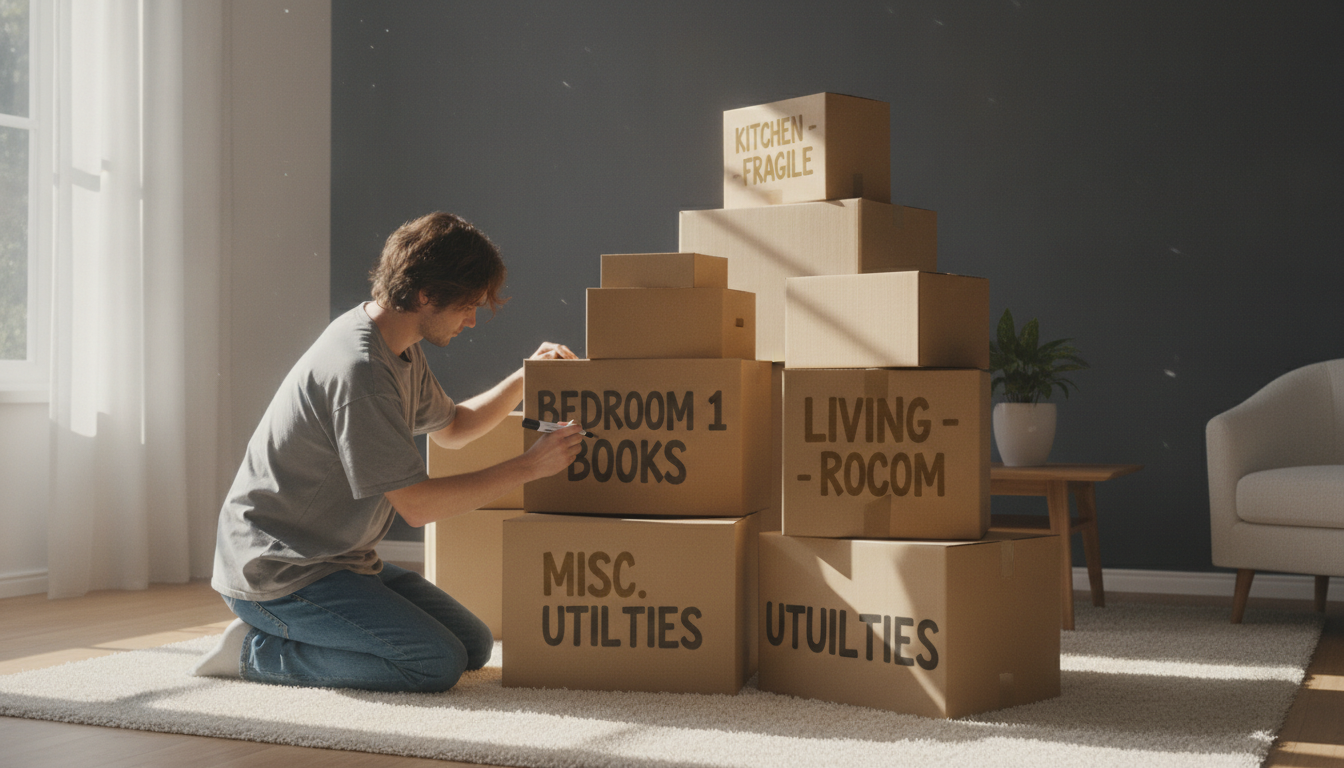
The single best thing you can do to make unpacking easier is label every box with three things: the destination room, a brief contents summary, and a priority number. That's it. A system that takes 30 extra seconds per box at pack-out will save you hours — sometimes days — at the other end.
We've packed and moved thousands of households over 35+ years in this business. The moves that go smoothly aren't always the ones with the most careful packing. They're almost always the ones with the best-labeled boxes.
Why does box labeling matter so much?
When movers carry boxes off a truck, they make placement decisions in under three seconds. If a box says "Kitchen — pots & lids — USE FIRST," it lands in the kitchen. If it says nothing, or just "misc," it lands wherever the mover guesses — or wherever is convenient. That single-room error cascades into 45 minutes of hunting for your coffee maker the next morning.
Good labeling also protects your stuff. Boxes marked "FRAGILE — THIS SIDE UP" actually get handled differently. Not always, but consistently enough to matter. A box that says nothing gets stacked upside down on a dolly just as often as not.
What information should every box label include?
Every box should have at minimum:
- Destination room — the room it belongs in at the new house, not the old one
- Contents summary — 3–5 words, not a full inventory
- Priority tier — open today, open this week, or in storage
Optional but useful:
- Weight warning — "HEAVY" for boxes over ~40 lbs
- Fragile flag — for anything breakable
- Name — helpful for family moves or roommate moves where boxes intermingle
What's the best box-labeling system for a move?
The color-coding method (our top pick)
Buy one roll of colored painter's tape or a pack of colored dot stickers — about $6–$10 at any hardware store. Assign one color per room:
| Color | Room |
|---|---|
| Red | Kitchen |
| Blue | Master bedroom |
| Yellow | Kids' room |
| Green | Living room |
| Orange | Bathrooms |
| Purple | Home office |
| White | Garage / storage |
Slap the color on all four sides of the box plus the top. Movers can spot the color from ten feet away without reading a word. Post a color key on the front door of the new home so every mover can route boxes in 30 seconds flat.
The number priority system
After color-coding, add a priority tier with a black marker:
- Priority 1 — open tonight (bedding, toiletries, phone chargers, a change of clothes, coffee supplies)
- Priority 2 — open within 3 days (most kitchen items, towels, everyday clothes)
- Priority 3 — open when you get to it (books, seasonal items, décor)
Write the priority number big on the top flap. When movers ask where to stack boxes in a room, you can tell them: "Priority 1s near the door, everything else against the wall."
The room-name-only method (simpler but slower to unpack)
If you don't want tape or stickers, just write the destination room in large block letters on all four sides AND the top of each box. The critical mistake people make is labeling only one side — then that side faces the wall and no one can read it. Label all five surfaces (four sides + top).
How to label boxes for specific situations
Shared-room boxes
If a box contains items from two rooms — say, bathroom items from two different bathrooms — label it with the most logical final destination and note both contents: "Master Bath — hair dryer, guest towels."
The "open first" box
Every household needs one clearly designated "open first" box per person — sometimes called a survival kit or essentials box. Label it in red marker: OPEN FIRST / [person's name]. Contents should include:
- Phone charger and a backup battery
- One set of bedding or a sleeping bag
- Two days of clothes
- Toiletries and medications
- Snacks, paper plates, utensils
- Important documents (or a clear note of where they are)
We recommend using a clear plastic bin for this — not a cardboard box — so it's immediately visible coming off the truck. See our moving-day room-by-room checklist for a full breakdown of what to stage for day one.
Boxes going into storage
Any box destined for a storage unit rather than a living space needs a different label entirely. Write "STORAGE" in large letters with the unit location if you're splitting between the home and off-site storage. Include a brief contents note so you're not opening 40 boxes six months later trying to find holiday decorations.
Fragile items
Write "FRAGILE" and "THIS SIDE UP" with an arrow on every side of fragile boxes — not just the top. Use a red marker so it contrasts against the cardboard. If you want to go further, add a brief note like "FRAGILE — wine glasses — do not stack." Movers appreciate the specificity. For best results, read our guide on packing and moving fragile items without breaking anything before you seal those boxes.
While you're reading
Skip the research — let Robert match you with movers.
Get real quotes from vetted movers in your area, free.
What supplies do you actually need for labeling?
You don't need much. Here's what we actually use and recommend:
| Supply | Purpose | Rough Cost |
|---|---|---|
| 2–3 thick black permanent markers | Main labeling | $4–$6 |
| Colored painter's tape or dot stickers | Color-coding by room | $6–$12 |
| Red marker | Fragile / priority callouts | $2 |
| Large sticky labels (optional) | Pre-printed room names | $8–$15 |
| Clear plastic bin | Open-first box | $10–$20 |
Skip elaborate label-printing systems unless you're moving a large household. A thick Sharpie and a roll of tape will beat a label printer every time in terms of speed and legibility under move-day stress.
For a full rundown of packing materials worth buying versus skipping, our guide on choosing moving boxes and packing supplies covers everything from box grades to bubble wrap alternatives.
Common labeling mistakes that cost you time
- Labeling only the top — the top gets covered by another box on the truck; always label all four sides
- Writing vague contents — "stuff" or "misc" is useless; "winter coats + boot rack" takes five more seconds and saves twenty minutes
- Using old labels or re-used boxes — cross out or remove old markings completely before relabeling; two contradictory labels cause wrong-room drops every time
- Skipping the new-home room map — tape a printed floor plan or handwritten room list to the front door of your new home so movers know that "office" means the second door on the left, not the first
- Labeling as you go without a master list — for a large move, keep a simple numbered box log (a notes app works fine): Box 14 = master bedroom, winter bedding, priority 3. If something goes missing, this log is how you find it
Should I create an inventory list for my boxes?
For a small move — a studio or one-bedroom — a written inventory is usually overkill. For anything larger, a simple box log pays dividends. Number each box, write that number on the top in a circle, and log "Box 22 — kitchen, bakeware + mixing bowls — priority 2" in a notes app or spreadsheet.
This becomes especially important for long-distance moves, where boxes may spend days on a truck and you won't be able to dig through them if something seems off. It's also your first line of defense if you need to file a damage or loss claim — a documented box log is far stronger than memory.
Finding movers who will follow your labeling system
A good labeled system only works if your movers respect it. Professional, vetted movers will follow your room assignments reliably — it actually makes their job faster, too. If you're still looking for a crew, browse verified movers in your area or search by state to find licensed, reviewed companies near you.
Once you've found candidates, our guide on hiring a moving company you can actually trust walks you through exactly what to look for before you book.
Have questions about your specific move? Our AI agent Robert is on the site and happy to help you think through the details.
Frequently asked questions
How many sides of a box should I label?
Label all four sides and the top — five surfaces total. Boxes get stacked and rotated on trucks and in rooms, so any single labeled surface will frequently end up facing a wall or hidden under another box. Five-surface labeling means the right information is always visible.
What's the best marker to use for labeling boxes?
A thick-tip permanent marker — like a Sharpie King Size or similar — is the gold standard. The thick tip makes letters legible from several feet away. Thin markers and ballpoint pens are too hard to read quickly under move-day conditions. Keep two or three on hand so you're not hunting for one mid-pack.
Should I label boxes with contents or just the room name?
Both. Room name in large letters so movers can route quickly; a brief contents note in smaller letters underneath so you can prioritize which boxes to open first. "Kitchen — spices & knife block — P2" tells you everything you need in under two seconds.
Do I need a color-coding system or is writing the room name enough?
Writing the room name on all sides is sufficient for small moves. Color-coding adds real speed on larger moves — four-plus bedrooms, many movers, chaotic truck unloads. It reduces wrong-room placements significantly because movers can act on color even when they can't stop to read.
What should I put in my "open first" box?
Think: survive the next 24 hours without opening anything else. Chargers, medications, one set of sheets and a pillow, toiletries, two days of clothes, coffee supplies, snacks, and any critical documents or keys. Use a clear plastic bin if possible so it's instantly identifiable coming off the truck.
Is it worth making a full box inventory list?
For moves of two bedrooms or more, yes — especially if you're hiring professional movers or moving long distance. Number each box, log what's in it on your phone. It takes an extra minute per box during packing and saves enormous time if you can't find something during unpack, or if you need to file a claim for damaged or missing items.
Tagged