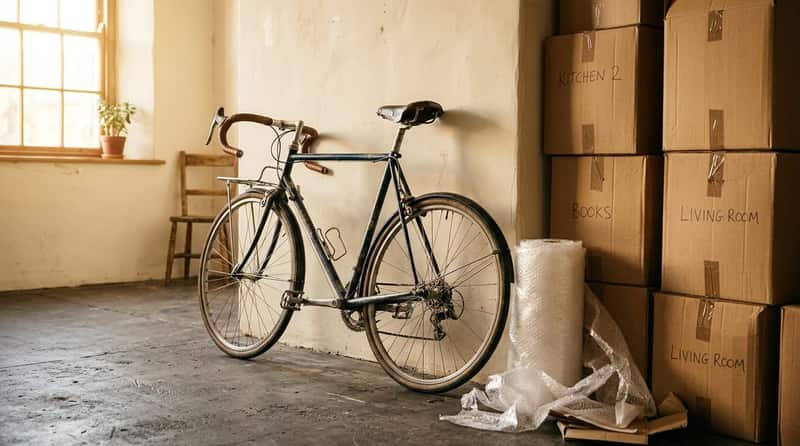
Moving a bicycle safely comes down to three decisions: take it apart the right amount, protect the parts that break easiest, and choose the right container for the journey. Do those three things and your bike arrives in the same condition it left — no bent derailleur, no scratched frame, no wheel that wobbles when you ride it.
Whether you're handing the bike to a full-service mover, loading it into a rental truck yourself, or shipping it ahead, the prep work is almost identical. Here's exactly what to do.
What parts do you have to remove before moving a bike?
You don't have to strip the entire bike — just the pieces that stick out, spin freely, or are fragile enough to get damaged when something shifts against them in the truck. For most bikes that means:
- Both wheels (or at least the front wheel on a quick-release bike)
- Handlebars — loosen the stem bolt and rotate them parallel to the frame, or remove them entirely on drop-bar road bikes
- Pedals — the left pedal has a reverse thread; turn it clockwise to loosen
- Seat and seatpost — slide out and wrap separately
- Rear derailleur — do not remove it, but protect it (see below)
If you have a thru-axle or bolt-on wheel, factor in a few minutes with an Allen key or wrench. Quick-release wheels come off in seconds.
What you do NOT need to remove: the bottom bracket, crankset, brake calipers, or cables — unless a bike shop specifically recommends it for a high-end frame.
How do you protect the frame and components once they're off?
The frame is the hardest thing to replace and the easiest to scratch. Here's how to protect each part:
- Frame: Wrap tube junctions (top tube, down tube, chainstay) in foam pipe insulation or bubble wrap, secured with painter's tape — never packing tape directly on paint or carbon fiber.
- Rear derailleur: This is the most vulnerable component. Either remove it and tuck it in a zip-lock bag, or zip-tie a piece of cardboard over it as a shield. Many cyclists add a derailleur hanger protector (a cheap plastic guard, around $5–$10).
- Fork: Once the front wheel is off, the fork dropouts are exposed metal — wrap them or slip a piece of cardboard between the legs.
- Wheels: Keep them together with a wheel bag or wrap each separately in moving blankets. Zip-tie a strip of cardboard between the spokes and the derailleur-side cassette to prevent cassette teeth from tearing through packaging.
- Handlebars/pedals/seat: Each goes into its own bubble-wrap bundle or small box. Label them so reassembly takes five minutes, not fifty.
If your bike has a carbon fiber frame or fork, do not use foam that traps moisture against the carbon for more than a day or two. Use dry padding.
Should you box the bike or move it unboxed?
| Method | Best for | Approximate cost | Key trade-off |
|---|---|---|---|
| Purpose-built bike box (from a bike shop) | Long-distance moves, shipping, air travel | Free–$25 at most shops | Bulky; needs assembly time |
| Generic moving box (extra-large, 60"+ length) | Local moves, rental trucks | $5–$15 | May require more internal padding |
| Soft bike bag | Frequent travelers, carbon bikes | $80–$300+ | Reusable; little hard protection |
| Unboxed, padded and strapped | Local moves in a pro mover's truck | Included in move | Depends entirely on how movers secure the load |
| Bike shipping service (BikeFlights, ShipBikes, etc.) | Long-distance if movers won't take it | $50–$150+ depending on route | Bike must be boxed; allow 5–10 days |
For a local move with professional movers, most carriers will load an unboxed bike if it's fully padded, the wheels are off, and you discuss it with the crew beforehand. Ask explicitly — don't assume.
For a long-distance interstate move, boxing the bike is strongly recommended. If the mover includes it in your shipment, it will be listed on the bill of lading with a declared value. Under Full Value Protection, the mover is responsible for repairing or replacing items damaged in transit — but document condition with photos before loading. If you choose Released Value (60 cents per pound per article) instead, your $1,500 road bike weighing 18 lbs is covered for about $10.80. That gap is worth understanding before signing anything. For a full breakdown of what valuation really means, see our guide on moving valuation vs. insurance.
Step-by-step: boxing a bike for a move
- Gather supplies: one large bike box, bubble wrap, foam pipe insulation, zip ties, packing tape, a few zip-lock bags for small hardware, and a marker.
- Remove pedals — left pedal clockwise, right pedal counterclockwise.
- Remove the front wheel and deflate both tires slightly (about 10–15 PSI) to prevent blowout in a hot truck.
- Lower or remove the seatpost and set aside.
- Rotate or remove the handlebars so they're parallel with the frame.
- Protect the derailleur with cardboard or a guard.
- Wrap the frame in bubble wrap at all contact points.
- Place the frame in the box with the chainring facing up to protect teeth.
- Slide the fork through the designated fork slot (bike boxes have one) or wedge cardboard to hold it.
- Place the wheels on either side of the frame with cardboard between wheel and frame.
- Fill voids with crumpled paper or foam so nothing shifts.
- Seal and label: write "Fragile — Bicycle" and mark the top clearly. Keep the box upright.
Reassembly at destination: torque specs matter on carbon. If you're not confident with a torque wrench, a local bike shop can reassemble for $25–$75 — worth it for an expensive bike.
While you’re reading
Skip the research — let Robert match you with movers.
Free quotes from movers in your area. Pick whichever is easiest.
Will a moving company move your bike — and what does it cost?
Most full-service movers will load a bicycle, but policies vary. Some include bikes in the standard inventory; others charge a specialty-item fee (typically $25–$75). A few long-haul carriers won't take high-value bikes at all and prefer you ship them separately.
Before booking, ask the mover directly:
- Do you load bikes, boxed or unboxed?
- Is there a specialty-item fee?
- How is the bike listed on the inventory — by weight or as a named item?
- What valuation protection applies to it?
If you're still comparing movers, you can find movers on our directory and filter by specialty-item handling, or browse mover reviews to see how other customers describe the care given to bikes and other oddly shaped gear.
For general guidance on what full-service movers will and won't load, the post on items movers will not put on the truck is a useful companion read.
What about e-bikes?
Electric bikes add one important wrinkle: the battery. Lithium-ion batteries are classified as hazardous on most commercial freight and air shipments. Most professional movers and shipping carriers will not accept an e-bike with the battery installed, and some refuse e-bikes entirely.
The standard approach:
- Remove the battery from the frame before moving.
- Transport the battery in your personal vehicle, in a fireproof battery bag.
- Check with your mover in advance — do not assume they'll take it.
E-bike batteries are also not covered by standard moving valuation in many carrier policies. Confirm in writing before loading day.
Packing a bike for a cross-country or long-distance move
If your mover won't include the bike in the shipment, or if you want maximum protection, shipping via a dedicated bike service is a solid option. The process:
- Box the bike as described above.
- Book a service (most quote online; prices typically run $50–$150 for domestic ground shipping depending on distance and box dimensions).
- Allow 5–10 business days for ground delivery — plan around your move date.
- Purchase the shipper's declared-value coverage for the bike's replacement cost, not its weight.
For the broader picture of what a cross-country move involves logistically, the long-distance moving cost breakdown by move size covers the full picture.
Frequently asked questions
Do movers move bikes without a box?
Often, yes — especially for local moves. Many professional movers will load a padded, disassembled bike in their truck without requiring a box, as long as the wheels are off and the frame is wrapped. Confirm with your specific mover beforehand. For long-distance moves, boxing is safer and strongly recommended.
How much does it cost to ship a bike when moving?
Dedicated bike shipping services typically charge $50–$150 for domestic ground shipping, depending on the distance and box size. Full-service movers may include the bike in your shipment or charge a specialty-item fee of roughly $25–$75. High-value bikes are worth shipping separately with declared-value coverage.
Do I need to deflate the tires before moving a bike?
It's a good idea to let out some air — dropping to around 10–15 PSI from a road bike's typical 80–120 PSI — before loading into a hot truck or container. Heat causes pressure to build, and a tire at full pressure in a 130°F truck bed can blow the tire off the rim.
Can movers damage a bike and what are my options?
Yes — improper loading can bend a derailleur, scratch a frame, or buckle a wheel. If your bike is included in an interstate move under Full Value Protection, the mover must repair or replace damaged items. Document the bike's condition with photos before loading. If damage occurs, file a written damage claim within 9 months of delivery — a note on the delivery receipt is not a formal claim.
Should I move my bike in my car instead of with the movers?
For short moves, transporting the bike yourself in an SUV or on a hitch-mounted rack is often the simplest option. For long-distance moves, your car may already be full, or you may be flying to your destination — in which case shipping or mover inclusion is the practical choice.
Where do I find a bike box for free?
Local bike shops almost always have boxes left over from new bike deliveries — call ahead and ask. They typically give them away free or for a small fee. You can also check online classifieds; cyclists often list used bike boxes after traveling.
Ready to find a mover for your upcoming move? Browse movers by state to compare carriers in your area, check mover reviews to see how others rate their handling of specialty items, or reach out to Robert, our moving concierge, for help narrowing down your options.
Tagged