Packing Christmas decorations for a move comes down to three rules: wrap every glass piece individually in packing paper, coil each string of lights around a stiff card or cardboard tube before boxing, and disassemble your artificial tree section by section into the original box or a wardrobe-height box. Do those three things and you'll unpack the same collection you packed, no matter how many miles the truck covers.
Why Holiday Décor Breaks More Often Than You'd Expect
Christmas decorations are almost always stored loose, stacked fast, and ignored for 11 months. By the time a move comes around, the original packaging is long gone, ornaments are nested without padding, and lights are wound into a single knotted mass. That casual storage routine is a disaster inside a moving truck, where boxes shift, stack, and vibrate for hours. Treating holiday items with the same care you'd give fragile valuables and irreplaceable items is what keeps them intact.
What You'll Need Before You Start
Gather these supplies before touching a single ornament:
- Unprinted packing paper (newspaper ink transfers to painted ornaments)
- Bubble wrap for heirloom or blown-glass pieces
- Small, medium, and large boxes — small boxes for ornaments (heavy when full), medium for garland and figurines, large for lightweight items like wreaths and tinsel
- Cardboard tubes or sturdy cardboard scraps for winding lights
- Tissue paper for gilded, fabric, or painted surfaces
- A thick black marker and colored label stickers — one color per holiday category
- Original ornament boxes, if you kept them (these are the single best container you have)
If you need to stock up, our guide to choosing the right moving boxes and packing supplies covers exactly which sizes and materials to buy — and what's a waste of money.
Step-by-Step: Packing Glass and Delicate Ornaments
- Sort by fragility. Set aside anything hand-painted, mercury glass, blown glass, or more than 20 years old. These get bubble wrap; everything else gets packing paper.
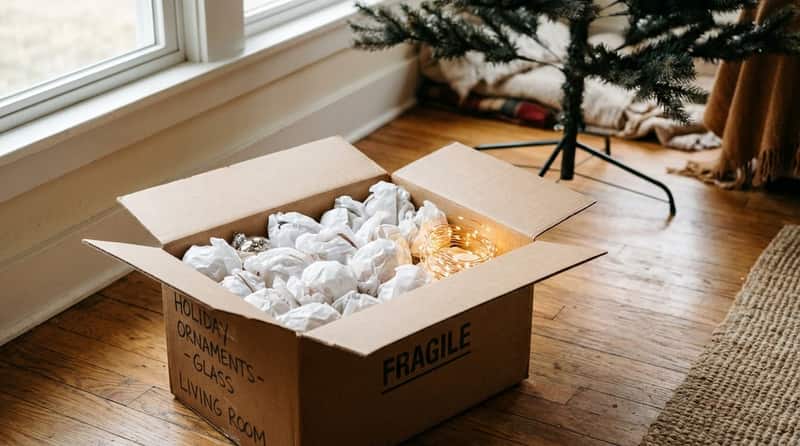
- Wrap each ornament individually. Lay a sheet of packing paper flat, place the ornament in the center, and roll it toward the opposite corner, tucking the sides as you go. Twist the top closed. Never stack unwrapped ornaments.
- Line the box. Put a 2-inch layer of crumpled packing paper on the bottom before the first ornament goes in.
- Pack heaviest pieces on the bottom, lightest on top. Ball ornaments on the bottom layer, delicate icicles or fragile star toppers on the top layer.
- Fill every gap. Loose ornaments rattle and crack. Crumple paper into every open space until the box doesn't shift when you shake it.
- Mark all four sides and the top. Write "FRAGILE — GLASS" and "THIS SIDE UP" on every face. Movers watch for this — it genuinely changes how a box is handled and stacked.
For heirloom or sentimental pieces: Double-wrap in bubble wrap, then paper, then place inside a small box that fits inside the outer moving box. The inner box acts as a second shock absorber.
Step-by-Step: Packing String Lights
Tangled lights are frustrating to unpack, but damaged lights — with cracked sockets or broken wire insulation — are a safety problem. Here's the method that solves both:
- Test every string before you pack it. Packing dead lights wastes space and time. Discard any string with broken bulbs, frayed wires, or sockets that spark.
- Wind each string around a cardboard tube or stiff cardboard rectangle. An empty paper-towel tube works perfectly for most indoor strings. Secure the loose end with a twist tie or the string's own plug.
- Place each coiled string in a gallon zip-lock bag labeled with the strand's length and where it goes (tree, mantle, exterior eaves). This makes setup at the new house fast.
- Layer the bags inside a medium box with crumpled paper between them so they don't compress the coils. Never put heavy items on top of this box.
Outdoor LED strands with heavy plugs benefit from a little extra protection: wrap the plug end in a half-sheet of bubble wrap before coiling.
Step-by-Step: Packing an Artificial Christmas Tree
Most artificial trees arrive in one of two configurations: a tall cardboard box with the pole and branch sections sleeved together, or a large zippered storage bag. Both work for a move, with one caveat — if the tree is taller than 6 feet, the original box is likely too long for a standard moving truck load without special positioning.
- Disassemble in reverse order of how you assembled it. Remove the top section first, then work down. This keeps the branch tiers from catching on each other.
- Fold each branch section in toward the center pole (the same folded position it ships in). Secure with the original twist ties or add zip ties if those are gone.
- Sleeve each section in the original plastic sleeve, or wrap loosely in a large trash bag. This keeps branch tips from snagging and scratching box walls.
- Pack taller sections vertically against the truck wall if possible — your movers should know this box is a standing load, so label it "VERTICAL — DO NOT LAY FLAT" on all four sides.
- If the original box is gone: A wardrobe box (typically 24" × 24" × 46") fits most 6-foot trees laid in sections, or use two large boxes taped together end-to-end.
The tree stand, if metal, is heavy. Pack it separately in its own small box with paper wrapping so it doesn't puncture anything.
Packing by Item Type: A Quick-Reference Table
| Item | Best container | Padding needed | Label priority |
|---|---|---|---|
| Glass ball ornaments | Small box | Packing paper per piece + fill | FRAGILE / THIS SIDE UP |
| Heirloom / blown-glass | Small inner box + outer box | Bubble wrap + paper | FRAGILE / THIS SIDE UP |
| String lights | Medium box | Cardboard tube coils + paper | FRAGILE (sockets) |
| Figurines & nativity pieces | Medium box | Paper-wrap each piece | FRAGILE / THIS SIDE UP |
| Garland (fabric/tinsel) | Medium or large box | Loose layer of paper on top | None required |
| Wreaths | Large box or wardrobe box | Tissue paper over face | FRAGILE (wired elements) |
| Artificial tree sections | Original box or wardrobe box | Plastic sleeve per section | VERTICAL — DO NOT LAY FLAT |
| Tree stand (metal) | Small box | Crumpled paper fill | HEAVY |
| Candles | Medium box | Wrapped individually in paper | FRAGILE / KEEP COOL |
While you’re reading
Skip the research — let Robert match you with movers.
Free quotes from movers in your area. Pick whichever is easiest.
Special Cases Worth Knowing
Candles: Taper candles snap easily; pillar candles soften in a hot truck. Wrap each one in paper, pack in a medium box, and keep this box in your car if the move is longer than a few hours in warm weather. Movers can decline to transport items that may melt or leak, so it's worth keeping candles with you anyway.
Nativity and porcelain figurines: Treat these exactly like packing lamps and other fragile household items — individual paper wrapping, no touching between pieces in the box, and a "do not stack" note on the lid.
Vintage or collectible ornaments: If you have ornaments with actual monetary value — Hallmark series, Radko, or antique glass kugels — it's worth noting them on your moving inventory and understanding what valuation coverage applies. Our guide on moving valuation and what coverage types actually protect explains how Released Value and Full Value Protection work for items like these, so you're not surprised if something breaks in transit.
Outdoor inflatables: Deflate fully, roll tightly from the base toward the motor, and pack the motor/blower unit separately in a padded box. Large inflatables often do better in a contractor bag inside a large box than in a standard moving box.
Labeling Your Holiday Boxes So You Can Find Them Later
Use a consistent color-dot system: one color per holiday or season. Christmas gets red dots, Halloween gets orange, and so on. Write on the box: contents (brief), destination room, and "OPEN LAST." Holiday boxes rarely need to be opened on move-in day, so they should load last onto the truck (which puts them first to come off) or, if storage is part of your plan, go into the storage unit first against the back wall.
For a broader system that works for every room, see our guide to labeling moving boxes so you can find everything on day one.
Should You Pack Holiday Decorations Yourself or Have Movers Do It?
Packing holiday decorations yourself is almost always the better choice — you know which ornaments matter most, and you can take your time with the irreplaceable ones. Professional packing services charge by the hour or by the box, and a full holiday collection can easily add $150–$400 to a packing bill depending on volume. Where professional packing does make sense is for a large collection of antique or collector-grade ornaments where valuation coverage matters; movers who pack items typically carry more liability for breakage than they do for items you packed yourself.
If you're weighing options, find movers near you, compare quotes, and ask specifically whether the quote includes packing materials for fragile seasonal items — that line item varies widely between companies.
Frequently Asked Questions
Can movers move boxes of Christmas ornaments without special handling?
Yes, but you should label every ornament box "FRAGILE" and "THIS SIDE UP" on all sides. Most movers place fragile boxes on top of loads and avoid stacking weight on them, but clear labeling is what triggers that care. If you have especially valuable or irreplaceable ornaments, let the mover know before loading so the crew can position that box accordingly.
Do I need to disassemble my artificial tree before movers take it?
Yes. An assembled artificial tree cannot be safely loaded onto a truck — it's too awkward to secure and the branches will be damaged. Disassemble it section by section, sleeve or bag each section, and pack it vertically in a tall box. Label the box "VERTICAL — DO NOT LAY FLAT."
What's the safest way to move a large collection of glass ornaments?
Use small boxes (never large — glass ornaments make a small box surprisingly heavy), wrap every piece individually in unprinted packing paper, and fill every gap with crumpled paper so nothing shifts. For heirloom pieces, add a layer of bubble wrap and pack them inside a smaller box within the main moving box for double protection.
Will movers cover damage to Christmas ornaments on a long-distance move?
Coverage depends on the valuation option you chose. Under Released Value (60 cents per pound per article), a broken 2-ounce ornament would yield about 7 cents — essentially nothing. Full Value Protection means the mover must repair, replace, or pay replacement value. For a long-distance move with a collection that matters to you, ask your mover about Full Value Protection before you sign. See our valuation vs. insurance explainer for details.
How do I keep string lights from tangling in a moving box?
Wind each string individually around a cardboard tube or stiff cardboard rectangle, secure the loose end, and place the coil in a labeled zip-lock bag. Pack bags loosely in a medium box with crumpled paper between them. Never pile multiple loose strings into one box — they will knot together in transit no matter how carefully you place them.
Should I keep my most valuable ornaments with me instead of on the truck?
For anything irreplaceable — ornaments with strong sentimental value, collector pieces, or family heirlooms — keeping them in your personal vehicle is a reasonable choice. Movers generally won't accept liability for items of extraordinary sentimental or personal value, and no coverage amount replaces something irreplaceable. Pack those in a padded bag or small box and take them with you.
Ready to find a licensed mover for your upcoming move? Browse movers by state to compare companies near you, check mover reviews before you book, and reach out to Robert, our moving concierge, if you'd like a hand narrowing down your options.
Tagged