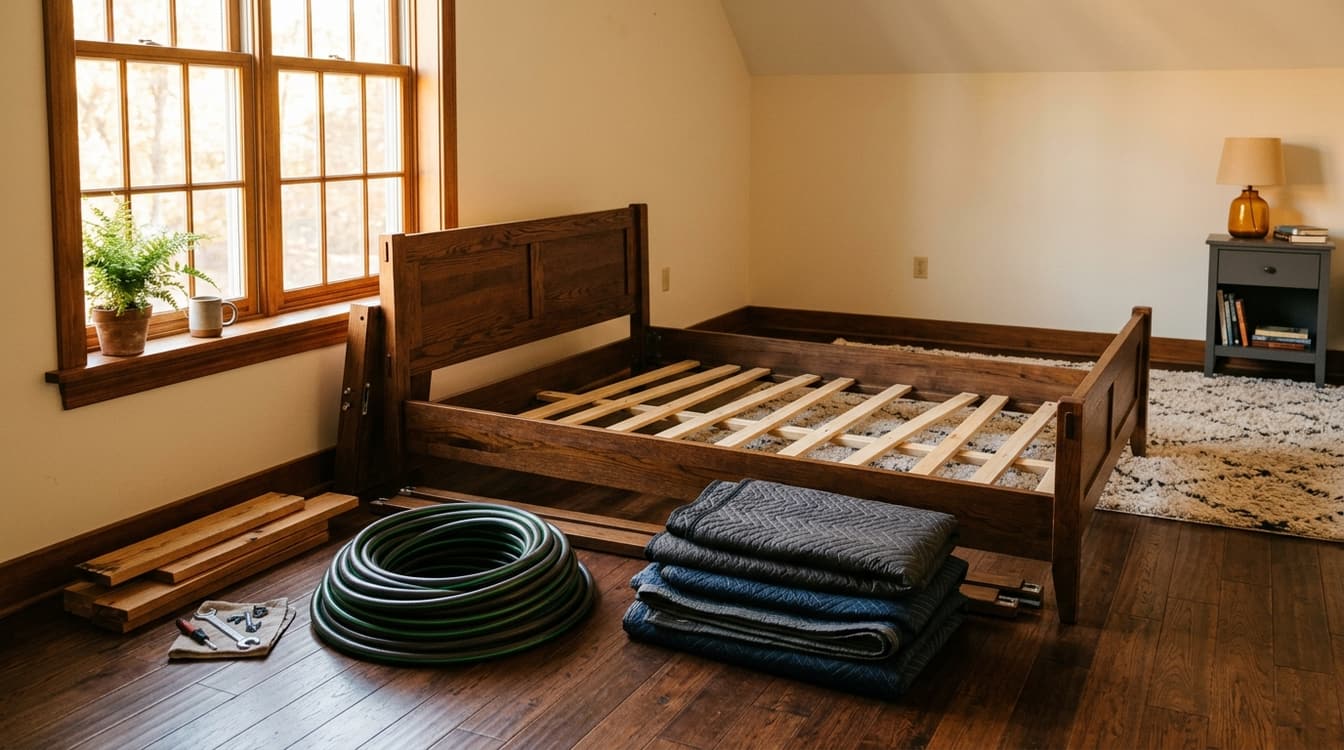
Moving a waterbed requires draining the mattress completely before it is touched by a mover or lifted into a truck — a full-size waterbed mattress holds 150–200 gallons and weighs up to 1,600 pounds when full. Once drained, the vinyl mattress rolls up like a rug, the frame breaks down into flat panels, and the whole setup travels like ordinary furniture. Plan on a full day for draining and breakdown, and another hour or two to refill and condition at the destination.
How much water does a waterbed hold — and why does it matter for moving?
The weight is the entire reason moving a waterbed is different from moving any other bed. A standard king hardside waterbed holds roughly 180–200 gallons; a queen holds around 150 gallons. At approximately 8.3 pounds per gallon, a full mattress can weigh well over 1,500 pounds. No floor, no dolly, and no moving crew can safely work with that weight. The mattress must be empty before anyone attempts to move it.
Even a softside waterbed — the kind built into a foam surround that looks like a regular mattress — needs to be drained. The internal bladder still holds 80–120 gallons on a queen.
What tools and supplies do you need before you start?
Gather everything the day before your drain date so you are not scrambling in the middle of the job.
- Submersible pump or siphon drain kit — a submersible pump (available at hardware stores for $25–$60) cuts drain time from 5–8 hours (siphon) to roughly 1–3 hours
- Garden hose, 25–50 feet — long enough to reach a bathroom drain, utility sink, or outdoor area
- Waterbed conditioner — one bottle per drain cycle; put it in before the final drain so the vinyl stays supple during storage and transport
- Waterbed patch kit — inspect the mattress while it is visible; repair any small leaks before rolling
- Plastic sheeting or old towels — catch residual water during disconnection
- Box fan or shop vac — speeds up the final moisture removal from inside the mattress
- Moving blankets — for wrapping the rolled mattress and frame panels
- Furniture dolly and straps — the rolled mattress is unwieldy even when empty
Step-by-step: draining and dismantling a waterbed
Step 1 — Add conditioner, then connect the drain
Pour the waterbed conditioner into the mattress through the fill valve at least 30 minutes before you begin draining. This coats the interior vinyl as the water leaves, preventing cracking and mildew during the time the mattress is rolled up.
Connect your garden hose to the fill/drain valve at the corner of the mattress. Run the other end to a drain. Make sure the hose runs continuously downhill with no upward bends — a pump eliminates this concern entirely.
Step 2 — Drain completely (allow 1–8 hours depending on method)
| Drain method | Typical time (queen) | Cost |
|---|---|---|
| Submersible pump | 1–3 hours | $25–$60 (buy or rent) |
| Siphon / gravity drain | 5–8 hours | $0 (hose only) |
| Wet-dry shop vac (final cleanup) | 15–30 min (final gallon) | Already owned |
The pump will stall when the water level drops below the intake. Switch to a shop vac or press the mattress by hand to force the last 2–4 gallons out. Leaving even a small amount of standing water inside can cause mildew and add surprising weight.
Step 3 — Roll the mattress and seal it
Once empty, open the fill valve and let air in so the vinyl does not stick to itself. Roll the mattress tightly from the far end toward the valve, pressing as you roll to expel remaining air. Fold the valve inside the roll, secure with moving tape or zip ties, and wrap the whole roll in a moving blanket. Do not fold a waterbed mattress — sharp creases crack the vinyl.
Step 4 — Dismantle the frame
Hardside waterbeds have a pedestal base, a frame (the "deck"), and a liner (the water containment box). Most frames use cam-lock bolts and break down in under 20 minutes with a screwdriver and mallet. Keep all hardware in a labeled zip-lock bag taped to one of the panels.
Softside frames are typically a rigid foam border that separates into sections. Remove the foam surround, then drain and roll the bladder as above.
Step 5 — Protect and load
Wrap the frame panels in moving blankets, just as you would for an oversized piece of furniture — a technique covered in detail in our guide to moving safes and oversized furniture. Stand panels on their long edge in the truck rather than stacking flat; this prevents bowing. The rolled mattress can ride flat on top of a padded surface.
While you’re reading
Skip the research — let Robert match you with movers.
Free quotes from movers in your area. Pick whichever is easiest.
Should you hire movers for a waterbed?
Most full-service movers will transport a drained and disassembled waterbed as standard furniture. The critical question is whether they will help with the draining — many will not, because specialized waterbed drain kits and the time involved fall outside a standard move scope.
What to confirm when you find movers:
- Will the crew disassemble and reassemble the frame, or is that your responsibility?
- Is the waterbed quoted as a specialty item (extra charge) or included in the standard inventory?
- Do they carry adequate liability coverage for a large vinyl mattress that could be punctured during loading?
Get those answers in writing before moving day. A mover who has not seen the bed in person cannot give you an accurate quote — a sight-unseen phone quote for specialty furniture is an FMCSA red flag for interstate moves, and a practical problem for any move. Our team has 35+ years of hands-on service-provider experience, including an operator who ran a moving company for 18 years, and specialty items like waterbeds are consistently where verbal agreements fall apart on moving day.
If your move is local, browse movers by state and look specifically for companies that list specialty furniture or bedroom sets in their service descriptions. Check mover reviews for any mention of beds, frames, or heavy items to gauge how a company handles oversized pieces.
Refilling the waterbed at your new home
Step 1 — Reassemble the frame first
Set up the pedestal and deck before unrolling the mattress. Trying to maneuver a mattress into a frame in a small bedroom is far harder than assembling the frame around it — but both approaches work if space is limited.
Step 2 — Lay the liner, position the mattress, and connect the hose
Spread the safety liner (the plastic containment sheet) inside the frame before unrolling the mattress. Unroll the mattress into the liner, locate the fill valve at the corner, and connect a garden hose to a hot-water faucet. Hot water fills faster and reduces the amount of air pockets.
Step 3 — Fill slowly, then add conditioner and a heater
Fill to within 3–4 inches of the top of the frame. Add one bottle of waterbed conditioner through the valve, then top off. Do not overfill — the mattress should move when you press on it, but the water line should not reach the rim of the frame.
Reconnect the waterbed heater and thermostat. Most heaters take 24–48 hours to bring the water to a comfortable sleeping temperature (around 85–92°F for most people).
Step 4 — Burp the air out
Press firmly across the mattress surface to work air pockets toward the fill valve. Open the valve briefly to release trapped air, then re-seal. Repeat until the mattress feels uniformly soft without hard air bubbles.
What about long-distance or cross-country moves?
For interstate moves, a drained waterbed mattress and disassembled frame are ordinary cargo — they go on the bill of lading like any other furniture. If you are moving across the country, review the FMCSA rules for interstate moves so you understand your valuation rights and delivery window expectations before you sign anything.
One practical consideration: the longer a vinyl mattress stays rolled up, the more the vinyl can stiffen. For moves longer than a week in transit, store the rolled mattress somewhere climate-controlled if possible — avoid attics or truck cargo areas that reach extreme temperatures.
Frequently asked questions
How long does it take to drain a waterbed?
With a submersible pump, most queen-size waterbeds drain in 1–3 hours. Gravity siphoning through a garden hose can take 5–8 hours or more. Budget the full day and start early.
Can I drain my waterbed into the yard or garden?
In most cases, yes — plain tap water with waterbed conditioner is not harmful to soil or grass in typical quantities. Check local wastewater rules if you are on a municipal system, as some prohibit discharging large volumes of water on driveways that drain to the street.
Will movers move a waterbed that isn't fully drained?
Virtually no licensed mover will attempt to move a waterbed with water in it. The weight risk to the crew, the floor, and the truck is too great. Some may check with a hand-press and decline if they feel any significant water remaining.
Do I need a special waterbed conditioner, or can I use something else?
Use a product formulated for waterbeds. Conditioners contain biocide (to prevent algae and bacteria) and a vinyl softener. Substitutes like bleach can degrade the vinyl and void any manufacturer warranty on the mattress.
How do I find movers who have experience with waterbeds?
Ask directly when you request a quote, and read through mover reviews for mentions of specialty or heavy items. A mover who has handled waterbeds before will know to ask about drain access and will typically quote the frame and mattress as separate line items.
Is a waterbed worth moving, or should I sell it and buy new?
That is a personal call, but the math is worth doing. A new quality waterbed mattress runs $300–$800 or more; a vinyl replacement for a hardside bed can run $150–$400. If the frame is solid hardwood and the mattress is in good shape, moving it typically costs less than replacing it — especially if you already own the pump and supplies.
Moving a waterbed is a two-day project when you factor in draining, drying, and reassembly — but it is entirely manageable with the right tools and a mover who knows what to expect. Start by searching for specialty movers in your area, confirm the scope of their service in writing, and connect with Robert, our moving concierge, if you want help thinking through the logistics before you book.
Tagged