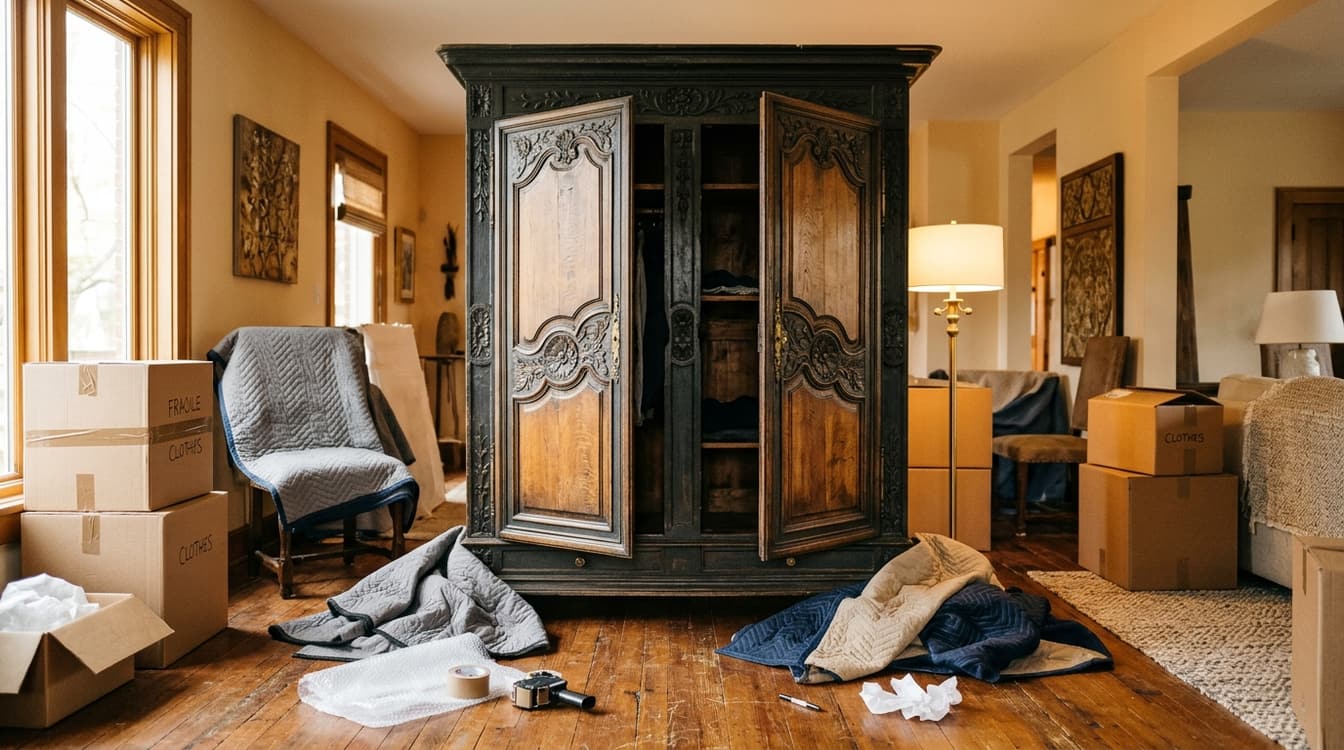
Moving an armoire safely means stripping it down before it goes anywhere near a doorway. Remove the doors and their hardware, empty every drawer, disassemble any removable base or cornice, wrap each piece in moving blankets, and stand the carcass upright on a furniture dolly — never lay it on its back unless the manufacturer says that's safe for the frame. Done in that order, a piece that weighs 150–400 lbs and stands six or seven feet tall becomes something two people (or a professional crew) can actually control.
Why armoires are harder to move than they look
An armoire is not just heavy — it's top-heavy, often assembled from multiple panels that rely on one another for rigidity, and built with decorative elements (mirrored doors, carved corbels, glass-fronted panels) that shatter or splinter if the piece flexes during transit. The moment you tilt a fully loaded wardrobe without bracing it, you're asking its joints to carry a load they were never designed for.
Our team has 35+ years of hands-on service-provider experience, including an operator who ran a moving company for 18 years. The single most common armoire mistake we've seen: movers attempt to carry it whole through a standard 32-inch doorway, realize halfway through it won't fit, and improvise from there. Avoid that moment entirely by measuring first and disassembling second.
Step 1 — Measure everything before you touch the piece
Take three measurements:
- The armoire itself — width, depth, and height with doors closed, then height and width of each door panel separately.
- Every doorway on the exit path — including hallways, stair landings, and the truck's lift gate opening.
- The diagonal clearance — for a tall piece, the diagonal dimension (height² + depth²)^½ is what actually matters when you tilt it to navigate a low ceiling or a tight turn.
If the carcass won't clear a doorway even stripped of its doors, you may need to partially disassemble the back panel or remove trim. Some antique armoires were built inside the room they now occupy and have never been moved whole — check for that before assuming the piece comes out intact.
Step 2 — Empty it completely and remove every removable part
| Part to remove | Why it matters |
|---|---|
| Clothes, linens, anything stored inside | Weight reduction; shifting contents can crack the frame mid-carry |
| Drawers | Each drawer adds 15–40 lbs and can slide out unexpectedly |
| Doors (lift the pin hinge or unscrew butt hinges) | Doors alone can weigh 20–60 lbs each; removing them cuts width by 3–6 inches per side |
| Shelves and interior rods | Loose shelves become projectiles if the piece tips |
| Removable crown molding or cornice | Reduces height by 2–6 inches; prevents snapping on low ceilings |
| Adjustable feet or leveling legs | Prevents them from snagging carpet or catching on door thresholds |
| Mirror panels (if removable) | Pack separately; mirrors crack from frame flex, not just impact |
Label every piece of hardware with painter's tape and a marker. Bag the screws and hinges per component — a zip-lock bag taped to the inside of the drawer it belongs to works well.
Step 3 — Protect the surfaces before anything moves
Moving blankets are the right tool here. Wrap the carcass in at least two full blankets and secure them with stretch wrap or furniture straps — not tape directly on the wood finish, which can lift veneer or lacquer. For mirrored or glass-panel doors, pack them as you would a large mirror: cardboard corner protectors, a layer of packing paper or bubble wrap, then a moving blanket, then a picture box or mirror box if the dimensions allow. Our guide on packing mirrors for a move covers the boxing method in detail.
Protect the floors along the exit path, too. Furniture sliders or a strip of cardboard under the dolly prevent scratches on hardwood. If you're using professional movers, ask what floor protection they bring — what movers use to protect your floors, doorways, and stairwells explains the typical toolkit.
Step 4 — Move the carcass on a furniture dolly, not by carrying it
A four-wheel furniture dolly (sometimes called a platform dolly) is essential for anything over 100 lbs. Tilt the armoire slightly, slide the dolly underneath, then lower it down. Two people minimum: one guides the dolly, one steadies the piece from the back to prevent forward tip.
On stairs: An armoire carcass almost always requires a stair-climbing dolly or an appliance hand truck with stair-glides, plus a third person. The piece should travel steps-side-down with the dolly operator below and two people above controlling the descent. If the staircase has a landing with a tight turn, pre-measure whether the piece can pivot — this is the moment most DIY moves call a professional. You can find movers near you who specialize in oversized furniture if the staircase geometry rules out a DIY approach.
Loading into the truck: Keep the armoire upright. Lay it flat only if the ceiling height of the truck is too low — and only if the piece's construction allows it (solid-panel backs handle it; thin hardboard backs often bow or crack). Secure it against the truck wall with two ratchet straps at different heights. Never let it free-stand in an open truck bed.
While you’re reading
Skip the research — let Robert match you with movers.
Free quotes from movers in your area. Pick whichever is easiest.
Step 5 — Reassemble in the new space before you unpack
Bring the carcass to its destination room before reattaching doors, drawers, and trim. Trying to navigate a door-equipped armoire through a new home's hallways undoes all the work you did in step 2.
Reattach pin hinges by aligning the door, lifting it into position, and dropping the pin. For butt hinges, have someone hold the door at the correct height while you drive the screws — stripped holes are the most common reassembly problem, and a toothpick dipped in wood glue inserted into the hole will give the screw something to bite before it fully cures.
Relevel the piece with the adjustable feet before reloading it with clothes. Armoires on uneven floors will rack the frame over time, making the doors bind or drift open on their own.
When to hire a professional for an armoire move
Consider calling in help if any of these apply:
- The piece weighs more than 250 lbs (common in solid hardwood antique wardrobes)
- It has a mirrored back panel or inset glass that can't be removed
- The exit path includes a staircase with a turn
- It's an antique or high-value piece where a chip or crack would be a significant loss
- You're moving it across state lines and want valuation coverage — for interstate moves, federal FMCSA rules give you the choice between Full Value Protection (the mover repairs, replaces, or pays replacement value) or a written opt-in to Released Value at 60 cents per pound per article; for a 300-lb armoire, that's only $180 in coverage under released value, which is rarely enough for a piece worth thousands
Browse mover reviews to find carriers with specific experience in oversized or antique furniture before you book.
For a broader look at how specialty furniture moves are priced and handled, see how to move a safe or heavy piece of oversized furniture.
What professional movers actually do differently
Experienced movers carry furniture straps that distribute weight across two people's shoulders rather than their hands, which gives much better control on stairs. They also bring stretch wrap and moving pads in quantity, and they know how to "walk" a tall piece around a tight corner by pivoting it on one foot rather than lifting and carrying the whole thing. If you're curious about the full toolkit, the gear movers use to move furniture explains dollies, straps, and sliders in detail.
Frequently asked questions
Can an armoire be transported lying on its back?
Sometimes, but it depends on construction. Solid-panel backs on quality furniture can handle it if the piece is padded and secured. Thin hardboard or MDF backs — common on flat-pack and budget wardrobes — often bow, split, or separate from the frame when laid flat. When in doubt, keep it upright and use a taller truck or a cargo van.
Do I need to take the back off the armoire to move it?
Usually not. Removing the back panel is a last resort for pieces that genuinely won't fit through any opening even fully disassembled. If you go that route, label every panel, photograph the interior before removal, and use the original screws — back panels on antiques often use specific fasteners that aren't interchangeable.
How many people does it take to move an armoire?
Two people can handle most armoires on flat ground with a dolly. Add a third person for any staircase. For pieces over 300 lbs or staircases with turns or low ceilings, four people or professional movers with a stair-climbing dolly is the safer call.
Will movers move an armoire that's still assembled?
Most professional movers will attempt it if it physically fits through the doorways — but a good mover will tell you upfront if the piece needs to be partially disassembled. Ask before moving day. A sight-unseen assessment over the phone is an FMCSA red flag for interstate moves anyway; the mover should conduct a physical or live video survey before pricing the job.
How much does it cost to have movers handle an armoire?
Specialty or oversized furniture handling fees vary by carrier. As part of a full-service local move, it's often included in the hourly rate. As a single-item move, expect a minimum charge of $150–$400 depending on distance, weight, and stair difficulty. Browse movers by state to compare carriers in your area and get itemized quotes.
What's the biggest mistake people make moving an armoire?
Trying to carry it whole through a doorway without measuring first. The piece jams at its widest point (often the door hinges or corner molding), and impromptu maneuvering cracks the frame or the door panels. Spend ten minutes measuring and disassembling and you avoid that entirely.
Need help finding a mover who handles oversized furniture? Use our directory to find movers in your area, check mover reviews to compare their experience with specialty pieces, and reach out to Robert, our moving concierge, if you'd like a hand narrowing down your options.
Tagged