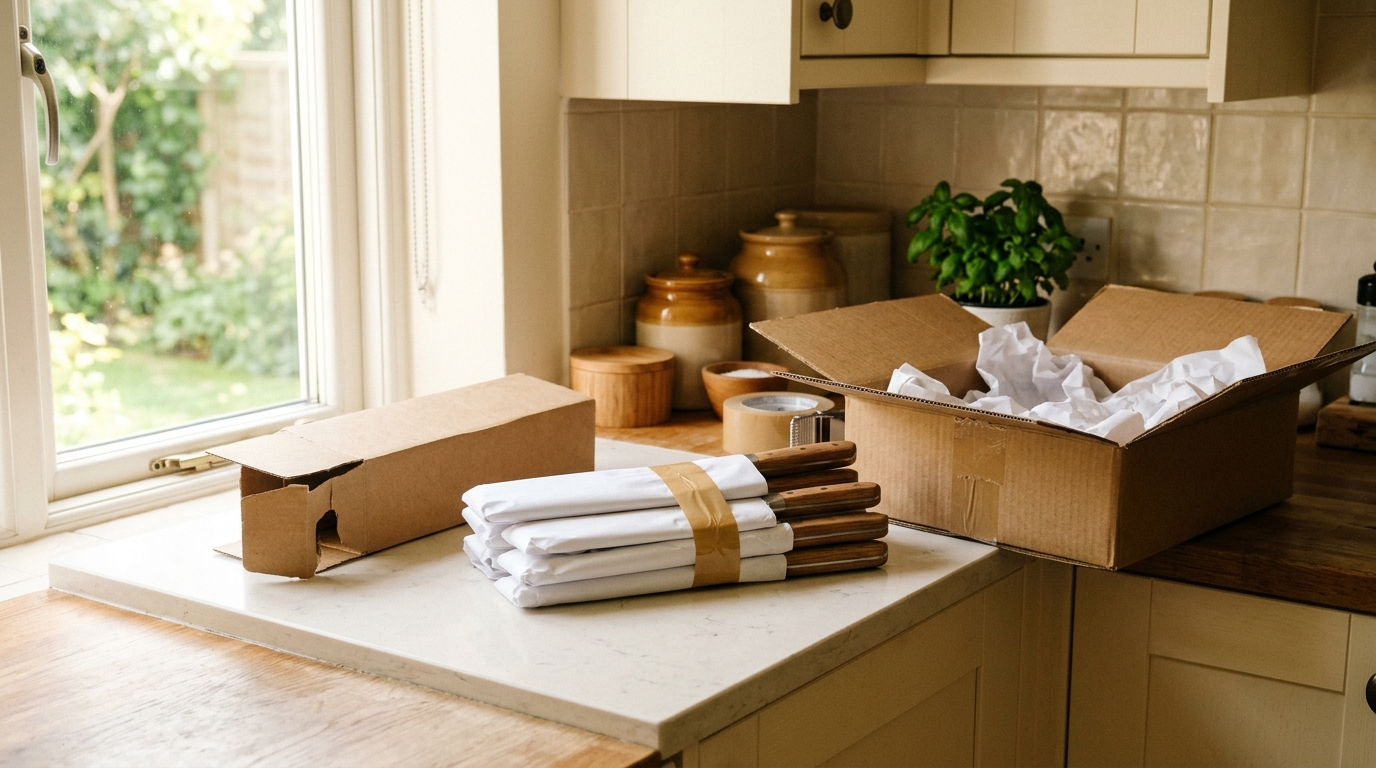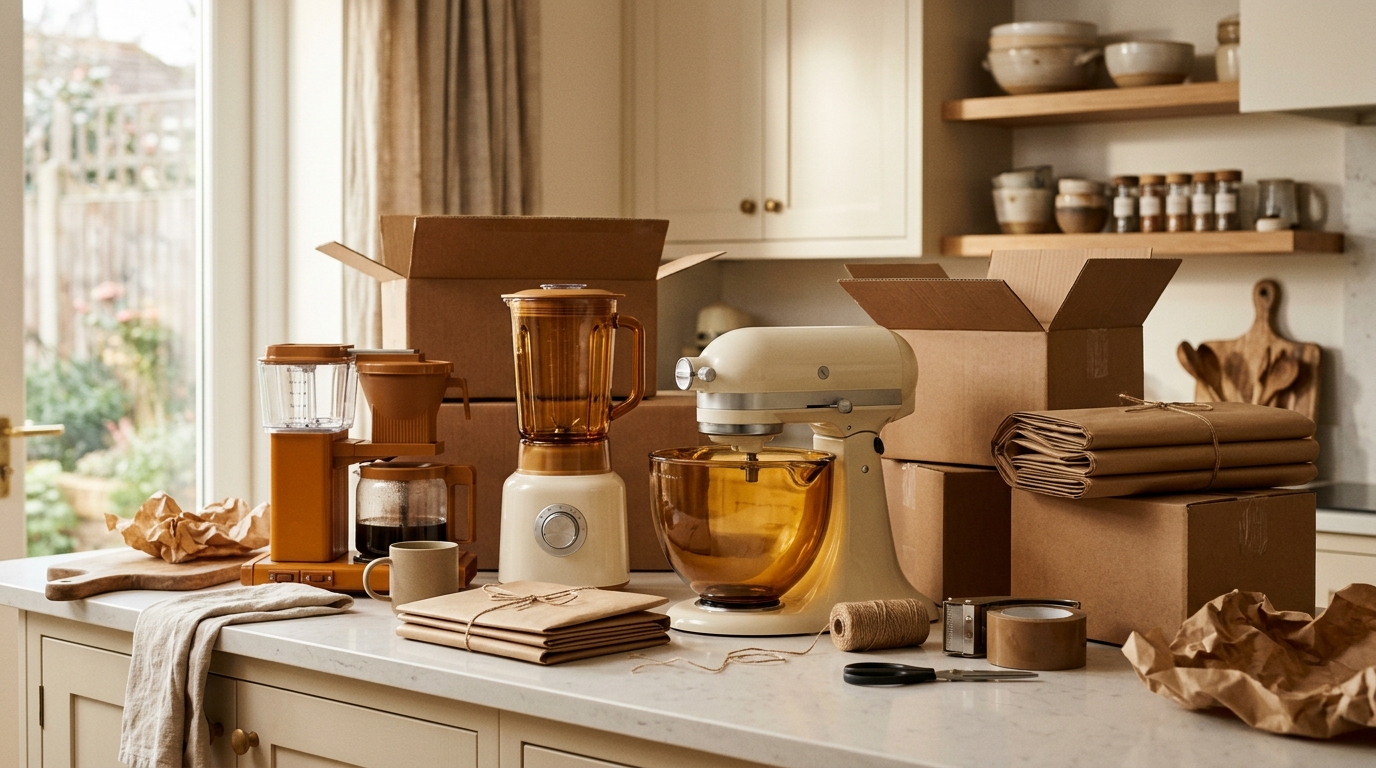
Wrap each appliance individually in several sheets of unprinted packing paper, secure all removable parts in the same box, and pack appliances upright in firm double-walled cartons with at least two inches of cushioning on every side. That three-step framework covers almost every small kitchen appliance — the details below spell out exactly how to apply it to the pieces most likely to arrive damaged when people skip a step.
Why kitchen appliances break in transit (and how to prevent it)
Appliances crack, chip, or lose parts during a move for three reasons: they shift inside boxes, their removable parts aren't separated and padded, and they're packed in boxes that are too large — leaving space for the appliance to bounce around. Every tip in this guide addresses one of those three failure points.
Before you start, gather your supplies: unprinted packing paper (newspaper ink transfers), bubble wrap for anything with a glass component, double-walled medium boxes (roughly 18" × 18" × 18"), high-quality packing tape, and permanent markers for labeling. If you need a refresher on choosing the right carton sizes, the guide on how to choose moving boxes and packing supplies walks through it by box type.
How to pack a stand mixer
A stand mixer is the heaviest and most awkward small appliance in most kitchens — the bowl, the head, and the base all need individual attention.
- Remove the mixing bowl and attachments. Wrap each attachment (whisk, dough hook, paddle) in a sheet of packing paper and bundle them together with tape. Wrap the bowl in three to four sheets of packing paper.
- Tilt the mixer head back (if the model allows) and secure it in the tilted position with a rubber band or the manufacturer's lock. This keeps the head from flopping and snapping the hinge.
- Wrap the base in four to six sheets of packing paper, then a layer of bubble wrap. Set it upright in the center of a double-walled medium box.
- Fill the gaps around the base and bowl with crumpled packing paper — no empty space. Lay the wrapped attachments on top.
- Test before sealing: pick up the closed box and shake gently. Nothing should move. Add more paper if it does.
Weight note: a KitchenAid stand mixer typically weighs 22–26 lb. Pack it alone in its own box — combining it with other items risks crushing or being too heavy to safely lift.
How to pack a blender
- Remove the blade assembly and carafe from the motor base — these three parts travel separately within the same box.
- Wrap the carafe (glass or plastic) in four sheets of packing paper plus a layer of bubble wrap, seam-side up.
- Place the blade assembly in a small zip-lock bag (blades are sharp — this protects you on unpack day, too), then wrap in paper.
- Wrap the motor base in paper. Place base at the bottom of the box, carafe upright beside it, blade bag nestled between them. Fill every gap with crumpled paper.
- Mark the box FRAGILE / THIS SIDE UP on at least two sides.
How to pack a coffee maker
The vulnerabilities here are the glass or thermal carafe and the water reservoir lid.
- Remove and empty the carafe. Wrap it in four sheets of packing paper, then bubble wrap. It goes in its own small box or is cushioned well inside the appliance box — never loose inside the main unit.
- Remove the filter basket and any reusable filters. Rinse and dry thoroughly; coffee oils can transfer to other items. Wrap the basket in paper.
- Wrap the main body in three to four sheets of packing paper. Coil the power cord loosely (tight coils stress the internal wire) and tuck it into the cavity or bag it separately.
- Place the body in the box, fill gaps with paper, and rest the wrapped carafe alongside it — never stacked on top.
Capsule or pod machines (like single-serve brewers): remove and empty the water tank, wrap it separately if it detaches, and follow the same base-wrap-and-fill method.
How to pack a toaster and toaster oven
| Appliance | Key prep step | Box type |
|---|---|---|
| Slice toaster | Pull out and discard the crumb tray or clean it; wrap in paper | Small box or padded space in a medium box |
| Four-slice toaster | Same — remove racks if detachable | Small/medium box, alone |
| Toaster oven | Remove racks, baking pan, and crumb tray; wrap each separately | Medium box, upright if possible |
Never lay a toaster oven on its side — the heating elements can shift. Pack it upright and mark the box accordingly.
How to pack a food processor
- Separate every blade, disk, and bowl — food processor blades are extremely sharp.
- Wrap each blade in several sheets of paper, fold the ends over, and tape securely. Mark the bundle BLADES — SHARP before placing it in the box.
- Wrap the bowl and lid in paper; wrap the motor base in paper.
- Pack the base in the center of a medium box, bowl beside it, and place the blade bundle on top where it's visible when you open the box.
How to pack an air fryer
Air fryers have a removable basket and, on some models, a crisper plate — both need to come out.
- Remove the basket and crisper plate. Wash and dry both completely; grease residue attracts pests in storage and can stain packing materials.
- Wrap the basket in paper, wrap the plate in paper.
- Wrap the body in three sheets of paper. Place body upright in the box, basket nested inside the cavity if it fits snugly, or beside it if it doesn't.
- Coil the cord loosely and tuck alongside the base.
While you’re reading
Skip the research — let Robert match you with movers.
Free quotes from movers in your area. Pick whichever is easiest.
General rules that apply to every kitchen appliance
- Always unplug, wash, and dry before packing. Moisture inside a sealed box can cause mold in transit, especially on longer moves.
- Keep cords with their appliance. Bag or tie each cord loosely and tape the bag to the inside of the appliance's box. You will spend 20 minutes on unpack day hunting a cord that ended up across the room.
- Use the original box when you have it. Manufacturers design packaging to absorb the specific shock pattern of their product. If you saved the box, use it and then place that box inside a moving carton.
- Label every box with contents and room. "Kitchen — coffee maker / carafe / basket" is far more useful than "Kitchen misc." The guide on how to label moving boxes so you can find everything on day one has a labeling system that takes less than two minutes per box.
- Do not pack liquids with appliances. Even a small amount of water left in a coffee maker reservoir can leak. Empty everything completely.
- Consider what's worth moving. If an appliance is old, rarely used, or would cost less than $30 to replace, it may not be worth the packing time and box weight — especially on a long-distance move where heavier shipments cost more. The post on how to declutter before a move has a quick framework for making that call.
What happens if a mover damages an appliance?
Whether a mover covers a damaged appliance — and how much — depends on the valuation option on your contract, not a standard insurance policy. For interstate moves governed by federal FMCSA rules, Full Value Protection requires the mover to repair, replace, or pay the replacement value. The alternative — Released Value at 60 cents per pound per article — means a 10-pound blender would be reimbursed at just $6. Released Value applies only if you sign a written waiver choosing it; it is not imposed on you automatically. For in-state moves, the rules are set by your state, not the FMCSA.
If something arrives broken, file a written claim within 9 months of delivery for interstate moves (90 days for Texas in-state moves). A note on the delivery receipt is not a formal claim. For the full process, see how to file a claim when movers damage or lose your stuff.
Regardless of which valuation level you choose, proper packing dramatically reduces the chance you'll need to file one. Movers will note whether an item was packed by the owner versus by the mover — owner-packed boxes affect how a damage claim is handled, so pack carefully.
Finding a mover who handles your kitchen carefully
The best protection for your appliances starts before moving day. Find movers in your area and check mover reviews to see how companies handle fragile items and kitchen packing. Look at how reviewers describe the care taken with boxes — not just whether anything broke, but whether the crew asked about fragile contents before loading.
If you want help narrowing down options or have questions about what a specific mover's packing services include, reach out to Robert, our moving concierge, through the directory.
Frequently asked questions
Should I keep appliances in their original boxes for moving?
Yes, when you have them. Original packaging is engineered specifically for that product's shape and weight distribution. Place the original box inside a moving carton for an extra layer of protection, especially for glass carafes and mixer bowls.
Can I pack multiple small appliances in one box?
Only if they are similarly sized, each is individually wrapped, and there is no risk of one crushing the other. A toaster and a small hand mixer can share a box if each is fully wrapped and the box has no dead space. A stand mixer should always have its own box — it is simply too heavy to share safely.
Do I need bubble wrap, or is packing paper enough?
Packing paper is sufficient for most plastic-bodied appliances. Bubble wrap adds meaningful protection for glass carafes, glass blender jars, and anything with a screen or display panel. Use a combination: paper for the outer wrap, bubble wrap for the most vulnerable surfaces.
Should appliances be packed upright or on their sides?
Upright whenever possible — especially toaster ovens, air fryers, and coffee makers, where internal components are designed to sit in a specific orientation. If an appliance must go on its side, check the manufacturer's manual first.
What should I do with appliances I'm not sure I want to keep?
Decide before packing day. Donating or selling an appliance you rarely use saves packing time, box cost, and — on a long-distance move charged by weight — potentially reduces your bill. How to declutter before a move walks through the decision process efficiently.
Do movers pack kitchen appliances if I ask them to?
Many full-service movers offer kitchen packing as an add-on service, and some include it in full-pack packages. Packing done by the mover typically affects how damage claims are handled for those items. Ask for specifics in writing before moving day. What services do moving companies offer explains what's typically included and what costs extra.
Tagged