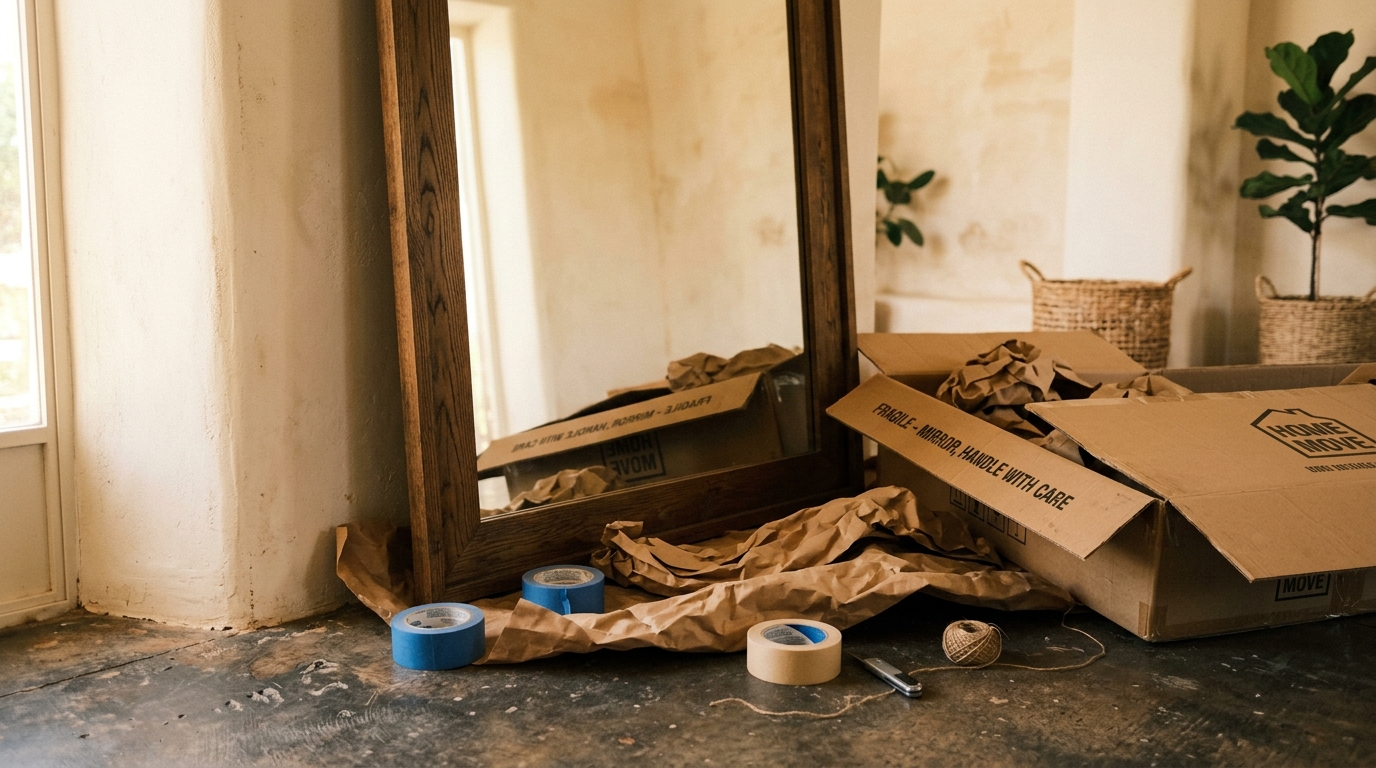
To pack a mirror for moving, tape an X across the glass with painter's tape, wrap the entire mirror in two or more layers of packing paper or bubble wrap, secure it with stretch wrap or tape, and place it upright — never flat — in a mirror box or picture box sized to fit. That sequence is the same whether you are moving a bathroom vanity mirror, a framed wall piece, or a 6-foot floor mirror. The details below will walk you through each step and tell you when a mirror is better left to a professional mover.
Why mirrors break in transit — and what actually prevents it
Glass breaks when it flexes. A mirror laid flat will sag in the center under its own weight, and any bump in the road concentrates stress at the edges. A mirror standing upright distributes its weight along the frame or edge and is far more resistant to road vibration. That single fact — keep it vertical — prevents more breakage than any amount of bubble wrap.
The second cause of breakage is contact with hard surfaces. Even a thin layer of kraft packing paper between the mirror and a box wall is enough to absorb the small shocks that chip edges and spider-web glass.
What supplies do you need to pack a mirror?
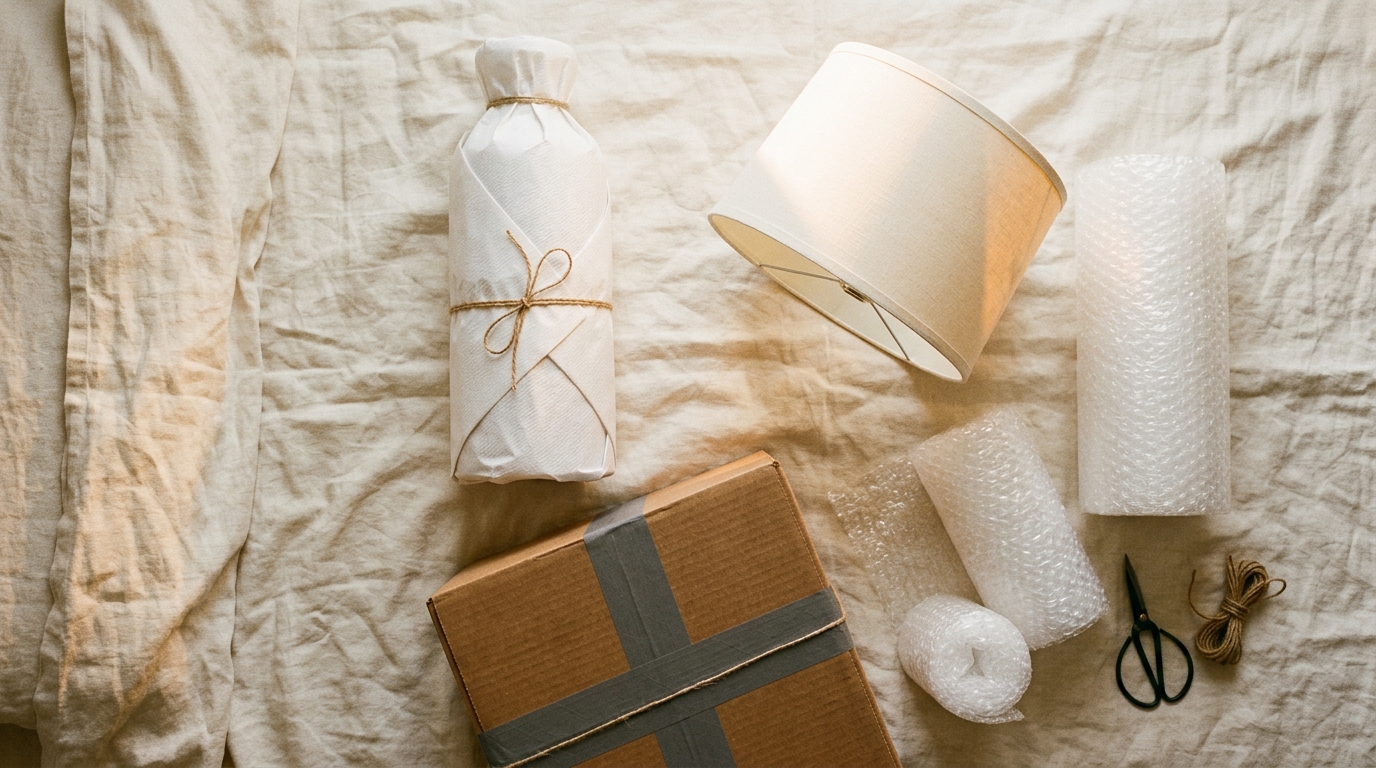
Gather everything before you start. Having to stop mid-wrap is how corners get dinged.
| Supply | What it does | Where to find it |
|---|---|---|
| Painter's tape (1–2 inch) | Tapes X across glass; holds shards if it breaks | Hardware stores |
| Packing paper (unprinted newsprint) | First-contact layer; won't leave ink on glass | Moving-supply stores |
| Bubble wrap (small or large cell) | Cushion layer over paper | Moving-supply stores |
| Stretch wrap / plastic wrap | Holds layers together without adhesive on glass | Hardware stores |
| Mirror/picture box | Rigid outer protection; sized to the piece | Moving-supply retailers |
| Packing tape | Seals the box | Any retailer |
| Foam corner protectors | Extra protection at most vulnerable points | Moving-supply stores |
For a standard bathroom mirror or framed wall mirror under 3 feet, plan on roughly $15–$30 in supplies. A specialty mirror box for large pieces (available in sizes up to 37 × 60 inches or larger) typically costs $8–$20. If your mirror is an antique or worth more than a few hundred dollars, see our guide on how to move art, antiques, and collectibles for crating options.
How to pack a mirror step by step
Step 1 — Tape an X across the glass face
Use painter's tape (not packing tape, which can leave residue or pull the silvering) to lay two diagonal strips of tape from corner to corner, forming an X. Add a few horizontal and vertical strips around the perimeter. This does two things: it reinforces the glass slightly, and if the mirror does break, the tape holds the shards in place so they don't shred your packing materials or injure anyone unpacking later.
Step 2 — Protect the corners first
Slide foam corner protectors onto each corner of the frame before you wrap anything. Corners are the first point of impact in a drop, and protecting them here costs nothing extra.
Step 3 — Wrap in packing paper
Lay two to three sheets of unprinted packing paper flat on the floor, overlapping them to create a surface wider than the mirror. Set the mirror face-down on the paper. Fold the paper up over the edges and onto the back, then tape it in place. Repeat with a second layer of paper — this time face up — to protect the back. For a frameless glass panel, add an extra layer.
Step 4 — Wrap in bubble wrap
Wrap the papered mirror in at least one full layer of bubble wrap (bubbles facing in, toward the glass). Secure with stretch wrap or tape on the bubble wrap — not directly on the frame or glass. For frameless or beveled pieces, add a second bubble-wrap layer.
Step 5 — Box it upright
Slide the wrapped mirror into a mirror box or picture box so it stands on its edge, not flat. If the box is slightly too large, fill the gap with crumpled packing paper or foam sheets until the mirror cannot shift side to side. Close and seal the box with packing tape, running strips along every seam.
Write FRAGILE — GLASS — THIS SIDE UP clearly on both faces of the box with a permanent marker. Our labeling guide has a full system for marking boxes so movers and helpers know exactly how to handle each piece.
Step 6 — Transport it on its edge
In a moving truck, mirrors should ride upright, leaning against a padded wall or mattress. Never lay a mirror box flat on the truck floor, even for a short drive. Strap or brace it so it cannot tip. Experienced movers typically load mirrors and glass panels last (or near last), against a padded wall, for this reason. See how movers load a truck if you want to understand the full loading sequence.
How to pack specific mirror types
Bathroom vanity mirrors (frameless or cabinet-mounted)
Frameless mirrors are the most fragile because there is no frame to absorb impact. Add an extra layer of packing paper and bubble wrap, and consider double-boxing: wrap the mirror, place it in a snug box, then place that box inside a slightly larger one with foam padding between them.
Large framed wall mirrors (over 3 feet)
Use a telescoping mirror box — two overlapping cardboard sections you adjust to fit — so the mirror is not swimming in empty space. Pack all four corners with crumpled paper or foam before closing.
Full-length floor mirrors (freestanding)
These are often too tall for standard mirror boxes. Options: (1) source an oversized picture box from a frame shop or art-supply store; (2) build a simple cardboard sandwich — two flat pieces of heavy corrugated cardboard taped on either side of the wrapped mirror, with foam edge strips all around; (3) ask your mover whether they carry a mirror carton or custom crating service.
Antique or ornate framed mirrors
If the frame has gilding, raised plaster, or carved wood detail, wrap the frame itself in acid-free tissue paper before applying bubble wrap. Pressure from stretch wrap can crush ornate relief work. For high-value pieces, professional custom crating is worth the cost — typically $75–$250 depending on size.
While you’re reading
Skip the research — let Robert match you with movers.
Free quotes from movers in your area. Pick whichever is easiest.
Should you let movers pack your mirrors?
If you opt for full-service packing, movers will typically use the same steps above, often with purpose-built mirror cartons they carry on the truck. The advantage is that they assume liability for anything they pack — ask your mover to confirm this in writing before moving day.
If you pack the mirror yourself, you carry the responsibility for how it was wrapped. Under federal valuation rules for interstate moves, Full Value Protection applies automatically — meaning the mover must repair, replace, or pay the replacement value of any item they damage. But if a mirror arrives cracked and the mover argues the packing was inadequate, the claim can become complicated. Packing it correctly, or paying the mover to pack it, protects you either way. Read more about how moving valuation works before you decide.
How much does a mirror box cost — and where do you get one?
Mirror boxes range from about $8 for a small (up to 24 × 36 inch) flat box to $20–$30 for large telescoping models at moving-supply stores. Home-improvement stores and U-Haul locations typically carry them. Some movers include mirror cartons in a packing service; others charge $10–$25 per box separately. Ask when you get your quote. If you are comparing packing supplies and wondering what is worth buying versus borrowing, mirror boxes are worth buying — improvised solutions (trash bags, blankets alone, loose in the back seat) are the leading cause of mirror breakage in a move.
When to call a specialist
Call a specialty mover or crating company — rather than a standard moving crew — if:
- The mirror is an antique worth $1,000 or more
- The frame has irreplaceable ornate detail
- The mirror is over 60 inches in any dimension
- The piece is a one-way plate glass panel (architectural glass)
You can find movers in our directory and filter by specialty services, or browse movers by state to find carriers near you who offer white-glove or crating options. Checking mover reviews for specific feedback on fragile-item handling is a smart step before you book.
Frequently asked questions
Can I use regular tape instead of painter's tape on the glass?
Avoid it. Standard packing tape leaves adhesive residue that can pull the silvering off the back of the glass and is difficult to remove from the face. Painter's tape holds well enough to reinforce the glass and releases cleanly.
Do I need bubble wrap if I already used packing paper?
Yes. Packing paper prevents surface scratches and provides a soft first layer, but it does not absorb impact the way bubble wrap does. Use both: paper first, bubble wrap over it.
Is it safe to lay a mirror flat in a car for a short trip?
A very short local trip (under 10 minutes, on smooth roads) can work if the mirror is fully wrapped and supported so it cannot flex — but even then, upright is always safer. Laying a large mirror flat across a car seat with nothing beneath it is a common cause of cracking.
What should I do if a mirror breaks during the move?
Photograph the damage before you unpack anything further, note it on the delivery receipt, and file a written claim with the mover. For interstate moves, you have 9 months from delivery to file; the mover must acknowledge within 30 days and respond within 120 days. A note on the receipt alone is not a formal claim — follow up in writing. Our damage claim guide walks through every step.
How do I pack a mirror without a mirror box?
Build a cardboard sandwich: cut two pieces of double-wall corrugated cardboard at least 4 inches wider than the mirror on every side, wrap the mirror fully in paper and bubble wrap, lay it between the two cardboard sheets, and tape the edges tightly together with multiple runs of packing tape. It is not as rigid as a purpose-built box, so reinforce all four edges with foam strips or additional cardboard strips. This works well for a single local move; a mirror box is worth the cost for a long-distance haul.
Should I disassemble a mirror from its frame before packing?
Only if the frame is large and fragile (e.g., a gilded antique frame where you want to protect each piece separately) and you are confident you can reassemble it without damage. For most standard wall or floor mirrors, keeping frame and glass together is safer — the frame itself acts as a protective border.
Packing mirrors correctly takes about 15–20 minutes per piece but saves you a headache — and potentially a damage claim — on the other side. If you would rather leave it to the professionals, start by searching for movers who offer packing services in the Majestic Moving Companies directory. You can also reach out to Robert, our moving concierge, for personalized guidance on finding the right carrier for fragile or specialty items.
Tagged