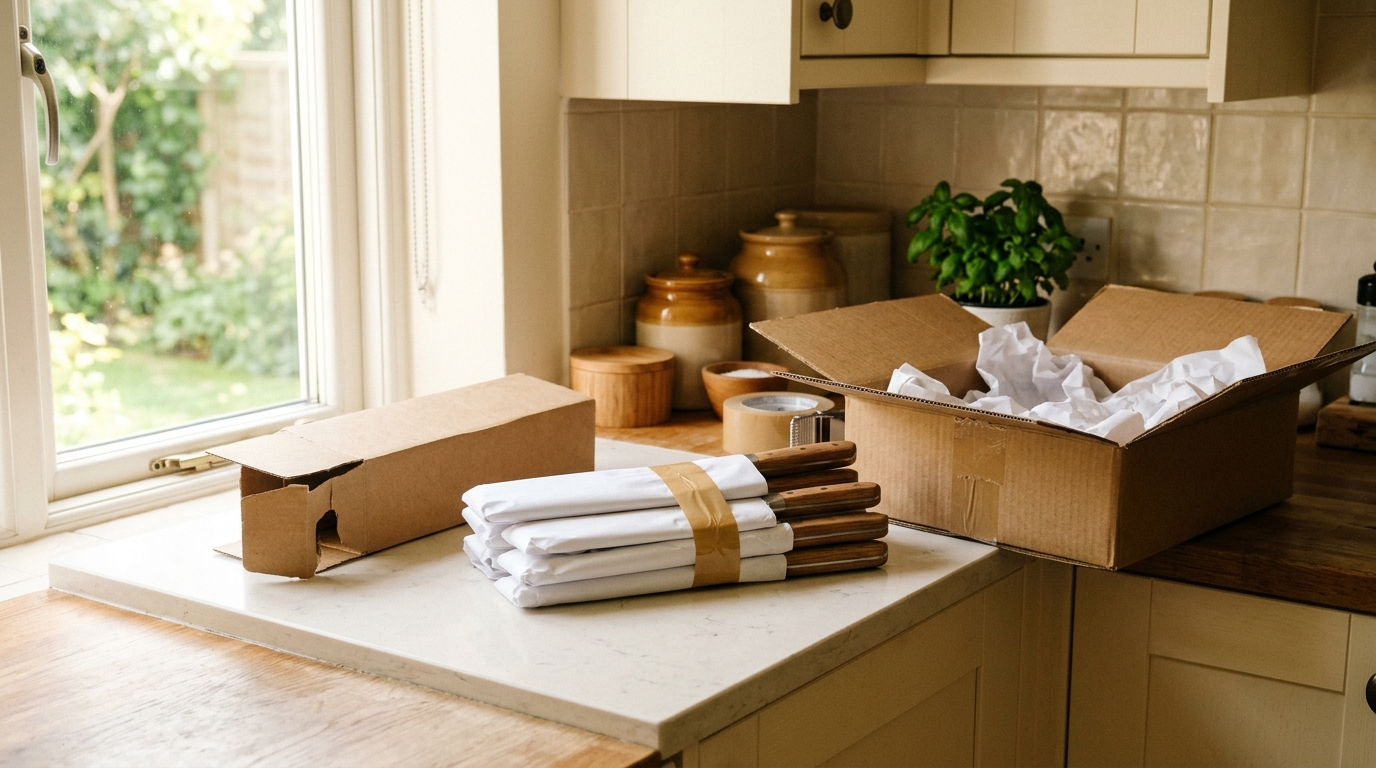
Wrap each knife individually in at least three layers of packing paper—blade first—then secure with tape, bundle blades-inward with the rest of your set, and pack the bundle upright in a small, clearly labeled box. That combination of wrapping, bundling, and labeling is what keeps knives from puncturing boxes, shifting during transit, and surprising anyone who reaches in without looking. The rest of this guide walks through every step, covers specialty knives and knife blocks, and answers the questions movers and customers ask most.
Why kitchen knives need their own packing approach
Knives fail in transit for one of two reasons: the wrapping isn't thick enough to stop a blade from cutting through cardboard, or the knives aren't secured tightly enough to stay put and end up working through whatever surrounds them. Unlike most kitchen items (pots and pans are a different story — see our guide on packing pots and pans so they nest, stack, and arrive without a scratch), knives are hazardous before they're even damaged. A loose chef's knife rattling around a box is a puncture risk for whoever unpacks it.
The method below adds almost no time to a kitchen pack and requires nothing beyond materials you're likely already using.
What you'll need before you start
- Unprinted packing paper (newsprint leaves ink on handles and blades; avoid it)
- Packing tape — 2-inch width is easiest to work with
- A small or medium cardboard box (smaller boxes keep knives from shifting)
- A marker for labeling
- Optional: rubber bands, bubble wrap for high-value knives
If you're still sourcing supplies, our guide to choosing moving boxes and packing supplies covers what's worth buying and what you can skip.
How to pack kitchen knives: step-by-step
Step 1 — Gather and sort
Pull all knives together: chef's knives, paring knives, bread knives, steak knives, cleavers. Sort by size. Packing like sizes together makes bundling cleaner and boxes more stable.
Discard or donate anything dull enough to replace. Every item you don't pack cuts your moving bill slightly — and knives are one of the easiest categories to thin out.
Step 2 — Wrap each knife individually
- Lay a sheet of packing paper flat on a stable surface.
- Place the knife at one corner, blade pointing away from you, at a 45-degree angle.
- Fold the corner of the paper over the blade tip first — this is the most critical step. A folded paper cap over the tip prevents puncture even if the knife shifts.
- Roll the knife tightly toward the opposite corner of the sheet, keeping tension even.
- Fold the loose sides inward as you roll, the way you'd wrap a burrito.
- Tape the final edge down securely.
- Repeat with a second sheet of paper around the outside. Three total layers of paper (counting the folded-over tip cap) is the minimum for a standard chef's knife.
For serrated blades — bread knives, steak knives — add an extra half-sheet over the serrated edge before the first full wrap. The teeth can catch on paper and work through it.
Step 3 — Bundle your knives
Once individually wrapped, group three to five knives together with blades all pointing in the same direction, tips inward toward the center of the bundle. Wrap the entire group once more with a full sheet of packing paper and secure with tape or a rubber band at each end.
Never bundle blades outward or alternate directions — a tip pointing outward will work through the bundle wrapping under transit vibration.
Step 4 — Prep the box
Line the bottom of a small box with two to three inches of crumpled packing paper. This cushion absorbs the vertical shock that happens when boxes are set down hard — and they always are at some point.
Step 5 — Pack the box
Place bundles upright (spine down, tips up) or flat in a single layer, never stacked on their sides in ways that let them slide. If you have multiple bundles, fill gaps with crumpled paper so nothing shifts. The box should feel firm, not loose, when you close it and gently shake it.
Step 6 — Label clearly
Write "SHARP — OPEN CAREFULLY" on all four sides and the top in large letters. This isn't optional. Movers and helpers who reach into unlabeled boxes are the most common cause of knife-related injuries on moving day. A clearly labeled box also tells movers to keep it right-side up.
Special cases: knife blocks, magnetic strips, and high-value knives
Knife blocks
A knife block can move with knives inside it only if the slots are snug and the knives can't slide out. Wrap the entire block in two layers of bubble wrap, tape it closed, and pack it upright in a box with crumpled paper on all sides. If any knives are loose in the slots, remove them and pack those separately using the method above.
Magnetic knife strips
Remove knives from the strip before packing them — don't try to transport a strip with knives attached. The strip itself can be wrapped in bubble wrap and packed flat.
High-value or heirloom knives
Japanese single-bevel knives, hand-forged blades, or any knife worth more than about $150 deserves individual bubble-wrap wrapping in addition to paper, followed by its own small box with extra cushioning. If you own a set worth several hundred dollars or more, it's worth documenting them in your moving inventory checklist before packing — a written record with photos supports any damage claim if something goes wrong.
Steak knife sets
Individual steak knives are short enough to pack in the slots of their original storage case if you have one, or bundled in groups of four to six using the rolling method above. Box them in a small container so they can't shift.
While you’re reading
Skip the research — let Robert match you with movers.
Free quotes from movers in your area. Pick whichever is easiest.
Should you let movers pack your knives?
If you've hired a full-service crew that includes packing, they'll typically handle knives with their own packing paper using a method similar to what's described here. Ask your mover specifically how they handle sharps before moving day — a good crew will have a clear answer. If you'd rather control how they're packed, do it yourself the night before and have the labeled box ready to go when the crew arrives.
Either way, our packing fragile & valuable items guide category has additional room-by-room packing guides for everything that needs more than a standard box.
A note on valuation and knives
For interstate moves, your mover's liability for damaged or lost items depends on the valuation option you've chosen. Under Released Value (60 cents per pound per article), a 1-pound paring knife that gets damaged would yield 60 cents in compensation — far below its replacement cost. Full Value Protection requires the mover to repair, replace, or pay the current replacement value. Review your valuation choice before loading day. Our guide to understanding moving valuation explains both options clearly.
Quick-reference packing table
| Knife type | Minimum wrapping | Bundle size | Box position |
|---|---|---|---|
| Chef's knife (8–12") | 3 layers packing paper | 3–4 per bundle | Upright, spine down |
| Paring knife (3–4") | 2 layers packing paper | 5–6 per bundle | Upright or flat |
| Bread/serrated knife | 3 layers + extra layer over edge | 2–3 per bundle | Upright, spine down |
| Cleaver | 3 layers packing paper + tape tip | 1–2 per bundle | Flat, cushioned |
| High-value/heirloom | Bubble wrap + 2 layers paper | Individual | Own box, extra cushion |
| Steak knife set | 2 layers paper or original case | 4–6 per bundle | Flat or upright |
Finding a mover you can trust with your kitchen
If you're still choosing a moving company, browse movers by state to find licensed carriers in your area, or read mover reviews to see how others describe a crew's packing and handling. Look up any mover's USDOT number on the FMCSA's search tool yourself before you book — that lookup tells you whether you're dealing with a licensed motor carrier or a broker.
Have questions about your specific move? Reach out to Robert, our moving concierge, through the site.
Frequently asked questions
Can I pack knives in a checked bag or carry-on when moving by plane?
TSA prohibits knives in carry-on luggage. If you're flying ahead of your household goods shipment and want to bring knives, they must go in a checked bag — properly wrapped and secured so they can't move inside the bag. Check the TSA website for current rules on blade length and type before packing.
Is it safe to pack knives in the same box as other kitchen items?
Generally, no. Knives should have their own box or at minimum their own clearly separated section within a box, surrounded by several inches of crumpled paper on all sides. Mixing loose knives with plates, glasses, or small appliances risks damage to both the knives and everything around them.
Do I need bubble wrap, or is packing paper enough?
For standard kitchen knives, packing paper — used in enough layers — is sufficient. Bubble wrap adds protection for high-value or heirloom blades and is worth the extra cost for anything you'd be upset to replace. For everyday knives, three layers of unprinted packing paper per blade is the practical standard.
Should I sharpen my knives before or after the move?
After. A freshly sharpened blade is slightly more likely to cut through wrapping during transit. Sharpen once you're settled — it also gives you a chance to inspect each blade for any damage that occurred during the move.
What if I don't have packing paper? Can I use newspaper?
Newspaper ink transfers to blades and handles during transit and can be difficult to remove from wood or resin handles. If you're out of unprinted paper, clean kraft paper, brown paper bags, or even paper towels layered thickly will work better than newsprint. Our guide to packing boxes with the right materials covers affordable substitutes.
Do movers charge extra to handle boxes labeled "sharp"?
Not typically — a labeled box just tells them to be careful with it, which is what any professional crew does anyway. If a mover quotes you a surcharge for handling a labeled box of kitchen knives, that's unusual and worth questioning.
Tagged