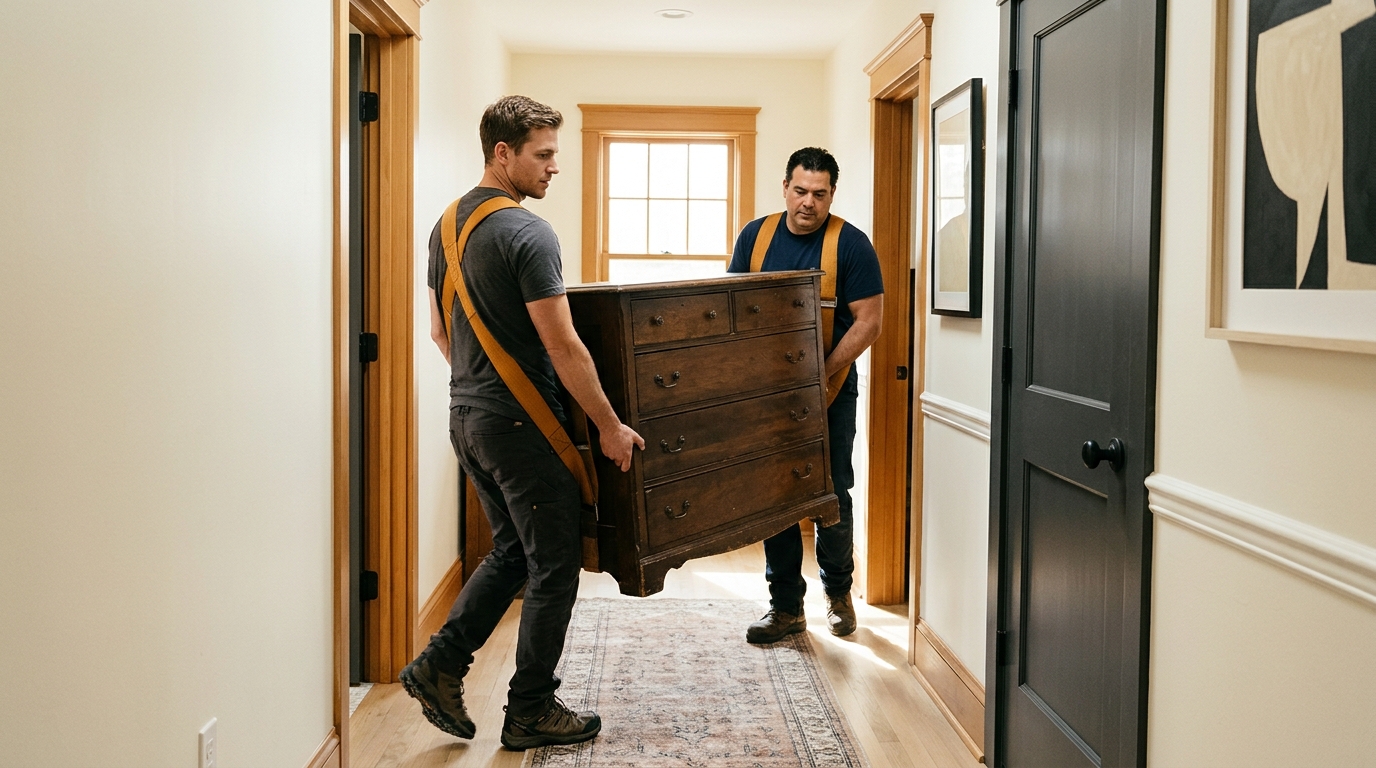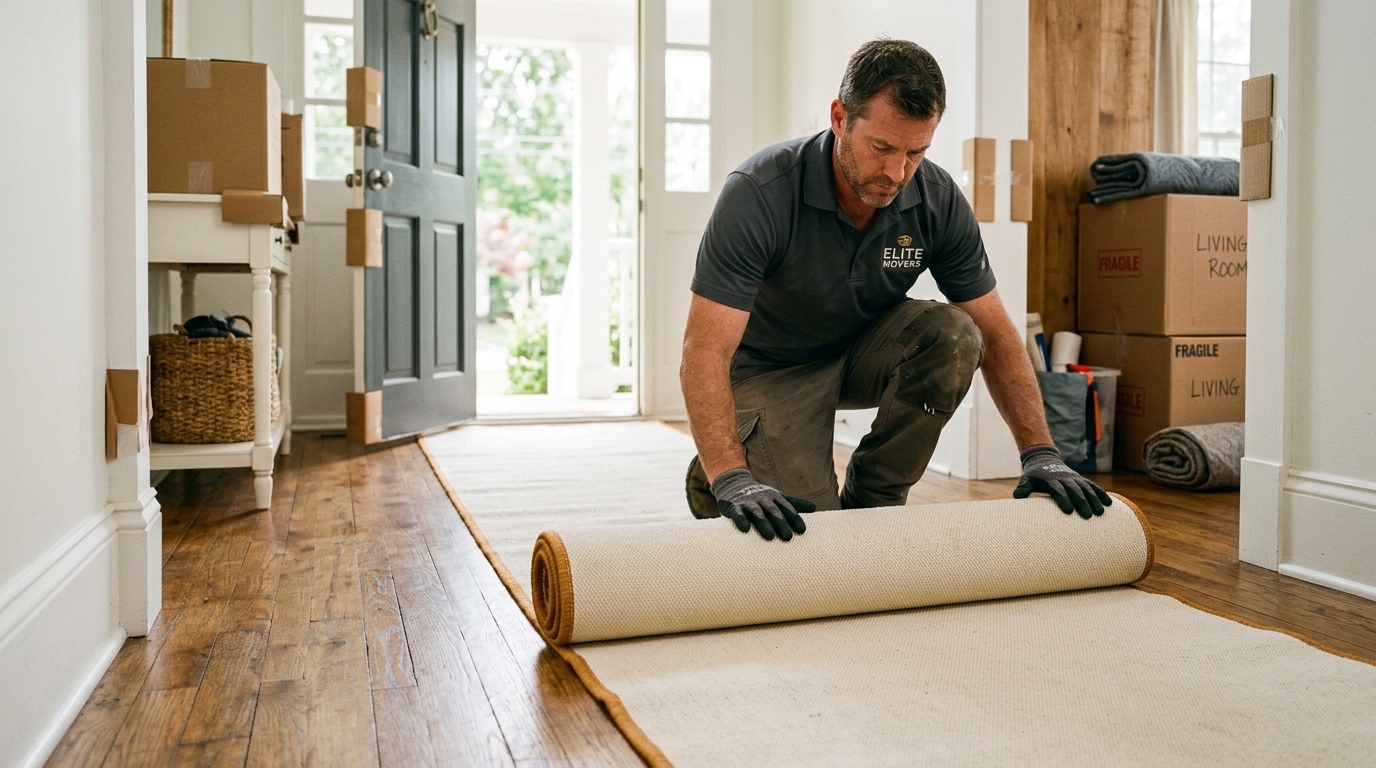
Professional movers protect floors using a layered system: adhesive plastic film for hard surfaces, thick canvas or rubber-backed runners for high-traffic paths, cardboard sheets under heavy items, and foam or cardboard guards on doorframes and banisters. Most full-service moving companies bring these materials as a standard part of the job — but not every company does, and knowing exactly what to expect (and ask for) can save your hardwood, tile grout, and carpet from a very bad day.
What materials do movers typically use on floors?
The specific products depend on the surface type. Here's what trained movers reach for room by room:
Hard floors (hardwood, engineered wood, tile, laminate)
| Material | What it does | When movers use it |
|---|---|---|
| Adhesive plastic film (Ram Board Film, similar products) | Sticks directly to the surface; shields against scuffs, moisture, and grit tracked in from outside | Entryways, kitchen tile, bathroom tile, any hard floor along the main path |
| Ram Board / heavy-duty cardboard panels | Rigid protection under appliances, furniture set-down zones, and dollies rolling over delicate surfaces | Under refrigerators, washing machines, piano dollies |
| Canvas or poly-blend floor runners | Non-slip, reusable; spread quickly across long hallways | Main walking corridors, dining rooms, living rooms |
| Masonite sheets | Stiff panels that distribute weight across large areas | Under extremely heavy items on older, softer wood |
A key detail: adhesive film must be rated for the floor finish you have. Some adhesive films can lift wax or polyurethane if left down too long (typically more than a day or two) or applied to freshly finished floors. If your floors are newly refinished, flag this before the movers start.
Carpet
| Material | What it does |
|---|---|
| Carpet film / self-adhesive poly sheeting | Adheres lightly to carpet pile; blocks dirt, mud, and wheel marks from dollies |
| Canvas runners (non-adhesive) | Laid on top when carpet film isn't available; held in place by furniture weight |
Carpet is more forgiving than hardwood under foot traffic, but dolly wheels can leave permanent compaction lines or snag loops in berber and loop-pile carpet. A good carpet film prevents both.
Stairways
Stairs get dedicated runner sections — usually canvas or rubber-backed poly — cut or folded to fit each tread. Movers carrying large items up stairs often can't see their feet, so a non-slip surface on every step matters as much for their safety as for your finish.
How do movers protect doorways and walls?
Floors aren't the only thing at risk. A sofa corner at the wrong angle will gouge drywall or crack a doorframe in seconds. Standard protection includes:
- Doorframe pads / corner guards — foam or cardboard sleeves that clamp or tape onto the frame edges. Most professional movers carry these and put them up before the first piece of furniture moves.
- Banister / railing wrap — moving blankets or foam secured with tape around stair railings that furniture brushes against.
- Wall padding — moving blankets hung or taped flat against walls in tight stairwells or hallways where clearance is under a few inches.
If a mover heads straight to your furniture without putting up any doorframe protection, that's worth pausing to ask about. Our post on the gear movers use to move furniture covers the equipment side — dollies, straps, and sliders — that works in tandem with floor protection.
Is floor protection included in the moving price, or does it cost extra?
For most full-service local and long-distance moves, basic floor protection (runners, plastic film, corner guards) is included in the hourly or flat job rate. However, specialty materials — Ram Board panels, Masonite sheets, stair nose guards — may be an add-on, particularly for premium or white-glove services.
A few situations where you should ask explicitly about cost:
- Moves into new construction with unfinished or freshly finished floors
- High-rise condos with long hallways where the building may require certified floor protection as a condition of the move-in permit
- Moves involving grand pianos, gun safes, or large appliances on delicate surfaces
When you're getting a moving quote, ask: "What floor and wall protection do you include, and is there anything I should supply or pay extra for?" Get the answer in writing.
What should I do before movers arrive to help protect my floors?
Even when a mover brings everything needed, a few steps on your end make a meaningful difference:
- Sweep or vacuum all floors the night before. Grit and sand under a moving blanket or runner act like sandpaper on hardwood.
- Remove rugs you want to protect. Roll them up, band them, and lean them against a wall out of the traffic path.
- Note any soft spots, loose tiles, or damaged planks and point them out to the crew lead before they start. A broken tile that existed before the move is hard to prove after the fact.
- Lift door stoppers. Rubber stoppers left on the floor get rolled over and can gouge wood or tile.
- Reserve the elevator if you're in a building. Elevator door edges are a common source of scratches when movers are rushing. Our guide on moving into an apartment building covers what building management typically requires.
- Keep pets and children clear of the protected path. Kids pulling up carpet film mid-move is more common than you'd think.
While you’re reading
Skip the research — let Robert match you with movers.
Free quotes from movers in your area. Pick whichever is easiest.
What if the movers don't bring floor protection?
This happens, particularly with smaller or less-experienced operations. Your options:
- Ask in advance. When you confirm the booking, ask the company to confirm in writing what protection they bring.
- Buy your own. A roll of carpet film (around $30–$60 for 100 feet) and a few canvas runners (roughly $25–$50 each) from a home improvement store are inexpensive insurance. You can also check mover reviews to see whether past customers mention floor damage — it's one of the most consistently reported complaints.
- Check the mover's USDOT number on the FMCSA database before you book. A licensed, professional carrier is far more likely to show up equipped. You can search at protectyourmove.gov using the number listed on any estimate.
If you're still deciding between doing it yourself and hiring help, our breakdown of DIY vs. full-service moving walks through exactly what you gain (and risk) with each approach.
What do movers use on especially tricky surfaces?
Heated tile and radial-heat floors: Adhesive films can bubble or lose their bond. Ask the mover whether their film is rated for radiant heat, or use canvas runners only.
Newly refinished hardwood (cured less than 30 days): Standard adhesive film may pull finish. Canvas runners with no adhesive, placed carefully, are safer. Tell your mover the cure date.
Marble and polished stone: Stone scratches easily from grit trapped under soft materials. Movers should sweep before laying any protection and use clean, lint-free runners.
Outdoor decks and composite decking: Less of a concern for finishes, but dollies can crack composite boards. Plywood sheets distribute weight on the way out.
Frequently asked questions
Do professional movers always protect floors, or is it something I have to request?
Most full-service companies include basic floor and doorframe protection as standard practice — it protects them from damage claims as much as it protects you. That said, "standard" varies by company. Ask what's included when you confirm your booking, and note it on the job order. Find movers near you and compare what each company includes before you sign.
What is the plastic film movers put on floors called?
It's typically called carpet film (for carpet) or surface protection film / floor film (for hard surfaces). Brand names like Ram Board, Pro-Tect, and Surface Shields are common in the industry. The hard-surface versions are adhesive-backed and peel off cleanly if removed within the recommended timeframe — usually 30–45 days, though for moves you'll remove it the same day.
Can the plastic film damage my hardwood floors?
It can, in two situations: if your floors were refinished recently (within about 30 days) and the finish hasn't fully cured, or if the film is left down for multiple days and the adhesive bonds too aggressively. For freshly finished floors, non-adhesive canvas runners are the safer choice.
Do movers protect the floors in the building hallways, not just inside my home?
In apartment and condo buildings, movers are often required to protect common-area hallways and elevator interiors as a condition of the building's move-in permit. The building management will often inspect before and after. Confirm with your building coordinator what protection is mandatory and make sure your mover knows ahead of time.
What should I do if the movers damage my floor during the move?
Document the damage with photos immediately — before anything is moved away from the spot. Note it on the delivery receipt or the final paperwork before you sign. Then file a written damage claim with the moving company. For interstate moves, FMCSA rules require the mover to acknowledge your claim within 30 days and resolve it within 120 days. For in-state moves, the timeline depends on your state's rules — check with the state regulator. Our guide on how to file a moving damage claim walks through every step.
Does floor protection affect how long a move takes?
Yes, modestly. Laying runners and applying film on the main path typically adds 10–20 minutes at the start of a job, and another 5–10 minutes to pull it up at the end. For hourly moves, that time goes on your bill — but it's far cheaper than refinishing a hardwood floor, which often runs $3–$8 per square foot.
The right floor protection costs movers a few extra minutes and you almost nothing. The wrong call costs hundreds — sometimes thousands — in refinishing or replacement. Before moving day, confirm what your mover brings, sweep your floors, and ask about any surfaces that need special handling.
Ready to find a company that shows up prepared? Browse movers by state to compare options in your area, or connect with Robert, our moving concierge, for help narrowing down the right fit.
Tagged