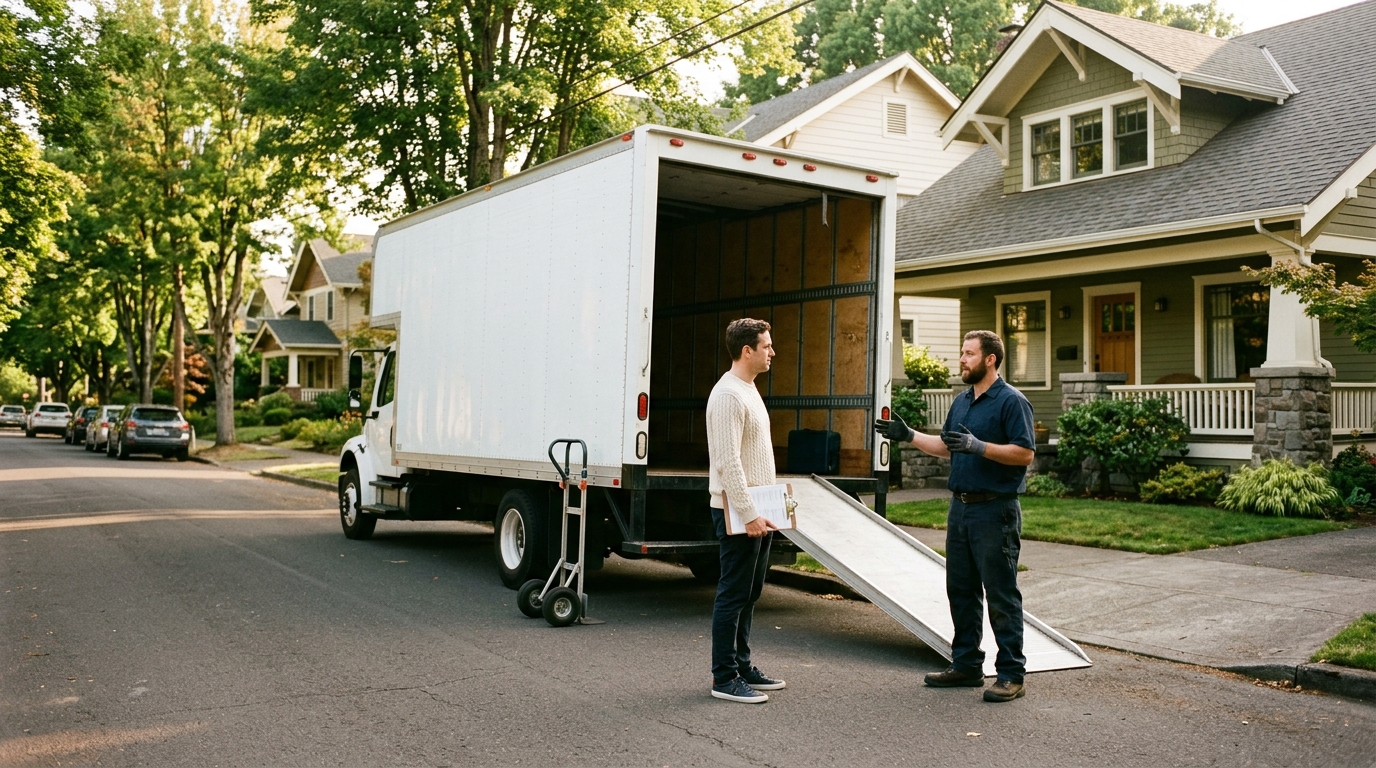
No — almost every professional moving company will decline the request. Movers are prohibited from carrying passengers in cargo vehicles under most commercial auto insurance policies, and their DOT operating authority typically covers freight movement, not passenger transport. The short version: their insurance won't cover you if something goes wrong, so reputable movers say no as a rule, not a preference.
Why Can't You Ride in the Moving Truck?
Commercial auto insurance doesn't cover passengers
A moving company's commercial vehicle policy insures the driver, the vehicle, and the cargo. Customers are not cargo. If you were riding in the cab and the truck was involved in an accident, you likely would not be covered under the mover's policy — and the mover could face a serious liability problem for allowing it in the first place. Most carriers explicitly exclude non-employee passengers.
DOT operating authority is for household goods, not people
Interstate movers operate under FMCSA-issued Motor Carrier authority for household goods (you can confirm a carrier's authority by looking up their USDOT number on the FMCSA website). That authority permits the movement of household goods, not the transport of passengers. Carrying you across state lines in a freight vehicle is outside the scope of that authority.
Cab space is a practical issue too
Most moving trucks seat two or three people — a driver and one or two helpers who may need to be in the cab as part of their work crew. On a typical local move with a three-person crew, there may simply be no seat available, and federal hours-of-service rules on long-distance moves add further constraints on who can be in the vehicle.
Does Any Mover Ever Allow It?
Occasionally a small, independent local mover operating only within a state may not have the same commercial policy restrictions — but this is uncommon, and you should never assume it is permitted. If a mover casually offers to let you ride along without checking with their insurance carrier first, that itself should give you pause about how carefully they manage liability in general.
Our team has 35+ years of hands-on service-provider experience, including an operator who ran a moving company for 18 years — and in that time, allowing customers to ride in the cab was never standard practice at any reputable operation.
What You Should Do Instead: Planning Your Moving-Day Travel
Not riding in the truck is actually a good thing for your move. Here's how to think about moving-day logistics:
Follow the truck — don't wait for a call
Plan to drive yourself or arrange a ride so you arrive at your destination around the same time the truck does. On a local move, this is straightforward. On a long-distance move, you'll either drive, fly, or take transit, and the mover will give you a delivery window to plan around. Check out our guide on how to understand your long-distance moving delivery window for how those windows work and what to do when they slip.
Know when the truck will arrive
Ask your mover directly: "What time do you expect to arrive at the destination?" For interstate moves, the FMCSA requires the mover to give you at least 24 hours' notice before delivery. For local moves, arrival times are set by the job schedule — what time movers usually start varies by company and day, so confirm the morning-of window the day before.
Be at the destination before the truck
You typically need to be present at delivery to direct the crew and sign paperwork. If you're not there, the mover may have to wait — and on hourly-rate jobs, that wait can cost you. On an interstate move, the bill of lading will note who is authorized to accept delivery if you can't be there in person.
Use the drive time productively
Your car trip (or flight) is a good window to handle tasks that can't be done while watching movers work: picking up keys, grabbing lunch for the crew, doing a final walkthrough of the old address, or running to the hardware store for supplies at the new place. See what to feed and offer your movers on moving day — having something ready when they arrive goes a long way.
What About Riding in the Truck Cab on a Long-Distance Move?
On a cross-country move, some customers wonder whether they can ride along for the multi-day haul. The answer is the same: no. Beyond the insurance issue, long-distance truck drivers are subject to federal hours-of-service regulations that govern rest stops, driving limits, and who is in the cab. Passengers are not part of that framework.
If you're doing a long-distance move and trying to figure out whether to drive, fly, or ship your car, those are actual logistics decisions worth thinking through early. Browse movers by state to find carriers who offer door-to-door service so your car can travel separately if needed.
While you’re reading
Skip the research — let Robert match you with movers.
Free quotes from movers in your area. Pick whichever is easiest.
A Quick Comparison: Your Ride Options on Moving Day
| Situation | Best Option | Notes |
|---|---|---|
| Local move (same city) | Drive yourself | Arrive ~30 min after truck to direct unloading |
| Local move (no car) | Rideshare or friend | Coordinate arrival timing with mover |
| Long-distance (driving) | Follow the truck route | Plan stops; arrive near delivery window |
| Long-distance (flying) | Fly to destination city | Coordinate with mover on delivery-day timing |
| Long-distance (car shipped) | Fly or drive a rental | Confirm car delivery window separately |
What to Do at the Destination When the Truck Arrives
Being present and prepared when the truck pulls up saves time and protects you. Before the crew starts unloading:
- Do a walkthrough of the new space — note any pre-existing damage so you're not blamed for it later.
- Confirm where each room's boxes go — a good labeling system means the crew won't have to ask. See how to label moving boxes like a pro if you haven't set that up yet.
- Review the bill of lading before signing — never sign a blank form. On interstate moves, you should have received this document at least three days before loading.
- Note any damage on the delivery receipt immediately — but remember, a note on the receipt is not a formal damage claim. For an interstate move, a written claim must be filed within 9 months of delivery.
If you want to understand everything that happens at delivery before you get there, the moving-day prep category has detailed guides on every stage.
Finding a Mover You Can Rely On
Before moving day, it's worth confirming that the company you've booked is properly licensed. For interstate moves, look up their USDOT number at the FMCSA website and confirm they are listed as a "Motor Carrier of Household Goods" — not just a broker. You can also read mover reviews to see what other customers experienced at delivery. When you're ready to book, find movers in your area to compare options.
Frequently asked questions
Can I ask a mover to let me ride in the truck just for a short local move?
You can ask, but most companies will decline even on short local moves. Their commercial auto insurance typically excludes passengers, regardless of distance. A mover who agrees without checking their policy first is taking on a liability risk — which is worth keeping in mind when evaluating how they handle other aspects of the job.
What if I have no other way to get to my new home?
Arrange a rideshare, ask a friend or family member, or book a one-way car rental. If you're shipping your own vehicle as part of a long-distance move, coordinate the car delivery so it arrives at or before your household goods. Your mover can often recommend logistics that work around your situation.
Can my kids or pets ride in the moving truck?
No — children and pets should never ride in a moving truck, under any circumstances. Beyond the insurance issue, the cargo area is physically unsafe, and the cab is not equipped or insured for passengers. Plan separate transport for children and pets on moving day. See how to move with a cat or dog for moving-day pet logistics.
Does it matter if the move is in-state vs. interstate?
The same practical prohibition applies regardless. While the specific regulatory framework differs — interstate moves are governed by FMCSA rules, and in-state moves follow state regulations — the commercial auto insurance exclusion on passenger transport exists in both cases.
If I can't ride in the truck, do I need to stay at the old address until it leaves?
Not necessarily. On a local move, one person can ride with the movers (in a separate vehicle) to the new address to meet the truck, while another handles the final walkthrough at the old address. On a long-distance move, you can leave once loading is complete — just make sure someone authorized to accept delivery will be at the destination.
What should I do if the movers are running late and I'm already at the new address waiting?
Contact the moving company directly. On interstate moves, the mover is required to notify you as soon as it knows of a delay. For local moves, a quick call usually resolves any uncertainty. See why movers show up late and what to do about it for a full breakdown of common causes and your options.
Have more questions about moving day logistics? Use our directory to find licensed movers near you, or reach out to Robert, our moving concierge, for help sorting through your options.
Tagged