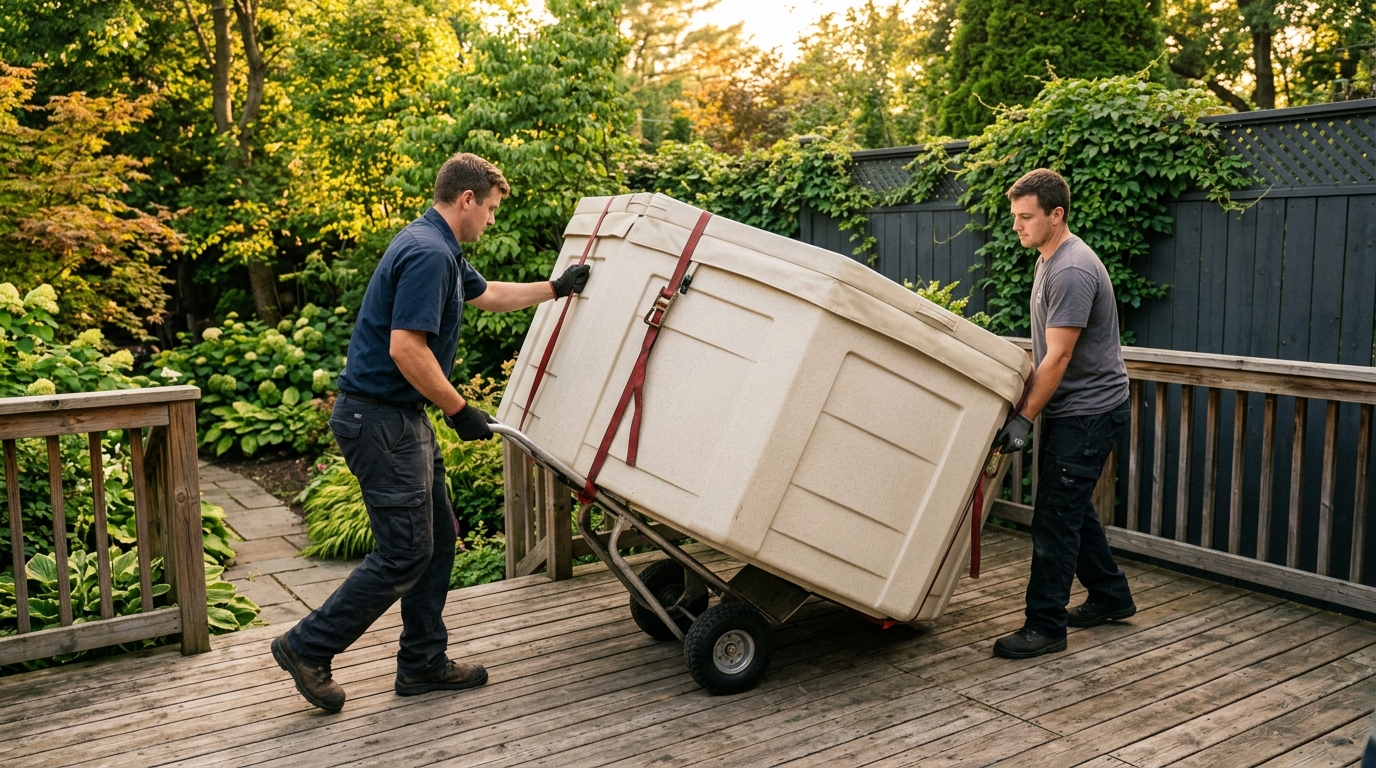
Moving a hot tub is a specialty job: an empty spa typically weighs between 500 and 1,000 pounds, requires complete draining and electrical disconnection before it can be touched, and almost always needs a crew with an appliance dolly, moving straps, and access equipment to get it from your backyard to a truck. Most homeowners who try to handle it without professional help damage either the tub, their property, or themselves. Plan to hire specialists, and give yourself at least two to three weeks to coordinate the logistics.
How much does it cost to move a hot tub?
Professional hot tub moving typically costs $300–$600 for a local move (under 50 miles) and $1,000–$2,500 or more for a long-distance move, depending on:
| Factor | Impact on price |
|---|---|
| Tub size and weight | Larger tubs need more crew members and heavier equipment |
| Access difficulty | Fenced yards, stairs, or narrow gates add time and cost |
| Distance to the truck | A long carry across a property adds labor |
| Crane or lift rental | Required if the tub can't be rolled out; adds $300–$800+ |
| Destination access | Tight spaces at the new property cost more to navigate |
These are typical market ranges—always get at least two written quotes before booking. A mover who gives you a firm price over the phone without seeing the job is quoting blind, which is a red flag regardless of what they're moving.
What needs to happen before the movers arrive
1. Drain the hot tub completely
A full hot tub holds 300–500 gallons of water, adding thousands of pounds. Drain it completely—no mover should attempt to lift a tub with any water inside.
- Turn off the breaker to the spa before starting.
- Attach a garden hose to the drain spigot (most tubs have one near the base) and route it to a suitable drainage area, or use a submersible pump to speed things up.
- Draining via the spigot typically takes 1–2 hours; a pump can cut that to 20–30 minutes.
- Once the main water is out, use a wet/dry vacuum to remove water from the footwell and any recessed areas—water left in low spots adds weight and can freeze in transport.
- Leave the cover off and jets open overnight if possible so internal plumbing can dry.
2. Disconnect the electrical supply
Hot tubs run on 240-volt dedicated circuits. This is not a DIY disconnect. Have a licensed electrician disconnect the wiring from the panel, cap the wires, and remove the disconnect box if required by your jurisdiction. Budget $100–$250 for this service call.
Do not simply unplug the tub and assume it is safe—most hardwired spas have no plug. Moving a tub that is still connected is a serious shock and fire hazard.
3. Remove the cover and accessories
- Take off the cover and bag it separately; covers are bulky and easily crushed if stored under the tub.
- Remove steps, handrails, and any attached equipment (ozonators, external heaters).
- Drain and disconnect any waterfall or fountain features.
- Label all hardware you remove.
4. Assess the exit path
Walk the route from the tub to the street or driveway and measure every tight spot:
- Gate or fence openings: most tubs need at least 36 inches, many need wider.
- Deck or patio surface: can it support four people plus a loaded dolly?
- Steps or changes in elevation.
- Overhead clearance under eaves or pergolas.
If there is no clear path, the crew will need to disassemble a fence panel or rent a crane. Flag this before the movers arrive—it affects pricing and scheduling.
What the moving crew actually does on the day
Professional hot tub movers typically use a combination of furniture dollies, appliance dollies, moving straps, and sometimes a powered stair climber or skid system. Here's what the process looks like:
- Tilt and slide — The crew tips the drained tub onto its side and slides a dolly or skid beneath it.
- Roll to the truck — They roll it across the yard, often using plywood sheets to protect soft ground or decking from the dolly wheels.
- Ramp or lift onto the truck — A liftgate is common; some crews use ramps with a powered dolly.
- Strap and pad — The tub is strapped upright or on its side in the truck, padded to prevent shell cracking.
- Repeat in reverse at the destination.
If the new location requires a crane—placing the tub over a fence, onto a second-story deck, or into a tight yard with no gate—that is coordinated separately and added to your quote.
For more on the equipment pros use to handle oversized items, see the gear movers use to move furniture.
While you’re reading
Skip the research — let Robert match you with movers.
Free quotes from movers in your area. Pick whichever is easiest.
How to find the right mover for a hot tub
Not every moving company handles hot tubs. When you find movers for this job, ask these specific questions:
- Do you move hot tubs regularly? Look for a company that can describe the process without hesitation.
- What equipment do you use? A vague answer ("we have dollies") is less reassuring than "we use an appliance dolly with a stair climber and moving straps rated for 1,200 lbs."
- Do you carry cargo liability coverage for specialty items? Confirm this in writing.
- Do you subcontract the job? Some general movers hand specialty jobs to a third party. Know who is actually showing up.
- Can you do a site visit or a live video walk-through before quoting? A written estimate based on an actual look at the property is far more reliable than a phone guess.
Check the company's USDOT number on the FMCSA website yourself before booking—this tells you whether they are a licensed motor carrier or a broker who will hand your job to someone else. For a full checklist on what to verify, see how to vet a mover's license and insurance before moving day.
You can also browse movers by state to find carriers in your area and read mover reviews to see how companies have handled other specialty and heavy-item moves.
Can you move a hot tub yourself?
Technically, yes—but it is rarely worth the risk. Here is an honest comparison:
| Approach | Typical cost | Main risks |
|---|---|---|
| DIY with rented dolly + friends | $50–$200 in equipment | Injury, shell cracks, deck damage, electrical hazard |
| Hire a general moving crew | $200–$400 local | May lack specialty equipment; potential for damage |
| Hire a spa/specialty mover | $300–$600 local | Highest cost, lowest risk |
| Crane service (when needed) | Add $300–$800+ | Necessary for certain access problems |
A cracked acrylic shell can cost $500–$2,500 to repair. A damaged deck, broken gate, or back injury will cost more. For most homeowners, the specialty mover is the better value. If you are weighing this against other cost-saving strategies, how to move on a tight budget has a straightforward framework for deciding where to save and where to spend.
Hot tub moving and your overall move: how it fits in
If you are moving the hot tub as part of a larger household move, talk to your primary mover early. Many full-service moving companies will not load a hot tub onto a standard moving truck alongside household goods—they require a separate service or a dedicated truck. Clarify this before signing anything, and make sure your moving contract specifically lists the hot tub and describes how it will be handled.
If you are moving the tub and nothing else (selling or donating the rest of your belongings, for example), a specialty spa mover or a junk-removal-style crew that handles heavy items is often the fastest option.
For a broader sense of what specialty and heavy-item moving costs across different categories, the pool tables & gym equipment category has several related guides.
Frequently asked questions
How long does it take to move a hot tub?
The physical move—loading, transit, and unloading—typically takes 2–4 hours for a local job with good access. Add 1–2 hours for draining (the night before or morning of is best), plus the electrician's visit. Plan for a full day when you add everything together.
Do movers take a hot tub apart to move it?
Standard hot tubs are not disassembled for a move—the shell is moved as a single unit. The cover, steps, and removable accessories are handled separately. Modular or inflatable spas are different and can be partially deflated or broken down.
Will my homeowner's insurance cover the hot tub if it's damaged during a move?
Possibly—some homeowner's policies include personal property in transit, but coverage varies widely. Check with your insurer before moving day. Also confirm what liability coverage the mover carries for the tub specifically; this should be spelled out in the moving contract before you sign it.
Does the moving company need to be there when the electrician disconnects the spa?
No—these are separate appointments. Schedule the electrician a day or two before the movers arrive so the tub is fully disconnected and safe before the crew touches it.
How do I prepare the destination before the hot tub arrives?
Make sure the foundation or pad is ready (concrete, pavers, or a purpose-built spa pad), that the destination electrical circuit is installed and inspected, and that the access route is clear. Have your electrician lined up to reconnect the spa the day after delivery. Filling and rebalancing the water typically takes several hours.
Is it worth moving an older hot tub, or should I sell it and buy new?
A hot tub that is more than 10–15 years old may not be worth the $300–$2,500 it costs to move it, especially if the shell has existing cracks or the heater and pump are due for replacement. Get a quote from a mover and compare it to current prices for a comparable used or new tub before deciding. Sometimes selling locally and buying at the destination is the smarter financial choice.
Moving a hot tub is manageable when you get the draining, disconnecting, and access sorted out before the crew arrives—and when you hire people who actually specialize in this kind of work. If you want help finding the right mover for the job, search the directory or reach out to Robert, our moving concierge, who can help point you toward the right type of specialist for your situation.
Tagged