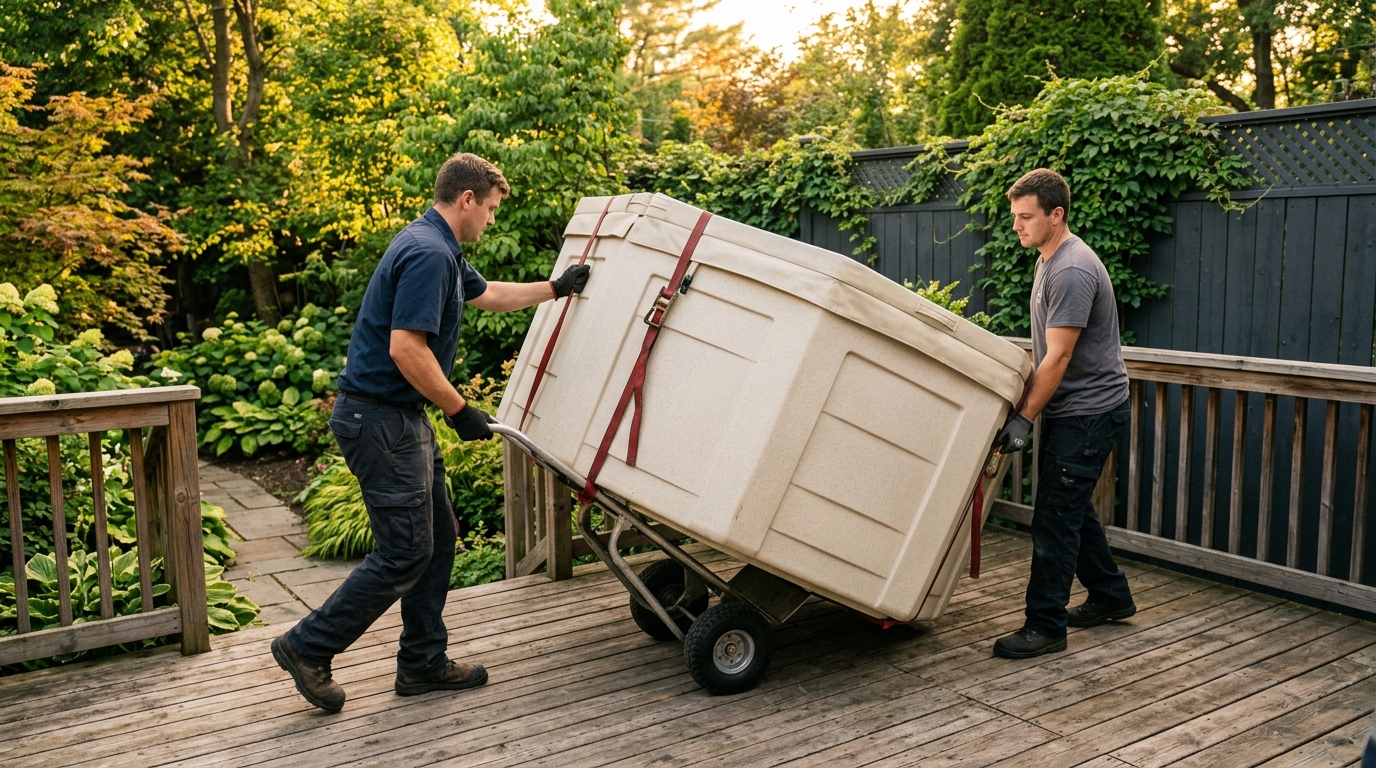
Moving a home gym is one of the most physically demanding parts of any relocation — and one of the most poorly planned. The safest approach is to disassemble every piece of equipment before the truck arrives, box or wrap each component properly, and hire movers experienced with heavy specialty items for anything over 150 lbs. Done right, a full home gym can be moved in half a day without a single damaged piece or strained back.
What makes home gym equipment so hard to move?
Most gym equipment violates every rule that makes moving manageable: it's heavy, awkward-shaped, partially assembled, and often expensive enough that a single gouge or bent frame costs hundreds to repair. A home gym — an actual one, with a power rack, a treadmill, and a set of rubber plates — is easily the densest load per square foot that goes on a truck.
The core challenges:
- Weight concentration. A 300-lb barbell set loaded on a single shelf can crack a truck floor or tip a dolly.
- Irregular shapes. Ellipticals, cable machines, and squat racks don't stack; they take up space like sculpture.
- Mechanical complexity. Treadmills and rowers have electronics, belts, and motors that can be damaged if tipped at the wrong angle.
- Floor damage risk. Dragging rubber-coated equipment across hardwood without protection will leave permanent marks — on your old floor or your new one.
Should you hire a specialty mover or your regular crew?
For a full gym — power rack, multi-station cable machine, commercial treadmill, or elliptical — you'll want to confirm upfront that your mover has experience with heavy fitness equipment. Not all crews do, and there's no shame in that.
Use your regular full-service crew if:
- Your gym consists mostly of free weights, a bench, and light cardio equipment
- Every piece is under 200 lbs fully assembled
- Items can be disassembled into manageable components
Consider a specialty or heavy-item crew if:
- You have a commercial-grade treadmill (often 250–350 lbs)
- You own a multi-station home gym unit (some exceed 400 lbs assembled)
- You have equipment bolted to floors or walls (wall-mounted pull-up rigs, mirror panels)
You can find movers experienced with heavy and specialty items on our directory — filter by specialty services before you call.
Step-by-step: how to move your home gym the right way
Step 1: Inventory everything and photograph before you start
Walk through your gym and document each piece with photos — assembled, from multiple angles. This matters for two reasons: it's your record if anything is damaged in transit, and it's your reassembly guide at the new place. We've seen people spend three hours reassembling a cable machine they could have rebuilt in 30 minutes with a single "before" photo.
Note the weight of each item. Most manufacturers list it on the product page or in the manual. Anything over 150 lbs assembled should be flagged for your movers in advance.
Step 2: Disassemble everything that can come apart
This is non-negotiable. Moving a fully assembled power rack, leg press, or functional trainer is a liability — both for the equipment and for the people carrying it.
What to disassemble and how:
| Equipment | What to take apart | What to keep together |
|---|---|---|
| Power rack / squat cage | Remove J-cups, safety bars, pull-up bar, weight storage pegs | Keep the uprights bolted together if they'll fit |
| Multi-station cable machine | Remove weight stacks, cables (bag them), weight selector pins | Frame usually stays assembled |
| Treadmill | Fold the deck (most modern treadmills fold); remove console if detachable | Keep power cord taped to the unit |
| Elliptical / rowing machine | Remove pedals, handles where possible | Frame typically moves in one piece |
| Adjustable dumbbells | Remove weight plates, store in original case or flat tray | Keep selector dial intact and protected |
| Barbell + plates | Break down into individual plates, bag collars | Store bars in a bar holder sleeve or wrap in blankets |
| Bench | Remove attachments (lat tower, leg curl pad) | Frame/pad usually moves assembled |
Save every bolt, pin, and cable tie in a labeled zip-lock bag taped to the piece it came from. We've seen entire reassembly jobs delayed by 48 hours because a single bolt for the weight selector went missing.
Step 3: Pack weights correctly — this matters more than you think
Free weights are deceptively dangerous to pack. A box of dumbbells that seems manageable at 50 lbs becomes a hazard if the box fails under stress during loading.
Rules for packing weights:
- Never exceed 30–40 lbs per box for Olympic plates or dumbbells — use small, double-walled boxes
- Wrap individual plates in moving paper or thin foam to prevent metal-on-metal scratching
- Pack plates flat (not standing on edge) to distribute weight evenly
- Rubber hex dumbbells can be packed in open-top plastic bins up to 50 lbs — they stack cleanly
- Kettlebells should be packed one to two per box, handles up, with padding underneath
For long-distance moves, check our guide to cost breakdowns by move size — weight matters for pricing, and a set of Olympic plates adds up fast.
Step 4: Protect floors, walls, and the equipment itself
Before anything moves an inch:
- Lay furniture sliders or moving blankets under anything you're sliding across hardwood or tile
- Wrap all painted or powder-coated metal frames in moving blankets secured with stretch wrap — not tape directly on metal
- For treadmill belts, fold the deck per the manufacturer's instructions and lock it with the transport latch (most have one)
- Electronics on cardio machines (console, speakers, display) should be padded with foam and, ideally, covered with a moving blanket before the unit is loaded
Step 5: Load in the right order
Heavy gym equipment loads last so it's unloaded first at your destination — it needs to go into the room directly rather than sitting in a staging area. Plates and boxed weights go floor-level against the truck wall. Large cardio units get positioned vertically when safe, horizontally when a machine can't be tipped (check your manual).
What movers typically won't load without prior arrangement:
- Equipment attached to the floor with lag bolts (you'll need to remove that hardware first)
- Mirrors over 48" — these typically require special glass packaging
- Equipment that's never been disassembled and has no visible way to reduce to parts (rare, but it happens with older multi-station units)
While you’re reading
Skip the research — let Robert match you with movers.
Free quotes from movers in your area. Pick whichever is easiest.
What does it cost to move home gym equipment?
Costs depend heavily on crew size, distance, and what equipment you have.
| Scenario | Typical cost range |
|---|---|
| Small gym (bench, dumbbells, barbell set) added to a standard local move | Little to no surcharge — part of regular hourly rate |
| Mid-size gym (power rack + barbell + cardio unit), local move | $150–$400 in added labor and time |
| Full gym with multi-station + cardio, local move | $300–$700+ depending on hours |
| Long-distance move with full gym | Priced by weight; a full gym can add $400–$1,200+ to a cross-country shipment |
| Specialty heavy-item crew (standalone, not part of a full move) | $200–$600 for 2–3 hours |
These ranges assume standard access — no stairs, no narrow doorways. Stairs add roughly $50–$150 per flight for heavy specialty items in most markets. If you're moving into or out of a condo, read our guide to condo and elevator moves before booking — building rules can significantly affect what equipment can move and when.
What about reassembly at the new place?
Most full-service movers will reassemble what they disassembled — but confirm this in writing before moving day. Some crews treat reassembly as a standard service; others charge by the hour for it (typically at the same hourly rate as the move itself, often $100–$175/hr for a two-person crew).
If you want to handle reassembly yourself, budget at least one full day for a gym with more than three major pieces. Use your pre-move photos as your blueprint, and don't rush cable routing on multi-station machines — a cable routed incorrectly under tension is a safety hazard.
Frequently asked questions
Can regular movers handle a treadmill?
Most can, with caveats. A standard residential treadmill (folding, under 250 lbs) is within the capability of a typical two-person crew with the right equipment — a heavy-duty appliance dolly and moving straps. Commercial-grade or non-folding treadmills (250–400 lbs) are a different story and warrant a call ahead. When you browse movers or contact companies directly, ask specifically: "Have you moved a non-folding commercial treadmill?" The answer tells you a lot.
Do I need to drain anything before moving cardio equipment?
Not typically for consumer-grade equipment. Treadmills and ellipticals don't contain fluid. However, if you own an air-cooled or water-cooled spin bike with a reservoir (some commercial bikes have them), check the manufacturer's documentation. Water rowing machines with a water flywheel (Concept2 RowErg models do not, but WaterRower models do) should have water drained or partially drained before transport — the weight and slosh can damage the machine and the truck floor.
Will movers pack my free weights for me?
Full-service movers will pack weights, but expect to pay for the service and the materials. Packing a 300-lb plate set properly takes time and quality boxes. If you want to save money, pre-pack your weights yourself using the 30–40 lb per box rule — it's one of the easiest ways to cut costs on your move without compromising anything.
Can gym equipment be put in a portable storage container?
Yes, and it's often a smart choice for local moves or when you need flexibility on timing. The key is weight distribution — put heavy plates at floor level toward the front of the container (the door end loads last), and secure upright machines with straps. For more on this option, see our guide to portable moving containers.
What if a piece of equipment is damaged during the move?
Document everything with photos immediately — before anything is moved and the moment you notice damage at delivery. Under FMCSA rules for interstate moves, movers are required to offer Released Value (free, at $0.60/lb) or Full Value Protection. A 300-lb treadmill at Released Value gets you $180 if it's destroyed — which is why Full Value Protection or a third-party policy matters for expensive equipment. For the full picture on coverage, our moving valuation guide walks through your options clearly.
Should I sell or donate gym equipment instead of moving it?
Honestly? For some pieces, yes. A budget treadmill worth $400 new that costs $250–$400 to move across the country doesn't make financial sense. Before the move, price out what each major piece would cost to replace locally — sometimes selling heavy, low-value equipment and replacing it at the destination is the smarter call. Our decluttering guide has a framework for making exactly this call room by room.
Moving a home gym well comes down to preparation: disassemble before the truck arrives, pack weights at safe box weights, document everything, and make sure your crew knows what's coming. If you're ready to book, browse movers by state to find crews in your area — and if you'd like a hand figuring out your options, our moving concierge Robert is available on the site to help you think through the details of your specific move.
Tagged