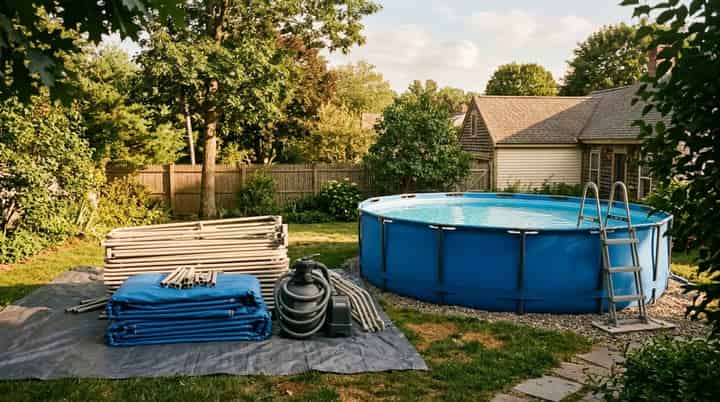
Moving an above-ground pool is a DIY-friendly project if you plan it right: drain and disassemble about two to three days before the truck arrives, keep the liner dry and folded on a warm day, label every frame component, and treat the pump and filter as you would any other appliance. Most steel- or resin-frame pools in the 15–24 ft round range can be broken down by two adults in four to six hours. Inflatable or soft-sided pools take far less time; large semi-inground models may need professional help.
Is It Worth Moving Your Above-Ground Pool?
Before you start draining, do a quick cost check. A basic steel-frame pool (15 ft round) sells new for roughly $400–$900. A quality 24 ft round with a resin frame and upgraded liner can run $2,000–$4,500 new. If your pool is under three or four years old, the liner is undamaged, and the frame isn't rusted, moving it almost always pencils out. If the liner has cracks, the frame has significant corrosion, or the pump is nearing the end of its life, buying new at the destination may be less headache.
Quick decision table:
| Factor | Move it | Buy new |
|---|---|---|
| Liner condition | No cracks, holds pressure | Cracked, bleached, or brittle |
| Frame condition | No rust, joints intact | Heavy corrosion, bent rails |
| Pool age | Under 4–5 years | 7+ years |
| Replacement cost | $1,500+ | Under $600 |
| Move distance | Any — it packs flat | Only if free disposal is easy |
What You'll Need Before You Start
Gather these before moving day:
- Submersible pump or sump pump (drains faster than the return valve alone)
- Garden hose rated for drainage
- Pool vacuum or shop vac (to remove the last few inches of water)
- Soft broom or mop
- Large clean tarp (6 mil poly, at least 20×20 ft for a 15 ft pool)
- Ratchet straps or pool-specific liner storage bag
- Zip-lock bags and permanent marker (for hardware)
- Foam pipe insulation or moving blankets (for frame rails)
- Cardboard or small boxes (for pump, filter, fittings)
Step 1: Drain the Pool Completely
- Check local rules first. Many municipalities prohibit draining chlorinated pool water directly into storm drains. Let chlorine dissipate to near-zero (stop adding chemicals 48–72 hours ahead, test before draining) or discharge to a sanitary sewer cleanout — check with your local water authority.
- Set up the submersible pump. Drop it in the deep end and run the discharge hose to your approved drain point. A ¾ HP submersible pump can drain a 15,000-gallon pool in three to four hours.
- Finish with a shop vac. Once the pump sits dry, vacuum the last few inches from the floor seam outward toward the main drain fitting.
- Rinse the liner. Hose down the interior lightly to remove algae and debris. This makes folding cleaner and extends liner life in storage.
Step 2: Remove the Filter, Pump, and Accessories
Disconnect and pack these before you touch the frame:
- Pump and filter: Drain both completely — residual water will freeze, crack housings, or grow mold in transit. Remove the drain plugs and store them in a labeled bag taped to the pump.
- Hoses: Coil loosely and secure with zip ties. Kinked hoses crack.
- Ladder: Disassemble if bolted; wrap the top steps (they can scratch the liner).
- Skimmer and return fittings: Remove from the wall, label each fitting, and bag the gaskets separately — these are the most commonly lost parts.
- Cover and cover clips: Bag the clips; roll or fold the cover on a tarp.
Box the pump and filter with at least two inches of packing material on all sides. For tips on packing other bulky outdoor equipment, see our guide on packing yard tools and garden equipment for a move.
Step 3: Fold and Pack the Liner
The liner is the most expensive single component and the one most damaged in moves. Follow these rules:
- Only fold on a warm day. Vinyl liners become brittle below about 65°F. Fold in mid-morning once the sun has warmed the material. If you must fold in cool weather, lay the liner in direct sun for 20–30 minutes first.
- Lay it flat on the tarp. Drag the liner off the frame walls onto the clean tarp. Have a second person hold the opposite edge to avoid dragging across concrete or gravel.
- Fold accordion-style, not in a ball. Fold in thirds lengthwise, then in thirds again widthwise. The goal is a flat stack with no sharp creases at the same point repeatedly — sharp creases cause permanent fold lines that eventually crack.
- Roll, don't crumple. For long-term storage or transport over several days, rolling is gentler than folding.
- Store in a liner bag or wrap in the tarp. Secure with ratchet straps, not bungee cords (bungees can dig in). Keep the liner out of the bed of a pickup where UV exposure and temperature swings are extreme — wrap it in a moving blanket if that's your only option.
- Never stack heavy items on top. Weight creates permanent crease damage.
Step 4: Disassemble the Frame
Frame systems vary by manufacturer (Intex, Bestway, Doughboy, Wilbar, and others), but the general sequence is the same:
- Remove the top rails and top caps first. These sit above the wall and are usually friction-fit or held by a single bolt. Number each cap with painter's tape and marker — they're often sized to specific positions on oval pools.
- Pull the wall out of the bottom track. Steel walls roll up; resin-panel walls stack flat. For steel walls, roll slowly with a second person guiding — a kink in a steel wall is permanent.
- Remove the uprights and bottom rails. Bag all bolts, pins, and connectors by section (e.g., "uprights A1–A6"). A single missing connector pin can delay reassembly by days.
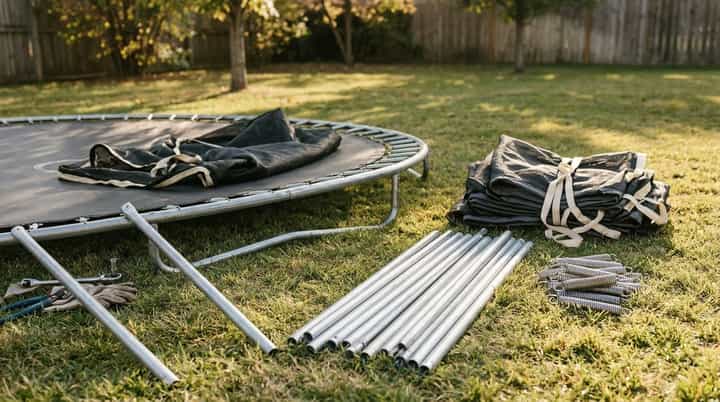
- Bundle rails. Group same-length rails together and wrap with foam pipe insulation or moving blankets secured with packing tape. Rubber-band or zip-tie the bundles — loose rails shift and dent in the truck.
- Label the frame diagram. Take a photo of your pool from above before you start. Some oval pools require specific rail orientations; a photo is worth more than memory six weeks later.
If your pool is a large semi-inground model (typically 48–54 in. wall height with a buttress system), the frame is heavier and the wall panels may require a third person or a wheeled dolly. Consider whether a specialty mover who handles pool tables and heavy recreational equipment has experience with oversized pool structures.
While you’re reading
Skip the research — let Robert match you with movers.
Free quotes from movers in your area. Pick whichever is easiest.
Step 5: What to Do With the Sand or DE Filter Media
Sand filters typically hold 100–300 lbs of #20 silica sand — not worth moving. Drain the filter, bag the sand for disposal, and ship only the empty filter tank and head assembly. Diatomaceous earth (DE) filters are lighter; drain and dry them, but dispose of the used DE (it can't be reused after a season).
Can a Moving Company Move an Above-Ground Pool?
Standard full-service movers will often load a disassembled above-ground pool if it's fully drained, dry, and packed. The liner and frame rails are bulky but not unusually heavy; the pump and filter are treated like appliances. What movers typically won't do:
- Drain the pool for you (they're not plumbers)
- Disassemble the frame (most exclude assembly/disassembly of outdoor structures)
- Load a wet or partially filled pool
If you want professional help, find movers in your area, confirm in writing exactly what they will and won't handle for pool components, and ask whether specialty outdoor equipment is excluded from their liability coverage. Always check that any mover you contact has a valid USDOT number — you can verify it yourself on the FMCSA search tool. For a broader look at how movers handle unusual items, the mover reviews on our site give a sense of which companies have experience with specialty loads.
Reassembly Tips for the New Home
- Let the liner warm before unfolding. Same rule as folding: 65°F or warmer, in direct sun if possible.
- Inspect the liner before installing. Lay it flat and look for cracks along fold lines. A cracked liner discovered after you've filled the pool costs far more in time and water than catching it first.
- Level the ground before setting the bottom track. An unlevel base by even 1–2 inches puts uneven stress on the liner and wall — the most common cause of pool failure after a move.
- Replace the pump and filter O-rings. They're inexpensive and almost always deform slightly during disassembly and storage.
- Re-prime the pump before first use. Dry-running a pool pump, even briefly, can burn out the seal.
For moves to warm-weather states like Florida or Texas where pools are used year-round, timing your move so the pool is set up before summer is worth the extra planning effort. If you're moving to the Houston area, browse movers in Houston who list outdoor and specialty equipment experience; same goes for the Tampa area and Phoenix where pool season is essentially the entire year.
Frequently Asked Questions
How long does it take to drain an above-ground pool before a move?
A submersible or sump pump rated at ¾ HP typically drains a 15,000-gallon pool (about a 15 ft round pool, 48 in. deep) in three to four hours. A 24 ft round pool holds roughly 14,000–16,000 gallons at typical depths, so budget a similar window. Gravity drainage through the return fitting alone can take 12–24 hours — rent or borrow a submersible pump to save time.
Can I move a pool liner that has been stored folded for years?
Possibly, but inspect it carefully before committing to the move. Old vinyl becomes brittle and fold-line cracks are common. Lay the liner flat in warm sunlight for 30–60 minutes to soften it, then unfold slowly. Any crack that holds its shape (rather than flexing shut) likely won't hold water under pressure. A replacement liner for a 15 ft round pool typically runs $60–$150; for a 24 ft round, $150–$350.
Will movers load a disassembled above-ground pool on their truck?
Most full-service movers will load a dry, fully disassembled pool alongside your household goods — the frame bundles and boxed pump are treated like any other bulky item. Confirm this in advance and ask whether the liner and pump are covered under their standard valuation or excluded as outdoor/mechanical items. For interstate moves, federal FMCSA rules (49 CFR 375) govern the mover's liability — either Full Value Protection or Released Value (60 cents per pound per article if you choose it in writing). For in-state moves, liability terms are set by state rules and whatever your contract says.
Should I move my above-ground pool or sell it and buy new?
If the liner is in good shape and the pool is under five years old, moving it almost always costs less than replacement. The main cost of moving is your time (four to six hours of labor to disassemble) and modest packing supplies. A new 18 ft round resin-frame pool with liner and pump typically runs $1,200–$2,500 installed; a comparable used pool moved carefully costs a few hours and $30–$60 in supplies.
What do I do with the water from draining the pool?
Check with your municipality first — most areas prohibit discharging chlorinated water into storm drains. The standard approach: stop adding chlorine 48–72 hours before draining, test the residual chlorine (aim for near zero), then discharge to a sanitary sewer cleanout in your yard, to a large lawn area that can absorb it slowly, or via your municipality's approved method. If you're unsure, your local water utility or pool supply store can confirm the current rules.
How do I keep the liner from cracking in a moving truck?
Keep the folded liner out of direct temperature extremes — the back of an open pickup in full sun or a freezing unheated truck overnight are both damaging. Wrap it in a moving blanket, store it in the cab of the truck or inside a climate-managed container if possible, and never stack heavy items on top. If transit spans multiple days (common on long-distance moves), ask your mover whether items are stored in a temperature-controlled warehouse overnight.
Ready to find a mover who can handle your whole move — pool included? Browse movers by state to compare companies near you, or reach out to Robert, our moving concierge, for a hand-picked shortlist based on your move details.
Tagged