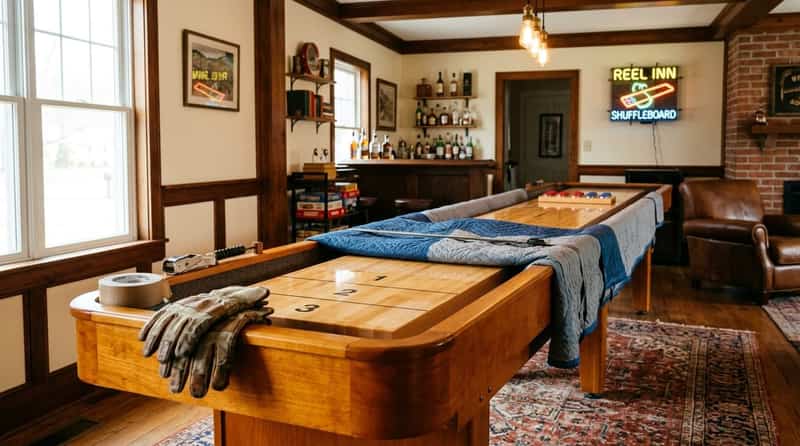
Moving a shuffleboard table requires disassembling it into its major components — playing surface, cradle, legs, and scoring unit — protecting the playing surface from moisture and impact, and using either an appliance dolly or a specialty mover with the right equipment. Because most tables weigh between 300 and 800 pounds and run anywhere from 9 to 22 feet long, this is not a standard two-person move: you need at least three to four people, correct dollying technique, and a truck with enough clearance to lay the top flat.
Why Shuffleboard Tables Are Different From Other Game Room Furniture
A pool table is heavy and awkward; a shuffleboard table is heavy, awkward, and extremely long. The playing surface — almost always a solid hardwood core, often covered with a polymer coat or a thin layer of silicone powder — is the most expensive single component and the most vulnerable. Even a modest flex during a carry can cause the board to bow, which will permanently ruin the flatness that makes the game playable.
If you've already read our guide on moving a pool table, you know that slate weighs a lot and needs careful handling. Shuffleboard presents a different version of the same problem: extreme length rather than extreme weight concentration.
Step 1 — Know Your Table Before You Touch It
Before you move anything, gather this information:
| Spec | Why It Matters |
|---|---|
| Length (9, 12, 14, 16, 18, 20, or 22 ft) | Determines truck size and door clearance |
| Weight (300–800 lbs depending on size and core material) | Determines crew size and dolly type |
| Playing surface material (maple, poplar, hardwood composite) | Thinner boards flex more; require more support points |
| Leg attachment style (bolted pedestal vs. cabinet base) | Affects disassembly complexity |
| Finish (polymer coat vs. exposed wood) | Bare wood needs moisture protection; polymer scratches easily |
A 9-foot table in a studio apartment is a very different move from a 22-foot competition table in a home game room. Measure every doorway, hallway, and stairwell before disassembly — you need to know exactly what path the longest piece will travel.
Step 2 — Gather the Right Supplies
- Moving blankets (at least 6–8; more for longer tables)
- Stretch wrap / plastic film
- Painter's tape and permanent marker (to label every bolt and bracket)
- Small zip-lock bags or a parts organizer for hardware
- An appliance dolly rated for the weight
- Furniture sliders for navigating tight turns
- Packing tape and cardboard sheeting for the playing surface
Do not use standard cardboard boxes for the playing surface. Sheet cardboard cut to size and taped firmly in place gives better edge protection and lies flat.
Step 3 — Disassembly in Order
Disassemble from the top down. Here is the sequence that works for the vast majority of residential tables:
- Remove the scoring unit. Most slide or unclip; some are screwed in. Set it aside and wrap it separately — the plastic or wooden frame cracks easily.
- Remove the gutters or side rails (if separate pieces). Label each one left or right, and which end of the table it came from; they are often slightly different lengths.
- Remove the leg assemblies or pedestal brackets. Have someone support the playing surface at all times from this point forward — it should never rest on its edge unsupported.
- Separate the cradle from the playing surface if your table has a separate cradle (most do). The cradle holds the board; removing them as separate pieces cuts weight significantly and reduces flex risk.
- Lay the playing surface flat on moving blankets on the floor while you prepare the truck or staging area.
Keep every bolt, screw, and clip in a labeled zip-lock bag taped to the component it came from.
Step 4 — Protecting the Playing Surface
The playing surface is the piece most people damage in transit. Follow these steps exactly:
- Clean off any silicone powder (the wax used in play). Silicone on a moving blanket migrates to other surfaces.
- Lay sheet cardboard across the entire playing face. Tape it at the edges, not across the face.
- Wrap the whole board in at least two layers of moving blankets. Secure with stretch wrap — not tape directly on the finish.
- Keep it flat throughout the entire move. Never store it on its edge, even briefly. If it must lean, use a 45-degree angle with padded support at minimum; completely vertical is a flex risk on longer boards.
Moisture is the other enemy. If your move involves any outdoor exposure, add a layer of stretch wrap before the blankets to act as a moisture barrier.
Step 5 — Loading the Truck
The playing surface goes in last (so it unloads first) and lays flat on top of or against padded furniture. For tables 14 feet and longer, you need a 26-foot truck — a standard 15-foot or 17-foot rental truck typically cannot accommodate a lying-flat board that long.
The cradle and legs load separately and can go on their sides with padding between them. Stack nothing on top of the playing surface.
Secure everything with at least two ratchet straps across the board, padded at every contact point. The board should not shift at all during transport — any movement risks surface scratches or, on longer boards, flex damage.
For a quick overview of how professional movers think about loading sequence, see what movers load first — the same logic applies to game room equipment.
While you’re reading
Skip the research — let Robert match you with movers.
Free quotes from movers in your area. Pick whichever is easiest.
When to Call a Specialty Mover (and What It Costs)
For tables 14 feet and over, or any table going up or down stairs, we strongly recommend calling a mover who has handled game room equipment before. Standard moving crews move furniture every day but rarely handle pieces this long. Here's a rough cost range:
| Move Type | Typical Cost Range |
|---|---|
| Local move, table under 14 ft, same floor | $200–$450 |
| Local move, 14–22 ft table or stair carry | $350–$700+ |
| Long-distance, any size | $500–$1,500+ depending on distance and weight |
These are typical ranges based on market rates; always get a written estimate. For a long-distance move across state lines, the federal FMCSA rules require the estimate to be binding or non-binding and state which type it is — a "not-to-exceed" price is a common way movers offer price certainty on specialty items. Confirm the estimate type in writing before anything is loaded.
If you're comparing this to other heavy game room moves, our guide on moving a hot tub covers a similar level of complexity and cost.
Verifying the Mover You Hire
Because shuffleboard tables are expensive — quality tables often cost $2,000–$10,000 or more — it's worth taking five minutes to check any mover's credentials before you book. Look up their USDOT number on the FMCSA's search tool yourself. On that search, "Motor Carrier of Household Goods" means they own trucks and move you directly; "Broker of Household Goods" means they hand you off to another company.
You can also read mover reviews on our site at /reviews — we gather them from customers, though we encourage you to cross-reference with other sources since we don't independently verify each review.
To find movers, filter by specialty or heavy items and ask each candidate directly: Have you moved a shuffleboard table before? How long was it? Did it require a stair carry? The answers tell you everything about their actual experience.
Reassembly Tips
Reassembly goes in reverse order: legs first, then cradle, then playing surface, then rails, then scoring unit. Before you set the playing surface into the cradle, check that the cradle itself is level — most tables have adjustable leg levelers, and the playing surface must be perfectly flat or gameplay will be affected.
Let the table acclimate for 24–48 hours in its new environment before applying silicone powder and playing. Wood expands and contracts with humidity changes, and rushing this step can trap the board in a slightly warped position.
Frequently Asked Questions
How heavy is a shuffleboard table?
Shuffleboard tables typically weigh between 300 and 800 pounds depending on length and the density of the playing surface core. A 9-foot table with a poplar core is toward the low end; a 22-foot maple table with a thick polymer coat is toward the high end. Always confirm actual weight with the manufacturer's spec sheet before booking movers.
Can a standard moving crew move a shuffleboard table?
Often, yes — but only if they have experience with long, flat pieces and have an appliance dolly rated for the weight. The bigger limitation is usually the truck: a standard 15-foot truck won't fit a 16-foot board lying flat. Confirm truck length and crew experience before you book, and ask specifically about their experience with game room furniture.
Do I have to disassemble a shuffleboard table to move it?
For moves involving stairs, doorways narrower than the table, or any distance more than a few feet, yes. Even for a straight roll on a dolly across a single floor, most tables are too long to navigate turns without at least removing the leg assemblies. Full disassembly is the safest approach for any move longer than across the room.
Will movers damage the playing surface?
The most common damage is surface scratching from blankets that weren't secured, and board flex from improper support. Both are preventable: use cardboard sheeting on the playing face, keep the board flat at all times, and use stretch wrap to hold blankets snug. For long-distance moves, make sure your valuation coverage reflects the table's replacement value — Full Value Protection on an interstate move means the mover must repair, replace, or pay replacement value for damage they cause.
How do I protect a shuffleboard table in a moving truck?
Keep the playing surface flat (never vertical), wrap it in cardboard sheeting plus two layers of moving blankets secured with stretch wrap, and use at least two padded ratchet straps to prevent any movement during transit. Load it last so it comes off first, and stack nothing on top of it.
Should I move a shuffleboard table myself or hire movers?
If the table is under 14 feet, stays on one floor, and you have four strong people plus an appliance dolly and a correctly sized truck, a careful DIY move is possible. For anything longer, involving stairs, or traveling more than a few miles, the risk to a table worth thousands of dollars makes professional help the smarter financial decision. If you're weighing the trade-offs, our DIY vs. full-service guide lays out the math clearly.
Ready to find a mover who has handled game room equipment before? Browse movers by state and ask each one directly about their specialty experience — or reach out to Robert, our moving concierge, for help narrowing down the right fit for your table and your timeline.
Tagged