Packing yard tools for a move means doing three things in the right order: drain or empty anything with fuel or chemicals, protect anything with a blade or sharp edge, then bundle and pad the rest so handles don't splinter and tines don't punch through boxes. Done correctly, the whole shed or garage can be packed in a few hours — done wrong, a leaking gas can or an exposed mower blade can damage other belongings or injure the crew loading the truck.
Step 1 — Drain fuel and empty chemicals before anything else
This is the non-negotiable first step, and it applies regardless of whether you're hiring full-service movers or loading a rental truck yourself.
Why it matters: Movers — and rental-truck agreements — prohibit transporting flammable liquids. A gas-powered mower, leaf blower, chainsaw, pressure washer, or generator with fuel still in the tank is, at best, a contract violation and, at worst, a fire hazard. Our team has 35+ years of hands-on service-provider experience, including an operator who ran a moving company for 18 years — fuel spills in a sealed truck are among the most common causes of load damage they've seen.
What to do:
- Run the engine until it dies, or use a hand pump to remove remaining fuel into an approved container for disposal.
- Start the engine again after draining to burn off residual fuel in the carburetor.
- Disconnect the spark plug wire once the engine is cool — this prevents accidental starts during transit.
- Drain oil from two-stroke engines the same way; it's also prohibited in transit.
- Empty lawn-care chemicals — fertilizers, herbicides, pesticides — completely. Many movers won't transport them even sealed; check with your mover before moving day.
For a full list of what typically can't go on the truck, see what movers won't put on the truck: prohibited and restricted items explained.
Step 2 — Sort what's worth moving vs. what to leave behind
Yard tools are heavy, awkward, and often inexpensive to replace. Before you wrap a single handle, do a quick triage.
| Item | Typically worth moving | Consider leaving |
|---|---|---|
| Quality long-handled tools (shovels, rakes, hoes) | ✓ If in good condition | If bent, cracked handles |
| Gas-powered mower | ✓ If <5 years old | If old, rusty, or barely runs |
| Manual push mower | ✓ Easy to pack | — |
| Riding mower | Check specialty movers | Often cheaper to sell |
| Garden hoses | ✓ Coil and bag them | If cracked or knotted |
| Bags of soil, mulch, sand | ✗ Too heavy, can tear | Donate or use up |
| Pesticides / fertilizers | ✗ Check with mover | Dispose of properly |
| Pots and planters | ✓ Nest and wrap | If cracked or very heavy |
If you're on the fence about big items, our guide on how to declutter before a move and cut your moving bill walks through a simple keep/donate/discard framework that works just as well in the garage as in the kitchen.
Step 3 — Protect blades, tines, and sharp edges
Every cutting surface needs a cover before it gets near other items or people.
Long-handled tools with metal heads (rakes, hoes, cultivators, edgers):
- Bundle 4–6 together with the heads aligned in the same direction.
- Wrap the head cluster with two layers of moving blanket or thick cardboard, secured with stretch wrap or heavy-duty tape.
- Bind the bundle every 18–24 inches with tie-down straps or bungee cords — not just at the ends.
Pruning shears, loppers, and hedge trimmers:
- Cover blades with a blade guard (the plastic ones that came with the tool), or wrap tightly in corrugated cardboard and tape shut.
- Place in a labeled box or a sturdy bag; never loose in a bundle of other tools.
Axes, hatchets, machetes:
- Sheath or wrap the blade in thick cardboard, then place in a box padded with newspaper or packing paper — never exposed in a bundle.
String trimmers (weed eaters):
- Remove the head if it detaches, wrap it separately.
- Lay the shaft alongside bundled long-handle tools or stand upright in the truck against the wall.
Step 4 — Pack and bundle the long-handled tools
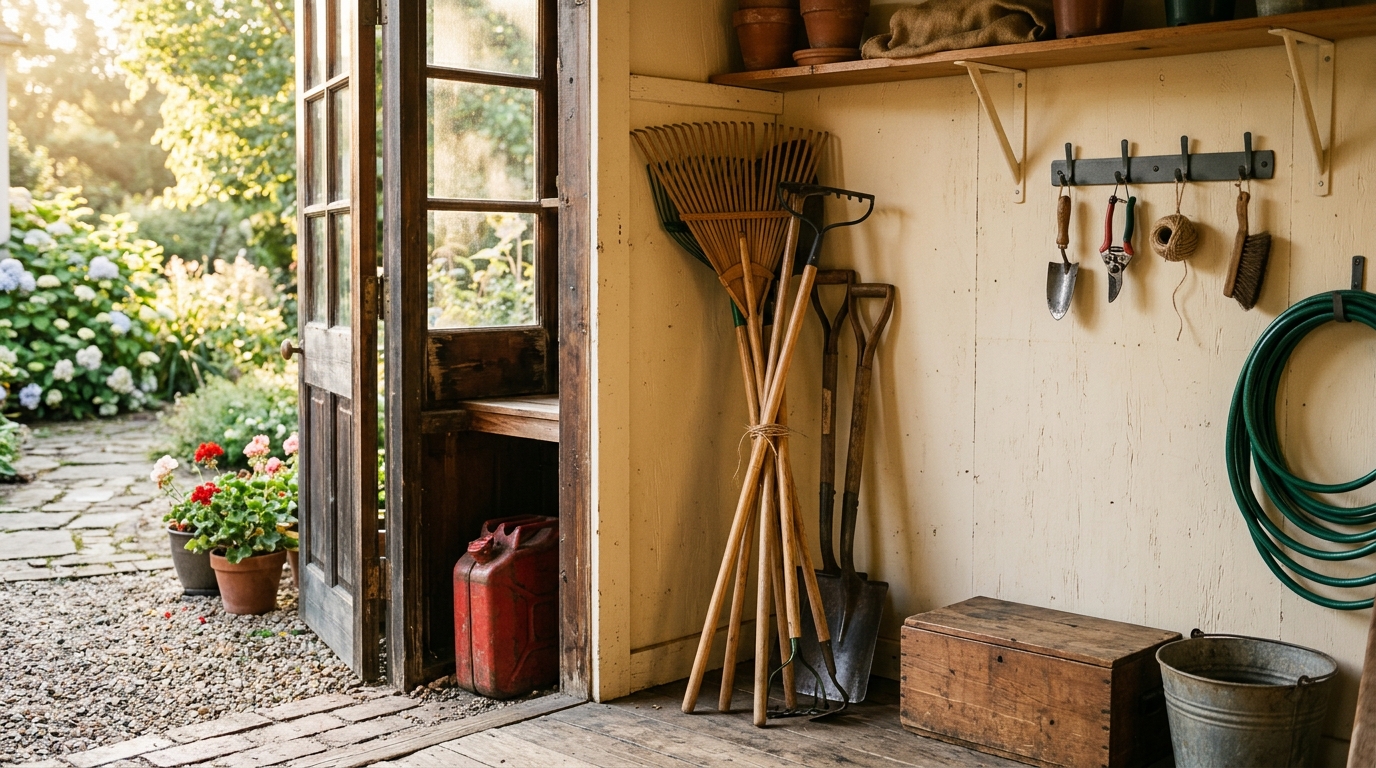
Long-handled tools — shovels, spades, rakes, brooms, leaf blowers with poles — are almost never boxed. They go as bundled units.
- Sort by length. Group tools of similar length together so the bundle is even.
- Pad the heads. Wrap metal heads together with moving blanket or old towels, secured with stretch wrap.
- Pad the handles. Wrap the full length of the bundle in moving blanket or bubble wrap so wooden handles don't splinter or scratch other items.
- Bind the bundle. Use ratchet straps or heavy-duty bungee cords at three points: near the top, in the middle, and near the bottom.
- Label the bundle. A piece of tape with "SHARP — YARD TOOLS" keeps the unloading crew safe.
In a moving truck, long bundles typically ride vertically in a corner or horizontally along the truck wall, strapped to the truck's side rails. If you're using a professional mover, ask them before moving day how they prefer to receive bundled tools — some load them last, some first.
While you’re reading
Skip the research — let Robert match you with movers.
Free quotes from movers in your area. Pick whichever is easiest.
Step 5 — Pack smaller garden tools and accessories
Hand tools (trowels, weeders, bulb planters, pruners):
- Wrap each one individually in packing paper or newspaper.
- Pack in a medium or large box, sharp ends down, padded with crumpled paper on all sides.
- Don't overload — garden tools are dense; keep boxes under 40–50 lbs.
Garden hoses:
- Drain completely, then coil tightly.
- Secure the coil with zip ties or bungee cord.
- Place in a large trash bag or a canvas bag — they don't need a box.
Sprinklers and nozzles:
- Drain and dry completely; pack loosely in a box with other garden accessories.
Knee pads, gloves, plant stakes, and twine:
- These go in any box with room; label the box "GARDEN ACCESSORIES."
Step 6 — Handle the lawn mower
A push mower (gas-powered, drained and de-sparked per Step 1) can ride on the truck floor or in the back of a pickup.
- Clean the underside. Remove caked-on grass — most movers require it, and it prevents mold.
- Fold or lower the handle if the mower allows it, to save space.
- Wrap exposed blade housing in moving blanket and tape it shut.
- Tip the mower back (toward the handle) for loading if space is tight — never on its side, which can push oil toward the air filter.
Riding mowers are a different situation. They're heavy, wide, and require a ramp — specialty equipment most standard movers don't carry. If you're moving a riding mower cross-country, ask your mover explicitly or look for a carrier that handles equipment transport. You can browse movers by state to find carriers in your area and confirm their capability before booking.
What movers will and won't do with your yard tools
Most full-service movers will load bundled tools and a drained mower without issue. What they typically won't do:
- Transport anything with fuel remaining in the tank
- Transport propane tanks (grill tanks, torch tanks) — even "empty" ones with residual gas
- Transport opened bags of fertilizer, herbicides, or pesticides
- Disassemble equipment for you (tillers, aerators, pressure washers) — that prep is yours
Before moving day, confirm with your mover what's on their prohibited list. If you're still choosing a carrier, read mover reviews and ask specifically about large outdoor equipment — not every company handles it the same way.
What about the grill?
A gas grill is a separate category. You must disconnect and cap the propane line, and most movers won't transport a propane tank — even a small one. Either use up the gas or arrange for a local exchange. The grill body itself (empty, clean, no tank) can typically go on the truck.
For anything with an engine that moves — pressure washers, generators, tillers, snowblowers — apply the same fuel-drain-and-spark-plug rules as the mower.
Frequently asked questions
Can movers transport a lawn mower with gas in it?
No. Flammable liquids — including gasoline in a mower tank — are prohibited on moving trucks by both federal transportation rules and standard carrier policies. Drain the tank, run the engine dry, disconnect the spark plug, and confirm it's empty before moving day.
Should I box long-handled tools like shovels and rakes?
No standard moving box fits a full-length shovel or rake handle. Bundle them together with moving blankets and tie-down straps instead. Make sure the heads are wrapped and the bundle is labeled with a warning about sharp edges.
What do I do with fertilizer, pesticides, and weed killer?
Most movers won't transport these, especially if opened. Use them up before the move, give them to a neighbor, or take them to a local household-hazardous-waste drop-off. Check with your mover before moving day — don't assume sealed containers are acceptable.
Is it worth moving an old riding mower?
Often not. Factor in the cost of specialty transport (typically $150–$400+ depending on distance), the fuel prep, and the risk of damage. If the mower is more than 10 years old or has mechanical issues, selling or donating it locally and buying new at your destination frequently makes more financial sense. Use the calculator at find movers to compare what full-service movers charge for large outdoor equipment.
How do I pack clay pots and ceramic planters?
Drain the soil, let them dry, then wrap each pot individually in packing paper or bubble wrap — the same method used for fragile kitchen items. Nest smaller pots inside larger ones with paper between them. Pack in double-walled boxes, label "FRAGILE," and place on top of heavier items in the truck. For more on wrapping fragile items, the guide on how to pack and move fragile items you can't replace covers the same technique in detail.
Can I leave dirt in my garden pots when I move?
Technically you can, but it adds significant weight (a 12-inch pot with wet soil can weigh 30–50 lbs) and risks spilling in the truck. Dump the soil, clean the pot, and bring it empty. If you're moving to a new state, be aware that some states restrict importing soil — check with the destination state's department of agriculture if you're crossing state lines with large volumes of soil or compost.
Getting the garage and shed squared away is one of the last things most people think about — and one of the first things that surprises them on moving day. Start with the fuel drain, protect every blade, bundle your handles, and you'll be ready.
Ready to find a mover who's handled plenty of garages and outdoor equipment? Browse licensed carriers near you or connect with Robert, our moving concierge, for a personalized recommendation based on your move size and location.
Tagged