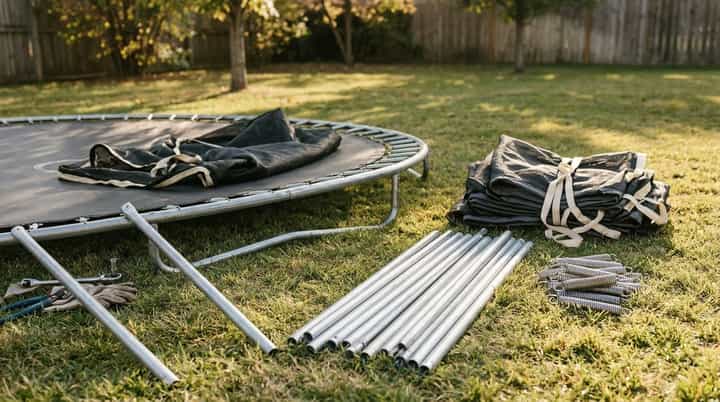
Moving a trampoline requires complete disassembly — frame, springs, mat, and enclosure net all come apart — before anything can be loaded onto a truck. A standard 14- or 15-foot round trampoline typically breaks down into 50–80 frame poles, 80–120 springs, a rolled jump mat, and a folded enclosure net; the whole pile usually fits in a 6×4-foot area of a truck, but only if it's organized. Skip the disassembly and you're looking at a 10-foot-wide item that won't clear most truck doors and can rack or warp under its own weight during transport.
Can Movers Move a Trampoline — or Is It a DIY Job?
Most full-service movers will load a trampoline, but only if it's already taken apart and ready to go. Expect the question "is it disassembled?" when you get your quote. Some movers treat a trampoline as a specialty or bulky-item surcharge — often $50–$150 on top of the standard rate — because of the volume it takes up and the time needed to handle awkward pole bundles. A handful of movers will decline altogether if the trampoline is an older rectangular model with a heavy steel frame.
If you want movers to handle the disassembly themselves, ask specifically when booking; most will charge an additional labor fee, and you'll want that in writing before moving day.
For long-distance moves, your trampoline will be listed on the inventory and weighed with everything else. Under FMCSA rules (49 CFR 375), if you have a non-binding estimate, the final bill is based on actual weight; at delivery you pay 110% of the estimate to release your goods, with any remaining balance billed within 30 days. A trampoline frame can easily add 150–300 lbs to your load, so make sure your mover accounts for it in the estimate — an in-person or live-video survey is required unless you waive it in writing, and that survey is exactly when to point at the trampoline. You can read more about how estimates work in our guide to binding vs. non-binding moving estimates.
What Tools You Need Before You Start
- Spring pull tool (usually shipped with the trampoline; a flathead screwdriver works in a pinch but is slower and hard on your hands)
- Rubber mallet
- Zip-lock bags or small hardware pouches for nuts, bolts, and leg caps
- Painter's tape and a marker for labeling poles
- Moving blankets or furniture pads for frame bundles
- Heavy-duty zip ties or bungee cords to bundle poles
- A tarp or large plastic sheeting to lay parts on
Step-by-Step: How to Disassemble a Trampoline
1. Clear and prepare the area
Move the trampoline to an open, flat part of the yard. You'll be walking around it repeatedly, so give yourself at least 3 feet of clearance on all sides. If it's wet, dry the mat and frame with towels — you don't want mildew packed into the truck.
2. Remove the safety enclosure net and poles
Unclip or unzip the net from the frame poles first. Most enclosure nets attach with Velcro straps, foam sleeves, or hooks at the bottom. Remove the enclosure poles from their sockets — these typically slide out upward, though some twist-lock designs require a quarter-turn. Fold or roll the net loosely (avoid tight rolling, which stresses the mesh) and place it in a large garbage bag or lawn bag to keep it clean.
Label enclosure poles with tape and a marker: "TOP," "MIDDLE," "BOTTOM" if they telescope, or simply number them (1 through 6, 8, or however many your model has) so reassembly is straightforward.
3. Remove the spring pad (safety pad)
The foam spring pad usually lifts straight off; it's held by elastic loops around frame hooks. Roll it tightly and secure it with zip ties or bungee cords. Store it upright in the truck rather than flat under heavy items — the foam compresses permanently if loaded under weight.
4. Remove the springs
This is the most time-consuming step. Using your spring pull tool, unhook each spring from the mat and from the frame. Work in a crossing pattern — remove a spring, skip two, remove the next — rather than going around the perimeter in order. This keeps even tension on the mat and frame as you go, reducing the risk of the frame bowing.
Collect springs in a zip-lock bag or a small bucket. A standard 14-foot trampoline has 88–96 springs; a 15-foot model often has 108–120. Count them before you bag them — you'll thank yourself when you're reassembling.
5. Remove the jump mat
Once all springs are off, the mat lifts free. Fold it in thirds lengthwise, then roll it into a cylinder. Secure with bungee cords. The mat is typically the lightest single piece; store it wrapped in a moving blanket to prevent the stitched spring tabs from snagging other items.
6. Disassemble the frame
Most round trampolines have a W-shaped leg system and curved top-rail sections that join with T-sockets or straight connectors. Start by pulling the top-rail arcs apart at the connectors — they usually pop apart with a firm tug or a tap with a rubber mallet. Then separate the leg sets from the top rail, and finally separate the W-legs themselves into individual poles.
Rectangular and oval models follow the same logic but typically have more straight sections and heavier gauge steel; expect more resistance at the joints.
Bundle same-length poles together with zip ties or rope and wrap the bundle in a moving blanket. Tape a label to each bundle noting length and quantity. This is the same organizing logic used for moving a backyard playset or swing set — hardware labeled on-site saves an hour of guesswork on the other end.
7. Store leg caps and hardware
Leg caps (the rubber or plastic feet at the bottom of each leg) slide or pull off. Bag them with nuts and bolts in a labeled zip-lock. Tape that bag to the inside of one of your hardware bundles so it doesn't float loose in the truck.
While you’re reading
Skip the research — let Robert match you with movers.
Free quotes from movers in your area. Pick whichever is easiest.
How to Pack and Load the Disassembled Trampoline
| Component | Best packing method | Where in the truck |
|---|---|---|
| Frame poles (bundled) | Wrapped in moving blankets, banded | Flat on truck floor, long wall |
| Enclosure poles | Bundled separately, labeled | Same flat stack as frame poles |
| Springs (bagged) | Zip-lock or small bucket | Inside a medium box, padded |
| Jump mat (rolled) | Moving blanket wrap, bungee-tied | On top of pole bundles or upright |
| Spring pad (rolled) | Bungee-tied, upright | Upright against truck wall |
| Net (bagged) | Lawn bag or garbage bag | Tucked in remaining space |
| Hardware bag | Zip-lock, labeled | Taped to a pole bundle |
Keep the pole bundles flat and long, running the depth of the truck. Never stack heavy furniture on top of the spring pad — that foam won't recover. The gear movers use to protect furniture (furniture pads, floor runners, dollies) doesn't translate well to loose poles, so if you're doing this yourself, budget extra moving blankets specifically for the frame bundles.
Will Movers Reassemble It at the New Home?
Some will, for an added labor fee; most won't include reassembly automatically. Ask explicitly at booking and get the answer in writing. If your mover won't reassemble, budget 60–90 minutes for two adults to put a standard round trampoline back together, assuming all hardware is labeled and accounted for.
How Much Does It Cost to Move a Trampoline?
Costs vary widely by move type and mover policy:
| Scenario | Typical added cost |
|---|---|
| Local move, movers load pre-disassembled trampoline | $0–$75 (bulky item fee) |
| Local move, movers disassemble + load | $75–$200 extra labor |
| Long-distance move, adds ~200 lbs to load | $40–$120 in weight-based charges (varies by mileage) |
| Mover declines; you rent a trailer | $30–$80/day trailer rental |
If a long-distance mover quotes you a fixed price (sometimes called a not-to-exceed estimate), confirm the trampoline's weight is specifically included — these estimates are only as accurate as the inventory they're based on.
Should You Move It or Buy a New One?
A used trampoline in good condition can sell locally for $150–$400; a comparable replacement costs $300–$700 for a mid-range model. If your move is long-distance and the weight charges plus labor fees approach $200 or more, run the math. Our team has 35+ years of hands-on service-provider experience, including an operator who ran a moving company for 18 years, and the consistent advice is: measure the trampoline's condition honestly. Rust on the frame, tears in the mat, or stretched springs are good reasons to sell and replace; a nearly-new enclosure model with a padded spring system is usually worth bringing.
You can explore more scenarios like this in our guide to moving backyard and outdoor equipment, or browse movers by state to compare quotes from carriers who handle specialty outdoor items.
Finding a Mover Who Handles Backyard Equipment
Not every general mover is comfortable with large outdoor items. When you find movers, filter for full-service carriers and mention the trampoline specifically in your inquiry — the right mover will ask about dimensions and weight without prompting. Check mover reviews for mentions of outdoor equipment or large specialty items to gauge experience before you book.
If you're unsure whether a carrier is legitimate, look up their USDOT number on the FMCSA website yourself before you sign anything. Our guide on how to vet a mover's license and insurance walks you through that check in under five minutes.
For questions about your specific setup — unusual trampoline sizes, tight backyard access, or timing — reach out to Robert, our moving concierge, through the site.
Frequently asked questions
Do movers take apart trampolines?
Some full-service movers will disassemble a trampoline for an added labor fee, typically $75–$200. Most movers expect the trampoline to be pre-disassembled and ready to load. Confirm this explicitly when you book, and get the answer in writing.
How long does it take to disassemble a trampoline?
One adult working alone takes about 60–90 minutes for a standard 14- or 15-foot round trampoline. Two people working together can usually finish in 30–45 minutes. Rectangular models with heavier steel frames typically add 20–30 minutes.
Can a trampoline fit in a moving truck?
Yes, once fully disassembled. The pole bundles, rolled mat, spring pad, and bagged hardware typically occupy a 6×4-foot section of a standard 26-foot moving truck. A fully assembled trampoline will not clear most truck doors and cannot be safely transported whole.
Should I label the trampoline poles before moving?
Yes — labeling is essential. Use painter's tape and a marker to note length, quantity, and position (enclosure vs. frame, top rail vs. leg). Numbered bundles make reassembly straightforward and prevent the frustrating situation of having poles left over at the end.
What happens to my trampoline's weight on a long-distance move?
On a non-binding estimate, the final bill is based on actual weight after loading. A fully disassembled 14-foot trampoline typically weighs 150–300 lbs depending on the model; that weight is added to your total and billed accordingly. Make sure your mover accounts for it during the survey so there are no surprises at delivery.
Is it worth taking a trampoline on a long-distance move?
It depends on condition and cost. If the trampoline is nearly new and in good shape, bringing it usually makes sense. If movers' weight-based charges plus any labor fees approach the cost of a replacement, selling locally before the move and buying new at the destination is often the more practical choice.
Tagged