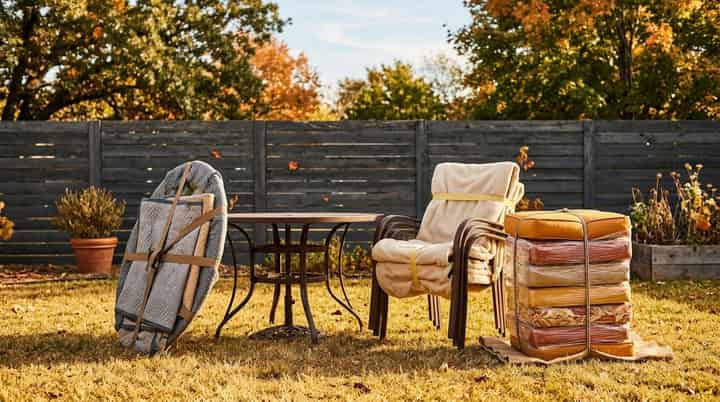
Moving patio furniture starts with two non-negotiable steps most people skip: clean every piece thoroughly before it touches a moving truck, and disassemble anything that comes apart. Outdoor furniture is heavy, oddly shaped, and often dirty enough that movers will charge extra handling time — or refuse to load it — if it arrives at the truck caked in grime, mold, or standing water. Do those two things right, and the rest of the move goes smoothly.
Why Cleaning Patio Furniture Before the Move Actually Matters
Dirt, mold, mildew, and dried debris don't just make a mess in the truck — they can transfer to upholstered furniture, scratch painted surfaces when pieces shift, and cause rust to accelerate during transit if moisture is sealed inside wrapping.
What to do at least 48 hours before loading:
- Scrub frames with a mild soap-and-water solution; rinse fully and let dry in direct sunlight.
- Treat any visible mold with a diluted white vinegar spray; wipe off and re-rinse.
- Check for rust spots on metal frames. Sand lightly and apply a touch-up rust-inhibiting spray — moving will expose raw metal to moisture in the truck.
- Drain and dry anything that holds water: planter bases, fountain features, umbrella stands with water ballast.
- Remove cushions and wash removable covers; store dry cushions in large garbage bags or dedicated cushion storage bags to protect them from condensation during the move.
Movers we know through our team's 35+ years of hands-on service-provider experience — including an operator who ran a moving company for 18 years — consistently say that wet or moldy outdoor furniture is one of the more common sources of avoidable truck damage. It's not dramatic; it's just preventable.
What to Disassemble (and What You Can Leave Together)
Pieces worth taking apart
- Dining tables with glass tops: Always remove glass and transport it separately, wrapped and padded standing upright (never flat). Glass laid horizontal is far more vulnerable to breaking from load shifts.
- Umbrella and base: Remove the pole from the base, fold or close the canopy, and transport base and pole separately. Bases filled with sand or water must be emptied — most weigh 50–100 lbs when full, and that weight will shift during transit.
- Sectional seating with modular clips or bolts: Disconnect sections so each piece is a manageable rectangle rather than an L-shape that is hard to load efficiently.
- Folding chairs and tables: Collapse them fully. Stack and strap in groups of four to six.
- Swing sets and hammock frames: Detach chains, hooks, and hanging hardware; bag the hardware in a labeled zip-lock and tape it to the frame.
What you can usually leave assembled
- Solid one-piece benches or Adirondack-style chairs — just pad the arms and legs.
- Small bistro tables (no glass) — wrap the top and load upside-down on a padded furniture pad.
- Resin or plastic stacking chairs — stack and wrap the whole column.
How to Wrap and Protect Each Material Type
Different materials need different protection. Here's a quick-reference table:
| Material | Main Risk | Recommended Protection |
|---|---|---|
| Wrought iron / cast iron | Scratches, chips, rust transfer | Moving blankets on all surfaces; cardboard sleeve on sharp edges |
| Aluminum (powder-coated) | Paint scuffs | Moving blankets; avoid plastic wrap directly on powder-coat in heat |
| Teak / hardwood | Gouges, moisture warping | Moving blankets; keep dry; stand upright or flat — not on edge |
| Wicker / rattan | Snapping, crushing | Surround with soft cushions; blankets over frame; never stack heavy items on top |
| Glass tabletops | Shattering | Cardboard on both faces, edge foam, transported standing upright in a padded cell |
| Resin / plastic | Cracking at legs in cold | Group-stack; moving blankets between stacks; protect from freezing in winter moves |
| Cushions / fabric | Moisture, mildew | Sealed bags; load in cab or inside box if truck has moisture exposure risk |
For glass specifically: cut two pieces of cardboard slightly larger than the glass, sandwich the top between them, run packing tape around all four edges, then wrap the whole assembly in a moving blanket. Transport it standing on its long edge, not flat — the same method used for packing mirrors for a move.
While you’re reading
Skip the research — let Robert match you with movers.
Free quotes from movers in your area. Pick whichever is easiest.
Step-by-Step: Loading Patio Furniture Into the Truck
- Load heavy bases and iron frames first, pushed against the truck wall. They act as an anchor for lighter pieces.
- Nestle glass panels vertically between mattresses or furniture pads if available, or prop them against the wall of the truck with a moving blanket buffer — never let glass lean at an acute angle with nothing behind it.
- Stack chairs in columns: place a moving blanket between each chair, then strap the column to the truck wall.
- Slide tables in upside-down where possible so the legs face up — it protects the tabletop surface and makes stacking easier.
- Fill gaps with cushion bags — they're bulky but light and serve as natural padding around metal frames.
- Strap everything: patio furniture shifts more than boxed items because of its irregular shape. Use at least two load bars or ratchet straps per large piece group.
If you're hiring movers, let them know about the patio set when you get your quote. Glass tops, oversized umbrella bases, and heavy cast-iron pieces may carry a stair-carry surcharge or large-item fee. Ask about it upfront — the guide to hidden moving fees explains exactly which items typically trigger add-ons.
Should You Hire Movers, Rent a Truck, or Sell It?
Before committing to moving your outdoor set, do a quick cost comparison. Patio furniture often surprises people with how expensive it is to move relative to what it's worth.
| Scenario | Move It? | Notes |
|---|---|---|
| High-quality teak, cast iron, or designer set worth $1,500+ | Yes | Worth the protection cost; consider white-glove service |
| Mid-range aluminum or resin set worth $400–900 | Probably | Move it yourself in an SUV or pickup if pieces disassemble |
| Big-box store resin or plastic set worth under $300 | Consider selling | Comparable sets are easy to replace; moving cost may exceed value |
| Umbrella base only (no umbrella) | Usually no | Heavy, awkward, cheap to replace |
The post Move the Old Furniture or Buy New? has a useful piece-by-piece framework for exactly this decision.
For a DIY move, a 10- or 15-foot rental truck can typically handle a full 6-piece patio dining set plus the rest of a 1-bedroom home's contents. If you're only moving the outdoor furniture and a few extras, an enclosed cargo trailer or even a large pickup bed with a fitted cover may suffice.
What Movers Will and Won't Do With Patio Furniture
Most full-service movers will load, pad, and transport assembled or disassembled patio furniture as part of a standard move. What they typically won't do:
- Empty a water-ballasted umbrella base for you — that prep is on you.
- Move items with active propane tanks (applies to any attached grill or outdoor heater; see the separate guide on moving a BBQ grill for the disconnect steps).
- Move items that have standing water in frames, table channels, or umbrella bases — this is a mold and rust liability.
- Disassemble furniture they didn't quote to disassemble without an additional fee.
If you want movers to handle glass tabletop removal, disassembly, and custom wrapping, ask for that explicitly when requesting your quote — and get it in writing on the estimate. Use our directory to find movers near you, and check mover reviews to see how companies handle outdoor and specialty items before you book.
Frequently Asked Questions
Will movers move patio furniture?
Most full-service movers will move patio furniture as part of a standard load, but glass tops, cast-iron pieces, and oversized bases often carry a surcharge. Confirm this during your quote, and check that the mover's estimate lists the items specifically so there are no surprises on moving day.
Do I have to disassemble my patio furniture before movers arrive?
Movers will often disassemble basic pieces for a fee, but glass tabletops should always be removed before the truck arrives — that is a task that benefits from care and time, not rushing. For everything else, check whether disassembly is included in your quote or priced as an add-on service.
Can I leave cushions on the patio furniture while it's loaded in the truck?
It's better not to. Cushions trap moisture during transit, can mold if the truck is closed for more than a day, and add uneven pressure on frames. Remove them, dry them, seal them in bags, and load them separately as padding between harder items.
How do I transport a glass patio table top?
Remove the glass, place cardboard on both faces, tape the edges, wrap in a moving blanket, and transport it standing upright on its long edge — not flat. Never lay glass horizontal in a truck; it is far more vulnerable to breaking from weight or vibration.
What do I do with an umbrella base full of sand or water?
Empty it completely before the move. Sand-filled bases can weigh 100 lbs or more; water-filled bases must be drained to prevent shifting and mold. Most have a plug at the bottom — drain it into a bucket, let the base dry, then load it.
Is it worth moving cheap resin patio furniture?
Often not. A basic resin or plastic set worth under $300 at a big-box retailer may cost nearly as much to move professionally as it would to replace — especially if there are stair carries, long walks to the truck, or if you're on a long-distance move priced by weight. Selling the set before you move and buying new at the destination is frequently the more economical choice. Browse movers by state to get quotes and compare costs before you decide.
Tagged