Moving a BBQ grill safely comes down to three things: eliminating fire and leak hazards (empty the propane tank or disconnect the gas line), cleaning out grease so the grill doesn't soil everything else on the truck, and protecting the grates and lid so they arrive intact. Do those three things right and the grill is one of the easier large outdoor items to move — but skip any of them and you create an actual headache, or worse.
Why a grill needs more prep than most outdoor furniture
A neglected grill carries grease, ash, and a pressurized fuel source. Movers can and do refuse items that pose a safety or contamination risk, and a grease-caked firebox next to your upholstered sofa is exactly that. Even if your mover is willing to load it as-is, the cleanup bill at the other end is never worth it. Spending 30–45 minutes prepping the grill before moving day is the single best investment you can make for this piece.
If you're still deciding whether to take the grill at all, the guide Move the Old Furniture or Buy New? A Piece-by-Piece Way to Decide has a framework that works just as well for outdoor equipment as it does for sofas.
Step 1: Handle the fuel source first — this is non-negotiable
Propane (tank-style grills)
Federal DOT regulations and most moving company policies prohibit transporting propane tanks on a moving truck, full or empty. A "empty" tank still contains residual gas and counts as a hazardous material.
What to do:
- Stop using the grill at least 24 hours before moving day so residual gas dissipates.
- Close the valve on the tank completely.
- Disconnect the regulator hose.
- Take the tank to a hardware store, home improvement store, or propane retailer — most accept exchanges or will purge and cap it for a small fee (typically $5–$15).
- Transport the empty, capped tank in your personal vehicle with windows cracked, never in a closed trunk.
- Buy a fresh tank at your destination.
This is one item worth leaving behind or disposing of rather than fighting over. A new 20-lb propane tank costs $50–$80 with exchange, which is far less than the liability of a tank on a loaded truck.
Natural gas (fixed-line grills)
A gas-line grill must be disconnected by a licensed plumber or gas fitter before moving day — not by you, and not by the movers. The line needs to be properly capped at the shutoff. Budget $75–$150 for the service call; in some markets it runs higher. At your new home, reconnection is a second service call. Check with your mover in advance: some include disconnecting standard appliances, but gas lines are almost always excluded.
Charcoal and pellet grills
No tank to remove, but the firebox must be completely cold and emptied of ash and unburned charcoal. Wet ash is heavy, corrosive, and messy. Bag it, tie it off, and dispose of it before packing day.
Step 2: Clean the grill thoroughly
A grill that smells like last summer's cookout will scent everything in the truck. Grease can also leak onto other items or onto the truck floor, creating a slip hazard.
Cleaning checklist:
- Burn off residue: Run the grill on high heat for 10–15 minutes (while still connected), then brush the grates while hot.
- Remove and scrub grates separately: Wrap them in newspaper or kraft paper once clean; they're the most likely items to leave marks.
- Empty and wipe the drip tray/grease pan: This is where most of the contamination lives. A disposable tray liner makes this much faster.
- Wipe down the interior of the lid and firebox with a degreasing spray and paper towels.
- Clean the exterior: Stainless panels scratch easily — use a soft cloth and a stainless cleaner, wiping in the direction of the grain.
- Let everything dry completely before closing the lid for transport. A damp, sealed firebox grows mold quickly.
Step 3: Disassemble what you can
Most grills break down more than people realize, which makes loading easier and reduces the risk of damage.
| Part | What to do |
|---|---|
| Grates (cooking + warming) | Remove, wrap individually in kraft paper or moving blankets |
| Drip tray / grease pan | Remove and bag; wrap the housing opening in plastic wrap |
| Side shelves | Most fold down or detach with a few bolts; bag the hardware |
| Rotisserie rod and motor | Remove and wrap; rod is a puncture risk if loose |
| Thermometer | Leave in place if flush-mounted; remove if protruding |
| Propane regulator hose | Remove after disconnecting, coil and bag it |
| Casters / wheels | Leave on; they help with loading |
Bag and label every set of hardware the same way you would for furniture — a small zip-lock taped to a wrapped part is enough. For a broader look at how experienced movers handle hardware from complex pieces, Packing Yard Tools and Garden Equipment for a Move covers the same bagging-and-labeling method for the rest of your outdoor gear.
Step 4: Secure the lid for transport
An unsecured grill lid can open during transit, bang against the body, and crack the hinge or the porcelain interior. Use one of these methods:
- Moving strap or bungee cord: Loop around the body and over the lid handle. Tight enough that the lid won't shift, not so tight it deforms the handle.
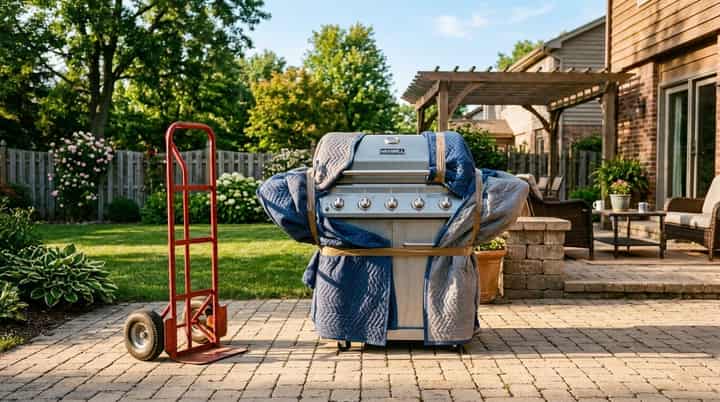
- Stretch wrap (plastic wrap): Two or three passes around the entire grill body locks the lid and protects the exterior simultaneously. This is the method most professional movers prefer.
- Foam pipe insulation: Slide a length over the edges of the lid and the body where they meet before strapping. This cushions the contact points if the lid does move.
While you’re reading
Skip the research — let Robert match you with movers.
Free quotes from movers in your area. Pick whichever is easiest.
Step 5: Wrap the exterior
Stainless steel and porcelain-coated panels are both susceptible to scratches and dents in transit. Wrap the grill in at least two moving blankets, paying extra attention to the corners, the front panel, and any knobs or igniters that protrude.
If you're renting a truck and doing this yourself, Moving Blankets: What They Cost to Rent or Buy — and When You Actually Need Them will help you figure out how many to have on hand. A standard 6-burner freestanding grill typically needs two to three blankets.
Step 6: Load it correctly
Always load the grill upright. Laying a grill on its side can:
- Crack porcelain interior panels
- Damage the burner tubes
- Let residual grease pool against surfaces you can't clean until unloading
For loading logistics:
- Use an appliance dolly (the tall, two-wheeled kind with a strap) to wheel it up the ramp. A standard furniture dolly works on flat ground but is awkward on a ramp with a heavy item.
- Load the grill against the cab wall or against another heavy, stable item — not against boxes that could shift.
- Strap it to the truck wall using the tie-down rails most moving trucks have; one strap at the base and one mid-body.
- Never stack anything on top of the grill during transport.
A large freestanding grill typically weighs 100–200 lbs depending on the model. A kamado-style ceramic grill (like a Big Green Egg) can weigh 150–400 lbs and is significantly more fragile — the ceramic shell cracks under lateral force. For a kamado, consider a specialty crate or consult the manufacturer; some dealers offer moving assistance.
Should movers handle the grill, or is this a DIY job?
For most standard propane or gas grills, full-service movers will load and unload the grill itself — the prep work (fuel disconnection, cleaning) is always your job. Some movers charge a specialty-item fee for grills, typically $25–$75, particularly for large kamados or built-in units. Ask about this when you get your quote so it shows up on the estimate, not as a surprise at delivery.
If you're moving locally and hiring hourly labor, the grill is a straightforward add-on once it's prepped and wrapped. For cross-country moves, confirm in writing that the grill is on the inventory and ask how it will be loaded — it should not be listed as a "misc outdoor item" on a non-binding estimate where weight matters.
For general guidance on how movers price heavy outdoor items and what to watch for on your bill, How Movers Charge by the Hour: What Drives the Bill and How to Keep It Low is a useful read alongside your quote.
You can find movers in your area, compare options, and read mover reviews before you commit — checking a mover's USDOT number yourself on the FMCSA's website takes about 60 seconds and confirms they're licensed to operate.
Frequently asked questions
Can movers transport a propane tank on the truck?
No. Federal DOT hazardous materials regulations prohibit propane tanks — full or nominally empty — on moving trucks. You need to have the tank exchanged or properly disposed of before moving day and transport any residual equipment in your personal vehicle with the windows open. This applies to both full-service and hybrid moves.
Do I have to disconnect a natural gas grill myself?
No — and you shouldn't. A natural gas line must be capped by a licensed plumber or gas fitter. Attempting to disconnect it yourself can leave the line open or improperly sealed. Budget $75–$150 for the service call and schedule it a day or two before the move.
Will movers move a dirty grill?
Most movers will refuse a grill with heavy grease buildup, or they'll ask you to sign a waiver accepting damage to surrounding items. Even if they accept it, loose grease and ash can contaminate boxes and furniture in the same truck. Cleaning is always your responsibility before moving day.
How do I move a built-in or island grill?
A built-in grill must be disconnected from the gas line by a licensed professional, then typically unbolted or lifted out of the surround. Most built-in units are not designed to be moved easily, and the surrounding structure (tile, stone, or cabinetry) usually can't be taken at all. Treat the grill head itself as a specialty appliance and discuss it specifically with your mover at the time of the estimate.
How do I move a ceramic kamado grill?
Ceramic kamados (Big Green Egg, Kamado Joe, etc.) are extremely heavy and extremely fragile. The ceramic body shatters under lateral stress. Move it on its original nest or a purpose-built cart, keep it upright at all times, and load it on the truck first against the cab wall with two straps. Some dealers offer crating services — worth asking if the unit cost more than $1,000.
What if I'd rather not take the grill?
If the grill is older, heavily used, or the move is long-distance and the quote makes the cost of moving it close to its value, leaving it behind is a reasonable choice. You can sell it on a local marketplace, include it in a home sale, or donate it. Buying new at the destination also gives you the right size for a new patio. The post Move the Old Furniture or Buy New? A Piece-by-Piece Way to Decide has a cost-comparison method that applies directly to this decision.
Ready to find a mover who can handle your grill and the rest of your outdoor equipment? Browse movers by state to compare licensed carriers in your area, or connect with Robert, our moving concierge, for personalized help sorting out the details before you book.
Tagged