The safest way to pack a lamp is to disassemble it completely — base, harp, bulb, and shade each packed separately — then box the base upright with firm cushioning on all sides. Lamp bases crack most often when movers pack them on their sides without padding, or when a shade rides in the same box and shifts into the base during the drive. Separate boxes, proper wrapping, and a few minutes of disassembly prevent almost every lamp casualty our team has seen in 35+ years of hands-on service-provider experience, including an operator who ran a moving company for 18 years.
What supplies do you need before you start?
Gather these before touching a single lamp:
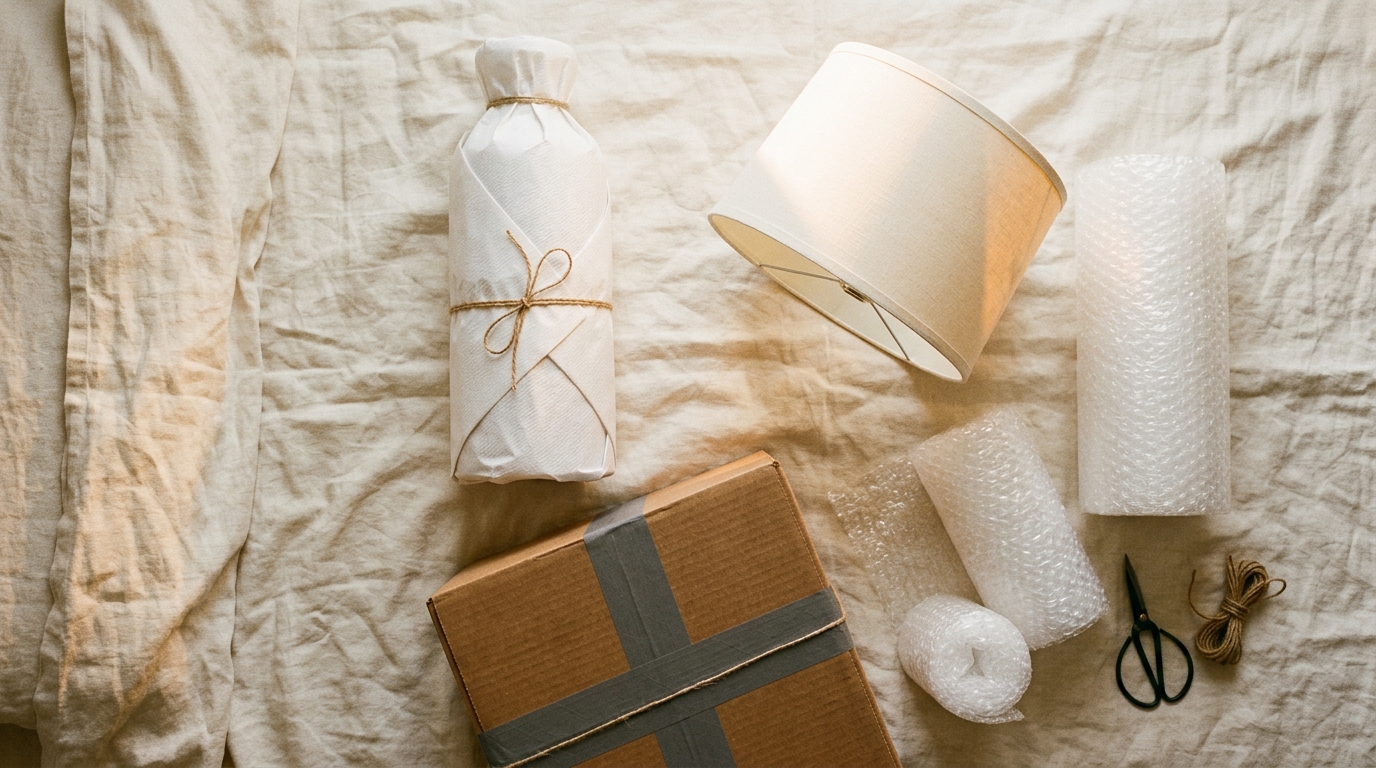
- Packing paper (unprinted newsprint) — the primary wrap for bases
- Bubble wrap — a second layer for ceramic, glass, or crystal bases
- Acid-free tissue paper — for fabric or pleated shades
- Dish-pack or double-walled boxes — for bases; a large, tall box for shades
- Cardboard dividers or crushed paper — for fill
- Painter's tape or stretch wrap — to hold wrapped layers without leaving residue on finishes
- Permanent marker — for labeling
Resist the urge to raid grocery-store boxes. A single-wall box cannot take the corner hit that drops a lamp base onto concrete. If you need guidance on which boxes to buy, the packing supplies & boxes category has several detailed guides.
How do you disassemble a lamp correctly?
Work through each lamp in this order — it takes about four minutes per lamp and prevents almost all the damage:
- Unplug and coil the cord. Secure it with a twist tie or a short piece of painter's tape so it doesn't flop and snag.
- Remove the bulb. Wrap it in a single sheet of packing paper and tuck it in a small bag or a labeled zip-lock.
- Lift off the shade. Set it upside down on the table while you work.
- Remove the harp. The U-shaped wire saddle lifts out; the harp itself unclips from the saddle. Keep the saddle, harp, and finial together in a zip-lock bag taped to the base box.
- Remove the socket cover or any decorative cap if it's loose. Wrap and bag it with the harp hardware.
You're now left with three things to pack separately: base, hardware bag, and shade.
How do you pack a lamp base?
| Base material | Primary wrap | Secondary layer | Box type |
|---|---|---|---|
| Ceramic or pottery | 3–4 sheets packing paper | Bubble wrap sleeve | Dish-pack (double-wall) |
| Glass or crystal | 4–5 sheets packing paper | Full bubble wrap envelope | Dish-pack |
| Metal (brass, steel) | 2 sheets packing paper | Stretch wrap | Medium single-wall |
| Wood | 2 sheets packing paper | None needed unless carved | Medium single-wall |
| Resin or plastic | 2 sheets packing paper | None needed | Medium single-wall |
Step-by-step for a ceramic or glass base:
- Lay four overlapping sheets of packing paper flat. Place the base in the center.
- Bring the paper up around the base, tucking it into the top opening if the base is hollow.
- Secure with painter's tape (not regular tape — it can strip finishes).
- Wrap a full layer of bubble wrap around the paper and secure it.
- Line the bottom of a dish-pack with 3–4 inches of crushed paper or foam peanuts.
- Stand the base upright in the box — not on its side. Upright is the position it was designed to bear weight; on its side concentrates stress on the narrowest point.
- Fill all gaps firmly with crushed paper so the base cannot shift even if the box is tilted.
- Add 3–4 inches of fill on top before closing.
- Mark all four sides: FRAGILE — LAMP BASE — THIS SIDE UP.
For more on wrapping techniques that apply to every breakable in the house, our guide on packing fragile items you can't replace covers the full room-by-room method.
How do you pack a lampshade?
Lampshades are the part most people pack wrong — usually by stacking them inside each other, which transfers dye, crushes pleats, and bends wire frames. Pack each shade individually.
Drum, empire, and bell shades (fabric):
- Line the inside of the shade with one or two loose sheets of acid-free tissue — this prevents fabric transfer if shades must nest.
- Place the shade upside down in a large box. The rim (widest point) sits on a 2-inch bed of crumpled packing paper.
- Stuff the interior of the shade with loosely crumpled paper — enough to hold the shape but not so tight it distorts the wire frame.
- Surround the shade with crumpled paper on all sides so it cannot roll.
- If a second shade must share the box, orient the smaller shade inside the larger one only if both are clean and tissue-lined. Never exceed two shades per box.
Pleated or delicate shades:
Pack alone, one per box, with the interior filled and exterior surrounded by paper. Do not use bubble wrap directly on fabric — the bubbles can leave impressions on pleated silk.
Wire-frame or open-weave shades:
These are the most vulnerable. Wrap the entire exterior in two layers of tissue, then one layer of packing paper, and box alone.
Label shade boxes: FRAGILE — LAMPSHADE — DO NOT LAY FLAT.
While you’re reading
Skip the research — let Robert match you with movers.
Free quotes from movers in your area. Pick whichever is easiest.
What about floor lamps and torchieres?
Floor lamp poles typically disassemble into two or three sections. Wrap each section in packing paper, bundle the sections together with stretch wrap, and transport them as long, padded bundles rather than boxing them (most boxes aren't tall enough). Protect the ends — the weighted foot and the top socket housing — with extra bubble wrap.
If your floor lamp has a large glass or fabric torchiere bowl at the top, treat that bowl exactly like a lampshade: individual box, interior stuffed, rim resting on a cushion of paper.
Should you let your movers pack the lamps?
If you're hiring a full-service packing crew, they will typically wrap and box lamps using their own materials. Before moving day, ask specifically how they handle lamp bases (upright vs. on side) and shades (separate boxes or stacked). Confirming the method takes 30 seconds and gives you a clear reference point if something arrives damaged.
If you want to compare what professional packing costs versus doing it yourself, How Much Do Movers Charge to Pack for You? breaks down typical per-room and per-hour rates.
Whichever path you choose, browse movers by state to find licensed carriers in your area, and check mover reviews to see how companies handle fragile loads before you book.
Quick-reference: common lamp packing mistakes
| Mistake | Why it matters | Fix |
|---|---|---|
| Packing shade in the same box as the base | Base shifts, crushes shade; weight cracks frame | Always separate boxes |
| Laying base on its side | Stress concentrates at the narrowest point | Pack upright |
| Using bubble wrap directly on fabric shades | Bubbles leave permanent impressions | Use tissue paper first |
| Under-filling the box | Base shifts in transit and hits the wall | Fill every gap firmly |
| Forgetting harp hardware | Lamp is unusable at destination | Bag and tape hardware to base box |
| Using a single-wall box for a heavy ceramic base | Box fails on a corner drop | Use dish-pack or double-wall |
Frequently asked questions
Do lamp bases need to be packed upright or can they go on their side?
Always upright. A lamp base is engineered to bear weight from the bottom — that's the widest, most stable point. On its side, a heavy box shifted by a driver's brake can crack a ceramic or glass base right at the neck, which is the thinnest and most fragile section.
Can two lampshades share one box?
Only if the smaller shade nests cleanly inside the larger one with a tissue-paper lining between them, and neither shade is pleated, painted, or has a delicate fabric exterior. When in doubt, one shade per box.
What's the best box size for a lamp base?
A dish-pack (18 × 18 × 28 inches, double-wall) works for most table lamp bases. For very tall bases, a wardrobe or mirror box cut down to size works well — the goal is to keep the base upright with at least 3–4 inches of cushioning on all sides and on top.
Should I leave the lampshade on during transport?
No. A shade left on during transport has no independent cushioning and will absorb any shock transmitted through the base. It also creates an awkward shape that's difficult to secure in a box or on a truck.
What if my lamp base has sentimental or high monetary value?
Treat it as you would a piece of art: double-box it (pack the wrapped base in a snug inner box, then place that box inside a larger outer box with 2 inches of foam or paper between them). For very valuable lamps — Tiffany, hand-blown glass, antique porcelain — consider specialty crating. Our guide on moving art, antiques, and collectibles covers crating options in detail.
Will movers cover a broken lamp under their liability?
It depends on the valuation option in your contract and whether the damage was due to improper packing (by you or by them). For interstate moves, Full Value Protection requires the mover to repair, replace, or pay replacement value — but if you packed the lamp yourself and the base was inadequately cushioned, the mover may dispute the claim. For in-state moves, liability terms vary by state and by what's written in your contract. Check your paperwork before moving day, and if you have questions about what coverage actually means, our valuation explainer is a good starting point.
Ready to find a mover you can trust with your lamps and everything else? Find movers near you in our directory, read mover reviews to see how companies handle fragile items, and reach out to Robert, our moving concierge, if you'd like a hand narrowing down your options.
Tagged