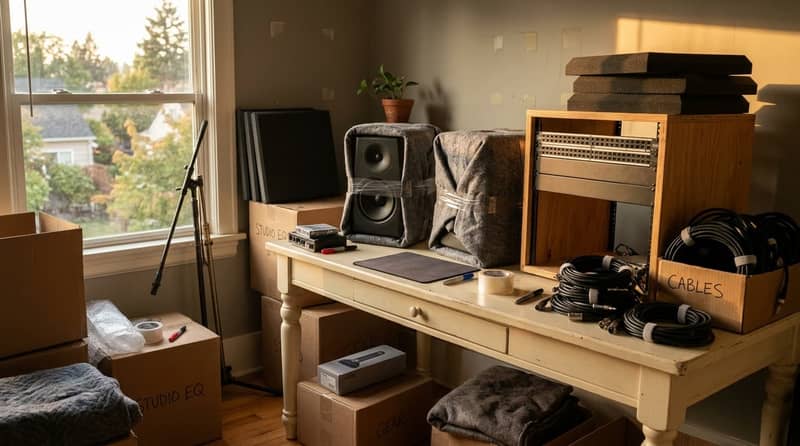
The safest way to move a musical instrument is in its original hard-shell case, padded with soft material to prevent any movement inside, then placed inside a labeled outer box or loaded last onto the truck so nothing presses against it. For instruments without hard cases — or high-value pieces — specialist packing and climate-controlled transit are worth every dollar.
That two-sentence answer covers the core of it. Below, we go instrument by instrument so you know exactly what each type needs.
Why Instruments Need Special Handling (and What Can Go Wrong)
Standard moving boxes and packing peanuts protect against bumps. Instruments face a different set of risks: humidity swings that crack wooden bodies, pressure that warps necks, vibration that loosens internal bracing, and jostling that chips lacquer or bends tuning pegs. A guitar that survives a 500-mile drive can still crack if the truck goes from air-conditioned to 95°F humidity in Texas or Florida.
For high-value, irreplaceable, or professionally used instruments, it's worth asking your mover about white-glove moving service — and checking what valuation coverage actually applies to your move before you sign anything.
How to Pack String Instruments (Guitars, Violins, Cellos, Upright Basses)
Guitars
- Loosen the strings by 3–4 half-steps. Full tension on a neck in a moving truck — especially in temperature extremes — stresses the truss rod and can bow the neck.
- Use a hard-shell case. Gig bags offer almost no structural protection in transit. If your guitar didn't come with a hard case, buy or rent one before moving day; a decent hard case costs $40–$120 and pays for itself once.
- Fill the body cavity. Crumple acid-free tissue paper or clean soft T-shirts and stuff them lightly inside the body (through the sound hole on acoustics) to prevent internal bracing from rattling.
- Fill gaps in the case. The headstock area and any side gaps should be stuffed with bubble wrap or foam so the instrument cannot shift even if the case is tilted.
- Double-box it. Place the closed, latched case inside a box at least 2 inches larger on all sides, with that gap filled with foam or bubble wrap. Label all six sides: FRAGILE — MUSICAL INSTRUMENT — THIS SIDE UP.
Violins, Violas, and Cellos
- Keep the bow in its proper slot in the case and loosen bow hair before packing.
- Remove the shoulder rest and wrap it separately.
- A violin in its case can then be placed in a soft tote bag for hand-carry; never let it ride in the truck cargo area unsupervised if it's worth more than a few hundred dollars.
- Full-size cellos in hard cases can travel in the truck; double-box or wrap the case in moving blankets and place it upright, secured against the truck wall.
- Upright basses nearly always need specialist crating — ask a mover who handles art, antiques, and collectibles or a dedicated instrument shipper.
How to Pack Keyboards and Electronic Instruments
| Instrument | Best protection | Common mistake |
|---|---|---|
| Stage piano / 88-key keyboard | Original manufacturer box + foam inserts; or custom foam-lined crate | Sliding it unwrapped into the truck on edge |
| Synthesizer | Original box or padded hard case; remove patch cables first | Stacking heavy items on top |
| MIDI controller | Original box or a padded bag inside an outer box | Shipping with keys facing down |
| Drum machine / sampler | Anti-static bubble wrap, then double-boxed | Leaving it in a gig bag |
Power cables and adapters: coil them loosely (no tight wrapping around the cord), secure with velcro ties, and pack in a clearly labeled zip-lock bag taped to the outside of the instrument's inner box. Tight coiling stresses the cable's internal conductors.
If you no longer have the original box, use a double-walled box with at least 3 inches of foam on every face. Electronics are sensitive to static: use anti-static bubble wrap (pink, not standard clear) where the instrument's circuit board area may be exposed.
How to Pack Brass and Woodwind Instruments
Brass (Trumpets, Trombones, French Horns, Tubas)
- Remove all slides and valves if your instrument allows — or fully seat them and secure with valve locks or rubber bands if they're likely to rattle.
- Drain moisture from all slides and water keys before packing.
- Place each piece in its designated case slot with the original foam insert. If foam is missing or deteriorated, cut closed-cell foam to fit.
- Never ship a trombone without a case that fully secures the slide — slide dents are expensive to repair and often irreversible.
- A hard case in good condition can ride in the moving truck; wrap the case in a moving blanket as an extra buffer.
Woodwinds (Clarinets, Flutes, Oboes, Saxophones)
- Disassemble into their natural sections and seat each section in its original case insert.
- For flutes: remove the headjoint and place it in its designated slot; never let it roll free.
- Reed instruments: remove and store reeds separately in a reed case — they will break under any pressure and warp with humidity changes.
- Alto and tenor saxophones are heavy enough that case latches can fail under transit stress; secure the case latches with a luggage strap or rope before putting it into an outer box.
While you’re reading
Skip the research — let Robert match you with movers.
Free quotes from movers in your area. Pick whichever is easiest.
How to Pack Percussion and Drum Kits
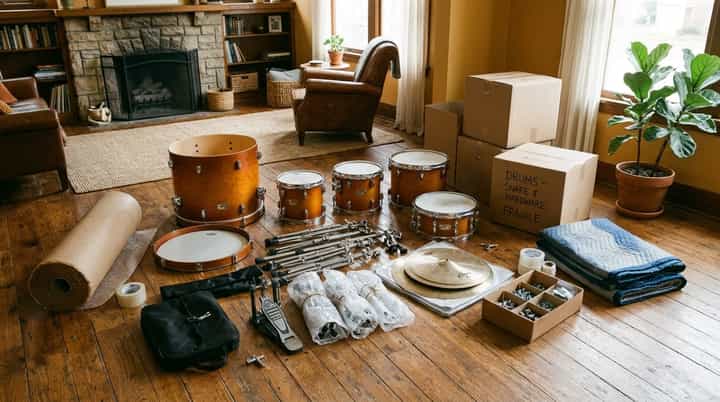
Drum kits are mostly hardware — the risk is cosmetic damage to shells and head punctures.
- Remove all drum heads if you want to be safe; if not, tape a piece of cardboard over each head and secure it.
- Nest smaller drums inside larger drums with blankets between them — just as movers do when loading a truck (see how a moving truck gets packed piece by piece).
- Hardware (stands, pedals, cymbal arms): bundle with moving blankets and secure with stretchable wrap. Never let cymbals touch each other without a cloth or felt insert between them.
- Cymbals: wrap each individually in bubble wrap, then sleeve into a dedicated cymbal bag or box standing upright — never flat and stacked.
What to Hand-Carry vs. Put in the Truck
| Hand-carry (with you in the car) | Can ride in the truck |
|---|---|
| Instruments worth $1,000+ | Instrument in original hard case, double-boxed |
| Anything irreplaceable (vintage, custom, signed) | Entry-level or student instruments in hard cases |
| Violins, small ukuleles, flutes | Drum hardware in road cases |
| Instruments without a hard case | Full drum kits properly padded |
If an instrument is irreplaceable, treat it like jewelry: pack it with you, not with the truck. No valuation coverage — federal or state — will bring back a vintage 1958 archtop.
Valuation Coverage: What Happens If a Mover Damages Your Instrument
On an interstate move, federal FMCSA rules give you two valuation options. Full Value Protection means the mover must repair, replace, or pay the current replacement value of your instrument. The alternative — Released Value at 60 cents per pound per article — is the free option, but you must sign a written waiver choosing it; it is not automatic. A guitar that weighs 8 lbs would receive just $4.80 under Released Value. That gap matters enormously for instruments.
Valuation is the mover's liability level — it is not the same as moving insurance. Separate moving insurance policies are available and state-regulated; ask your mover or an independent insurer.
On an in-state move, federal rules do not apply. Liability is set by your state regulator and by whatever the mover's contract says. Check with your mover and your state's consumer protection agency for the specifics that apply to you.
Before moving day, document every instrument with photos and, for valuable pieces, a written appraisal. If something is damaged, a note on the delivery receipt is not a claim — you'll need to file a separate written claim.
You can find movers who handle specialty items in our directory, and check carrier reviews at mover reviews before you book. Always look up a mover's USDOT number yourself at FMCSA's online registry — that's the only way to confirm they're properly licensed.
Frequently Asked Questions
Can movers transport musical instruments, or do I need a specialty shipper?
Most full-service movers will transport instruments, but high-value or rare instruments often travel more safely with a specialty shipper or instrument transport service. For everyday instruments in hard cases, a careful full-service mover is typically fine. Ask specifically whether the crew has experience with musical instruments and confirm valuation terms in writing.
Should I ship my guitar with the strings at full tension?
No. Loosen the strings by several half-steps before packing. Full string tension combined with temperature swings in a moving truck can stress the neck and truss rod. Re-tuning at your destination takes five minutes; repairing a warped neck can cost hundreds.
What if I don't have a hard case for my instrument?
Buy or rent a hard case before the move — it's the single most effective protection. A basic hard case for a guitar runs $40–$120. Instrument rental shops sometimes sell used cases cheaply. Without a hard case, double-box the instrument with generous foam padding on all sides, but understand the risk is meaningfully higher.
Will the mover's valuation cover the full value of my instrument?
Only if you choose Full Value Protection on an interstate move — and that protection is based on replacement value, which requires documentation. Keep appraisals, receipts, and photos. Released Value (60 cents per pound) will not come close to covering most instruments. For in-state moves, check your mover's contract for the liability terms that apply.
Can I keep my instrument in its gig bag for the move?
Gig bags are designed for pedestrian transport — short walks, public transit — not moving trucks where heavy boxes shift and stack. For the truck, a hard case is essential. If all you have is a gig bag, hand-carry the instrument in your own vehicle.
How should I pack a keyboard without the original box?
Use a double-walled box at least 3 inches larger than the keyboard on every face, and fill that gap with foam or anti-static bubble wrap. Remove all cables and pack them separately. Label the box with the correct orientation and "FRAGILE" on all six sides. If the keyboard has weighted keys, note its weight before lifting — a full 88-key stage piano often exceeds 50 lbs.
Moving something else that needs careful handling? Browse specialty item packing guides for more room-by-room advice, or connect with Robert, our moving concierge, for help finding the right mover for your instruments and your move.
Tagged