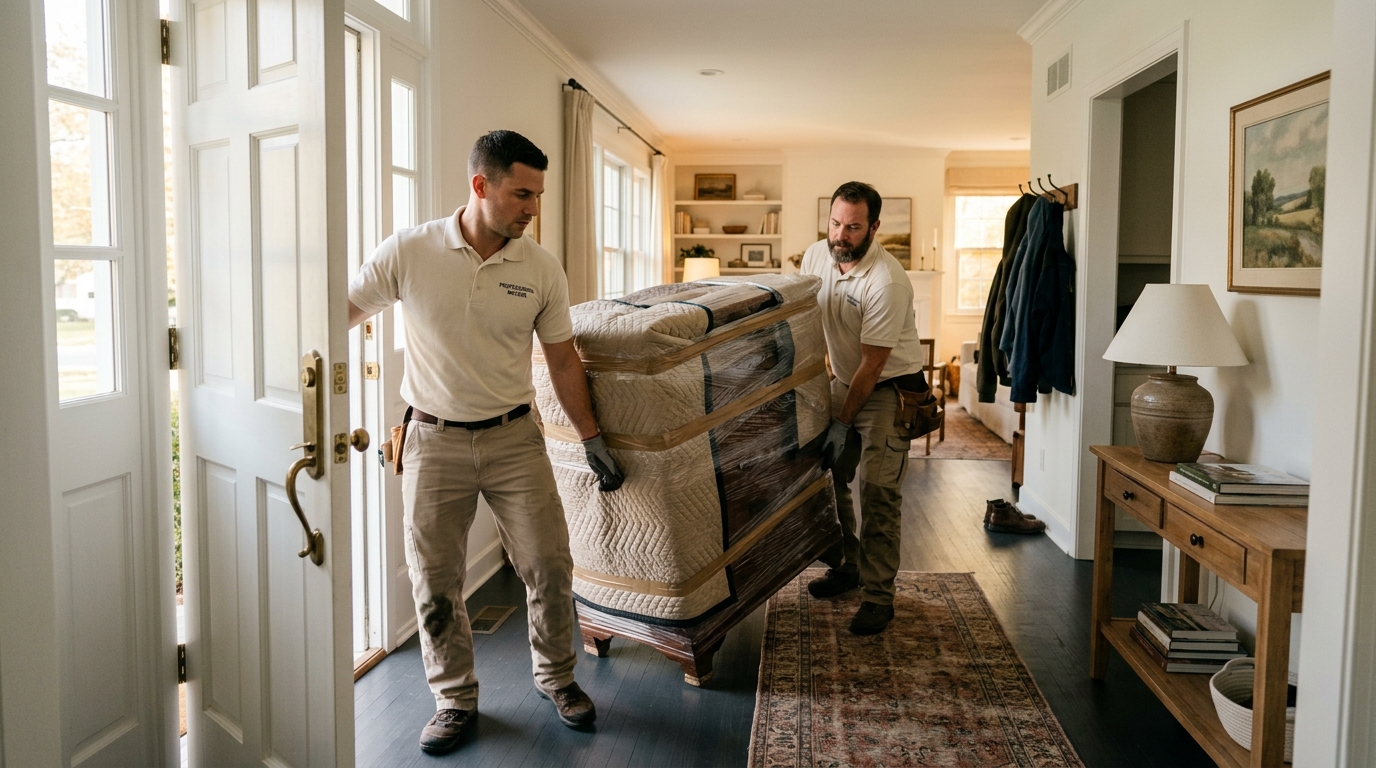
White glove moving typically costs $150–$250 per hour for local moves and $5,000–$15,000 or more for long-distance moves, depending on home size, distance, and the specific services you add. It is the highest tier of full-service moving: movers pack everything, handle every piece with premium materials, and often unpack and arrange furniture at the destination. If you own items that are expensive, fragile, or irreplaceable, white glove service is worth understanding before you assume standard full-service is enough.
What does white glove moving actually include?
"White glove" is a marketing term, not a regulated category — so what's included varies by company. In practice, most white glove movers offer some combination of the following:
- Professional packing of every room using custom crating, acid-free tissue, double-wall boxes, and furniture padding
- Disassembly and reassembly of furniture, beds, shelving, and sometimes appliances
- Specialty handling for art, antiques, pianos, mirrors, and electronics
- Inside delivery — movers carry items to the specific room you choose, not just to your doorstep
- Unpacking and debris removal — boxes are emptied, items are placed, and packing materials are hauled away
- Floor, wall, and door-frame protection during the move
- Dedicated crews (often the same team at origin and destination for long-distance moves)
- White-glove storage — climate-controlled, fine-art-ready facilities for items in transit
Not every company bundles all of these together. Always get a written itemized quote so you know exactly what's included.
How much does white glove moving cost? A breakdown by move type
Local white glove moves (same metro area)
| Home size | Estimated hours | Typical cost range |
|---|---|---|
| 1–2 bedrooms | 4–8 hours | $600–$2,000 |
| 3 bedrooms | 7–12 hours | $1,050–$3,000 |
| 4+ bedrooms | 10–16+ hours | $1,500–$4,000+ |
Rates assume a 3–4 person crew at $150–$250/hour. Add 20–30% for specialty items (grand pianos, safes, large art). Our guide to how movers charge by the hour explains what drives local billing in detail.
Long-distance white glove moves (state to state or cross-country)
| Home size | Typical cost range |
|---|---|
| Studio / 1 bedroom | $3,000–$7,000 |
| 2–3 bedrooms | $6,000–$12,000 |
| 4+ bedrooms | $10,000–$20,000+ |
Long-distance white glove quotes are typically priced for the whole move — based on weight, distance, and services — rather than by the hour. For comparison with standard long-distance rates, see our long-distance moving cost breakdown by move size.
What drives the price up
- Crating custom-built for a single piece of art or antique: $300–$2,500+ per crate
- Climate-controlled storage-in-transit: $100–$400/month per unit
- Elevator or stair surcharges in high-rise buildings: $75–$200 or more
- Long-carry fees when the truck can't park close: $50–$150
- Shuttle fees if a large truck can't reach your address: $200–$600
White glove vs. standard full-service moving: what's the difference?
| Feature | Standard full-service | White glove |
|---|---|---|
| Packing | Usually available as an add-on | Included as standard |
| Packing materials | Standard boxes and wrap | Custom crating, specialty wrap |
| Inside delivery | To nearest room | To exact placement you specify |
| Unpacking | Rarely included | Often included |
| Debris removal | Not typical | Usually included |
| Specialty items | Basic handling | Trained crews for art, antiques, pianos |
| Floor/wall protection | Varies | Standard practice |
| Crew consistency (long-distance) | Often third-party at destination | Often same team, origin to destination |
If you're moving standard furniture and everyday belongings, standard full-service typically gets the job done. White glove is worth the premium when you're moving items where damage is either irreplaceable or very expensive to fix — or when you simply cannot be present to manage a complex move. Our deep dive on how to move art, antiques, and collectibles shows exactly why standard handling falls short for high-value pieces.
When is white glove moving actually worth it?
White glove makes the most financial sense when:
- The items being moved are high in value or fragility. A single damaged oil painting or antique can cost more to restore than the entire white glove premium.
- You're moving into a building with strict move-in rules. High-rises in cities like New York, Miami, or Los Angeles often require padded elevators, COI certificates, and scheduled move windows — white glove crews handle these as routine.
- You can't be on-site to supervise. A dedicated, experienced crew operating under a detailed inventory reduces the risk of errors when you're not there to direct.
- You have oversized or custom pieces. Items that don't fit standard moving boxes — grand pianos, wall-to-wall shelving, custom mirrors, wine collections — benefit from crating and specialty transport.
- You're doing a long-distance move with irreplaceable contents. The cost of one broken antique on a cross-country haul can dwarf the upgrade price.
White glove is often overkill for a straightforward 2-bedroom apartment move with IKEA furniture. In that case, standard full-service or a hybrid move is almost always the better value.
While you’re reading
Skip the research — let Robert match you with movers.
Free quotes from movers in your area. Pick whichever is easiest.
How valuation works for white glove moves
Valuation is the mover's liability level — it is not the same as insurance, and this distinction matters even more at the white glove tier.
For interstate moves, federal FMCSA rules (49 CFR 375) name two valuation options:
- Full Value Protection: the mover must repair, replace, or pay replacement value for any item lost or damaged.
- Released Value: 60 cents per pound per article — the free, basic option, but only applied if you sign a written waiver choosing it.
On a white glove move, you are almost certainly better off with Full Value Protection, since the items being moved are typically the most expensive ones you own. Confirm the valuation level in writing before signing anything, and ask your mover whether they recommend separate third-party moving insurance for items with extraordinary value. Our explainer on moving valuation vs. insurance walks through what each option actually covers.
For in-state moves, valuation rules are set by your state regulator, not the FMCSA. Check with your mover and your state authority for the specifics.
How to get an accurate white glove quote
- Request a survey — not a phone estimate. For interstate moves, federal rules require that written estimates be based on a physical survey (in person or by live/recorded video) unless you waive it in writing. A phone quote with no visual inspection is an FMCSA red flag. For in-state moves, insist on a video or in-person walkthrough anyway — it's the only way a white glove quote can be accurate.
- Ask for an itemized, written quote. White glove pricing should break out packing, crating, specialty items, storage, and delivery separately so you can see exactly what you're approving.
- Ask about estimate type. For interstate moves, every estimate must be labeled binding or non-binding. A fixed-price (not-to-exceed) estimate is worth requesting — it caps your maximum cost while allowing you to pay less if the actual weight comes in lower.
- Verify the mover's USDOT number yourself at the FMCSA's search tool. Confirm they are registered as a "Motor Carrier of Household Goods," not a broker who will hand you off to another carrier. Our guide to how to vet a mover's license and insurance shows exactly how to do this in under five minutes.
- Check mover reviews independently. Read mover reviews and cross-reference on other platforms to look for patterns in how the company handles high-value items and claims.
- Get at least three quotes. White glove pricing varies significantly between carriers — sometimes by 30–50% for the same origin and destination.
Red flags specific to white glove moves
- A quote given over the phone or online with no visual survey
- No itemized breakdown — just a single lump price labeled "white glove"
- A large upfront cash deposit (FMCSA considers this a red flag for any interstate move)
- The company can't show you proof of specialty training or experience with fine art or antiques
- Vague answers when you ask about valuation and what happens if something breaks
Frequently asked questions
How much more does white glove moving cost compared to standard full-service?
White glove typically runs 30–60% more than standard full-service moving for the same home size and distance. The premium is mainly driven by specialty packing materials, custom crating, and the experience of the crew handling fragile or high-value items. For many moves, the gap is $1,000–$4,000 on top of a standard full-service quote.
Is white glove moving worth it for a 2-bedroom apartment?
It depends on what's in the apartment. If you own art, antiques, a grand piano, or high-end electronics, the premium can be justified by the protection it provides. If your 2-bedroom is furnished with everyday furniture and standard electronics, standard full-service moving is almost always a better value.
Does white glove moving include unpacking?
Usually, yes — but confirm it in writing. Most white glove packages include unpacking boxes, placing items in the rooms you designate, and hauling away all packing materials. Some carriers offer unpacking as an optional add-on even within their white glove tier, so it pays to ask specifically.
What valuation should I choose for a white glove move?
For interstate moves, Full Value Protection is the appropriate choice for most white glove customers — it requires the mover to repair, replace, or pay replacement value for damaged items. Released Value (60 cents per pound per article) is the free alternative but pays almost nothing for high-value items. Ask your mover about the cost of Full Value Protection and whether additional third-party insurance makes sense for items of extraordinary value.
Can I book white glove moving for just a few items, not a whole house?
Yes. Many white glove carriers offer single-item or partial-home service, particularly for specialty items like pianos, fine art, antiques, or safes. Expect a minimum charge — often $500–$1,500 — even for a small job, because of the crew expertise and materials required.
How do I find a white glove mover I can actually trust?
Start by finding movers in your area and filtering for companies that specifically list specialty or white glove service. Verify their USDOT number on FMCSA's site, read mover reviews carefully for comments about high-value items, and always request an in-person or video survey before accepting a quote. You can also browse movers by state to find carriers licensed in your origin and destination states.
Ready to compare white glove carriers side by side? Find movers in your area, or reach out to Robert, our moving concierge, for help narrowing your options.
Tagged