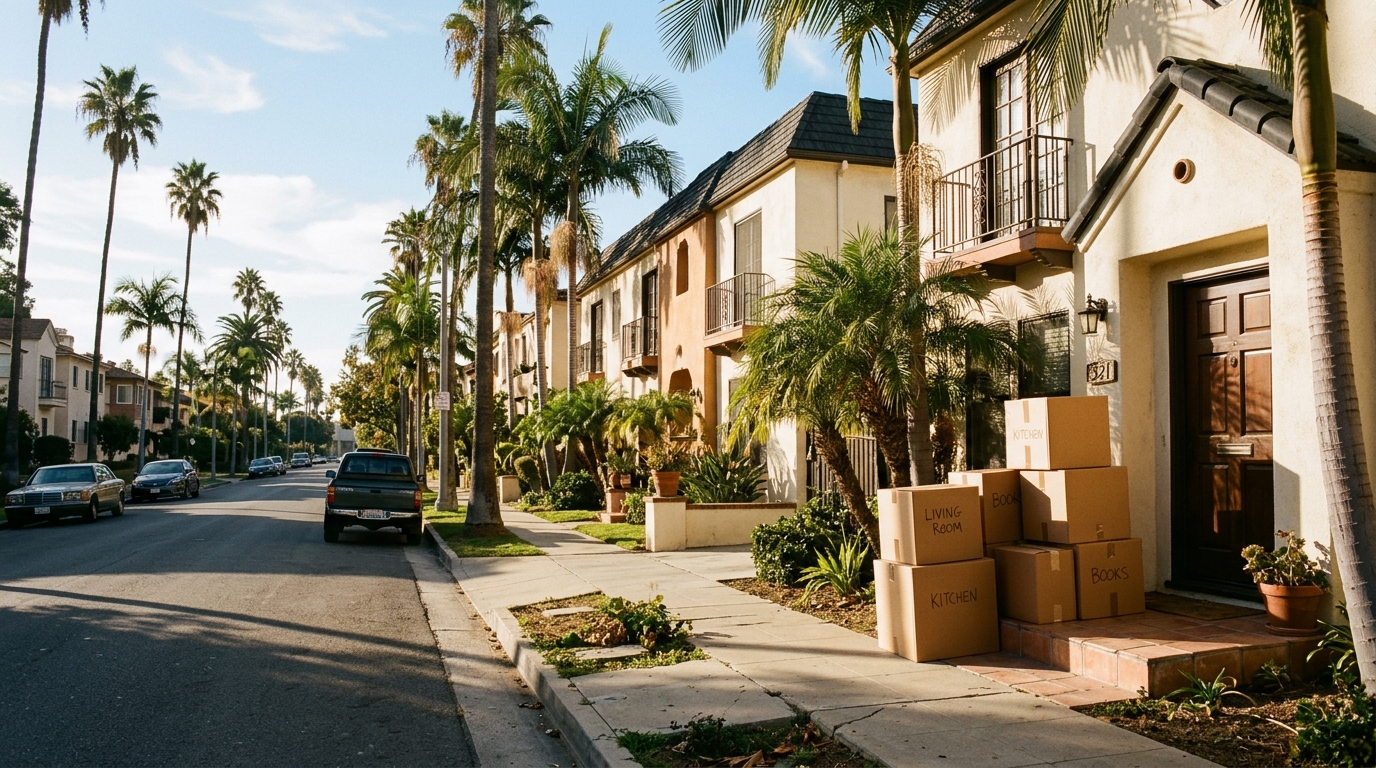
The single fact that shapes this move more than any other: in Bakersfield, seven in ten homes are detached houses. In Los Angeles, nearly half of all homes are in buildings of five or more units. The odds are high that you are leaving a place with a driveway and arriving at a place with a loading dock, a freight elevator, and a street parking permit zone. That changes what you bring, how you price the move, and what you need to arrange before the truck arrives.
The Housing Cost Gap — and What It Means for What You Ship
The median home value in Los Angeles is $879,500, compared with $347,300 in Bakersfield — a 153% difference. Most people moving this route rent rather than buy on arrival: 64% of Los Angeles households rent, versus 40% in Bakersfield. And the median rent runs $1,879 a month in Los Angeles against $1,371 in Bakersfield, a 37% gap.
The practical consequence is space. Apartments in the price range many Bakersfield renters are used to will often be significantly smaller in Los Angeles. Before you load a single box, walk through every piece of furniture you own and ask honestly whether it fits the floor plan you can afford. A sectional sofa, a king bed frame, a riding mower stored in the garage — these are common culprits. Selling or donating oversize pieces before your move date almost always costs less than moving them and then discovering they do not fit or cannot get through the building's elevator.
This is also the moment to sort what goes into a storage unit. Los Angeles has no shortage of self-storage options, but adding a monthly storage bill on top of a higher rent changes your math quickly. Be deliberate about what earns a place on the truck.
From Driveways to Elevator Buildings — How Loading Day Changes
In Bakersfield, the movers pull up to a driveway or a curb in front of a detached house. There is usually room to park a 26-foot truck close to the front door, and there are seldom rules about when they can do it.
Los Angeles is a different environment. Because nearly half of all housing units are in buildings of five or more units, there is a genuine chance your destination building has:
- A freight elevator that must be reserved in advance. Many buildings have a sign-up sheet managed by the building manager, and popular weekend slots fill weeks out. Call the building manager as soon as your move date is set.
- A loading dock or designated move-in bay with a time limit — often two or four hours. If the crew cannot complete the move in that window, they may need to circle or park elsewhere, which adds time and cost.
- Street parking restrictions. Most Los Angeles residential streets require a parking permit for vehicles over a certain length, or prohibit commercial vehicles during certain hours. Your mover will need a temporary moving permit from the Los Angeles Department of Transportation. This is not something to arrange the morning of the move; it can take several business days and there is a fee. Confirm with your mover who handles this and when.
On the Bakersfield side, your current home is probably a detached house — the move-out end is typically more straightforward. That said, if you are leaving an upper-floor apartment or a home on a narrow street, mention it to your mover when requesting an estimate.
The difference in building types between the two cities is also the main reason this move can take longer than the distance suggests. Add time for the elevator, the loading-dock window, and permit parking, and a same-day move that looks simple on a map can stretch into the afternoon or evening.
Timing the Move Around Air Quality and Wildfire Season
Bakersfield sits in the San Joaquin Valley and is one of the most air-quality-challenged metro areas in the country. Valley geography traps wildfire smoke and agricultural pollutants, and summer days can be brutal — heat routinely exceeds 100°F with poor air. If you are packing and loading in July or August, that heat affects your crew's pace, your plants, your electronics, and anything heat-sensitive in the truck.
Los Angeles has a different seasonal risk. Summers are warm and dry — more comfortable than Bakersfield for outdoor loading — but fall brings Santa Ana wind conditions and elevated wildfire risk across the region. Smoke can move into neighborhoods quickly and unpredictably, and in a worst case, access roads to a neighborhood can be restricted.
The practical upshot for timing: late spring — roughly April through early June — is the most favorable window for this route. The San Joaquin Valley heat has not peaked, the Santa Ana season has not begun in Los Angeles, and the brief Southern California rainy season is winding down. If you must move in summer, start as early in the day as possible on the Bakersfield end while temperatures are manageable. If you are moving in fall, keep an eye on regional air quality and fire advisories and build flexibility into your schedule.
One more timing note: Los Angeles has one of the highest housing-turnover rates in California, and the end of the month — when leases turn over — is consistently busier for movers. If you can sign a lease with a mid-month start date, you are more likely to get your first choice of dates, times, and elevator slots.
Income, Cost of Living, and the Budget Reality Check
The median household incomes in the two cities are closer than you might expect — $77,397 in Bakersfield and $80,366 in Los Angeles. That relatively small income gap against a 37% jump in median rent means most people moving this route feel a serious squeeze in the first months. Knowing that going in lets you plan: build a larger cash reserve before you move, be conservative about the size of apartment you commit to sight-unseen, and if possible, secure your lease in person after seeing the unit.
How the Move Itself Is Priced
Because this is an in-state move within California, state consumer-protection rules apply rather than federal ones. Ask any mover you consider whether their estimate is binding (you pay the agreed amount, adjusted for anything you add after signing) or not-to-exceed (the final price can come in under the estimate but not above it). Get that in writing before anything is loaded.
What drives the price on this specific route:
- Volume and weight. If you take the time to downsize before the move, you pay less. The difference between a full three-bedroom and a selectively downsized two-bedroom load is significant.
- Building access at the destination. Elevator buildings, time-limited loading docks, and permit-parking logistics all add time to the job, and time is how most moves are priced.
- Floor of origin and destination. Stairs and long carries on either end add time. Be specific when you describe both homes to your mover.
- Date and time. Weekends and end-of-month dates cost more on this route because demand in Los Angeles is consistently high.
For any written estimate, California movers are required to base it on a proper survey of your belongings — either in person or by video. A price given over the phone without any visual survey is a red flag; do not accept one as a firm number.
If you have concerns about a mover's license status, the California Public Utilities Commission licenses household-goods movers operating within the state. You can look up any mover's license before you sign anything.
Finding the Right Mover for This Route
This is a short-distance in-state move, but it is not a simple one. The building-access realities in Los Angeles mean you want a mover who has worked elevator buildings and secured LADOT moving permits before — not one who is figuring it out on your moving day. When you talk to movers, ask specifically how they handle freight-elevator reservations and street-parking permits at the destination. The answer tells you a lot.
Our team has 35+ years of hands-on service-provider experience, including an operator who ran a moving company for 18 years. That background shapes the questions we ask when we connect people with movers on routes like this one.
Movers in Bakersfield are your starting point for the origin-side search. Once you know your destination neighborhood or zip code, movers in Los Angeles can show you operators who work the destination end regularly. You can also find movers by entering both cities, or browse by state if you want to explore all California options in one place.
The Bakersfield-to-Los Angeles move is common enough that experienced movers run this corridor often. The difference is in the details: what you ask, what you confirm in writing, and how far in advance you coordinate with your new building. Get those pieces right and moving day is manageable — even in one of the busiest cities in the country.