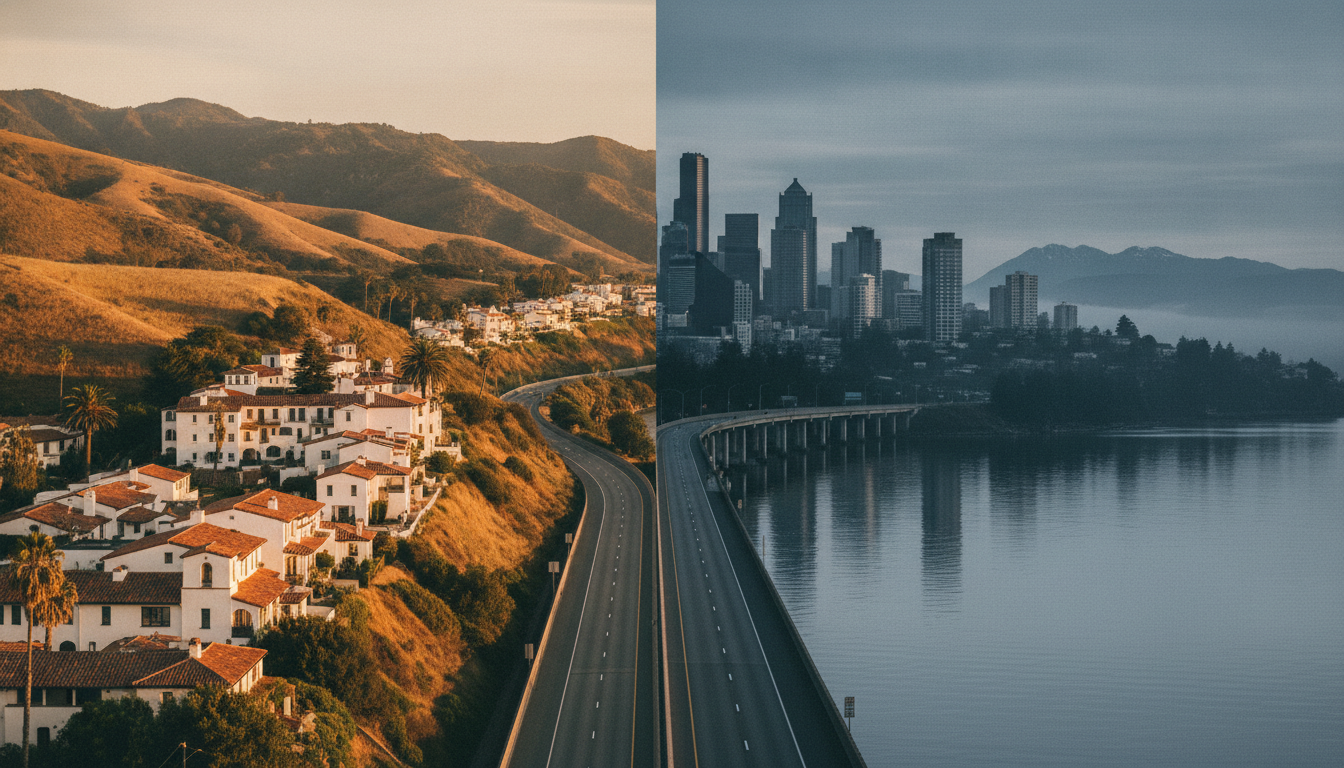
San Diego to Seattle is approximately 1,064 miles as the crow flies — a true long-distance move that typically takes a professional moving truck two to four days on the road. Depending on the size of your home and the time of year, expect to budget roughly $3,500–$8,500 for a full-service interstate move. The single biggest life change you'll navigate isn't the distance — it's the weather: you're trading one of the most reliably sunny climates in the country for a city that earns its grey reputation from October through April.
Below are the costs, the honest tradeoffs, and the details that separate a smooth transition from a stressful one on this particular route.
The I-5 drive and the delivery window
The driving distance between San Diego and Seattle via I-5 is roughly 1,250 miles, depending on the exact routing. A professional moving crew will typically cover that in two to three days of driving — but factor in loading, any required transit stops, and delivery scheduling, and your belongings will often arrive within a 3–7 business day delivery window after pickup. Whatever window a carrier quotes, ask for it in writing before you sign anything.
For planning purposes: if you're driving yourself up, budget at least two full days of driving with one overnight stop, or a more relaxed three days if you want to enjoy the route through Oregon's Willamette Valley.
Price ranges for a San Diego to Seattle move
Long-distance moving costs on this route vary most by home size and time of year. The ranges below are what full-service interstate moves on routes like this typically run:
| Home Size | Estimated Cost Range |
|---|---|
| Studio / 1-bedroom | $2,500 – $4,500 |
| 2-bedroom | $3,500 – $6,000 |
| 3-bedroom | $5,000 – $8,500 |
| 4+ bedrooms | $7,500 – $12,000+ |
These are estimates for full-service moves (loading, transport, and unloading). Ask each carrier how the month of your move changes its quote.
A few terms worth knowing before you hire:
- Binding estimate: The mover prices your shipment from a detailed inventory. At delivery you pay that estimate, plus any services you added after signing, plus up to 15% for impracticable operations; anything above that 15% is billed later.
- Delivery window: The range of dates your shipment could arrive. On a 1,250-mile route, a 3–7 day window is typical — get it specified in your contract.
- Valuation coverage: This is not insurance; it sets the level of the mover's liability if something is damaged. Full Value Protection applies automatically, so the mover must repair, replace or pay the replacement value. Released Value, at 60 cents per pound per article, is the free, basic option, and it applies only if you sign a written waiver choosing it. Separate moving insurance is optional and regulated by the state.
To compare movers in San Diego who handle long-distance routes, start your search early — ideally 6–8 weeks before your move date.
San Diego and Seattle on the 2024 price index
On the federal price index for 2024 (U.S. = 100), the two areas come out about level: 111 for the Seattle area and 112 for the San Diego area. Washington's lack of a state income tax is the other number to weigh, and its effect depends on your income level.
| Category | San Diego, CA | Seattle, WA |
|---|---|---|
| Cost-of-Living Index | 112 | 111 |
| Median 2BR Rent | $2,950/mo | $2,850/mo |
| Median Home Price | $850,000 | $850,000 |
| State Income Tax | Up to 13.3% | 0% |
| City Population | 1,386,932 | 737,255 |
Median home prices are virtually identical, so Seattle won't automatically deliver savings on real estate. Where the two states differ is the paycheck: Washington has no state income tax, compared to California's rate of up to 13.3%. Run your own numbers with a tax professional before counting on any particular saving.
Rent is roughly comparable, with Seattle's median two-bedroom running slightly less than San Diego's.
Seattle neighborhoods from Ballard to Burien
Seattle is built from separate neighborhoods, each with a character of its own, and a handful of questions will narrow the choice quickly:
- Commute first: Seattle's traffic is genuinely challenging. Living near a light rail station (the Link Light Rail system has expanded significantly) or close to your workplace will define your daily quality of life.
- Urban vs. residential: Capitol Hill, Fremont, and Ballard attract younger professionals and offer strong walkability and dining. Neighborhoods like Ballard and West Seattle have more of a residential, community feel. Further out, areas like Bellevue and Kirkland (across Lake Washington) offer a suburban character with easy access to the city's major tech employers.
- Budget: Seattle proper tends to be pricier than surrounding suburbs. If your budget is tighter, Renton, Shoreline, and Burien offer more affordable entry points with reasonable commutes.
Before you commit to a building, ask about parking, elevator access and building rules, since these decide how easy the move-in will be. Your carrier can also tell you what the truck will need at the Seattle end.
Seattle's rain, smoke, ice storms and job market
The rain is genuine — but manageable. Seattle averages around 38 inches of rain per year (less than New York City, actually), but it falls as persistent grey drizzle from October through April rather than dramatic downpours. You won't melt, but you will want to reframe your relationship with overcast skies. Summers, in contrast, are genuinely beautiful — mild, dry, and bright, with long evenings and temperatures in the mid-70s °F.
Wildfire smoke is a newer reality. While Seattle itself isn't in a fire-prone zone, smoke from wildfires in Eastern Washington and Oregon drifts in during late summer most years. Air quality alerts in August and September are increasingly common. If you or a family member has respiratory concerns, factor this in.
Trade one seasonal risk for another. San Diego comes with wildfire risk and Santa Ana wind events — particularly in fall. Seattle trades those for ice storms (rare but disruptive when they happen, since the city's hilly terrain doesn't handle snow and ice well) and the omnipresent grey of winter. Neither is unmanageable; both are worth knowing.
The tech ecosystem is enormous. If you're moving for work in tech, healthcare, aerospace, or logistics, Seattle's economy is deep and diverse. Amazon, Microsoft, Boeing, and a dense startup ecosystem mean the job market is generally strong.
Picking a carrier for the I-5 haul
Interstate moves require a federally licensed carrier — look for a valid USDOT number, which you can verify through the Federal Motor Carrier Safety Administration (FMCSA). Beyond licensing, here's what matters on a 1,250-mile route:
- Collect three or more written estimates. Each one must say whether it is binding or non-binding, and a not-to-exceed price is also worth asking about. Don't commit to the first quote, and don't choose on price alone.
- Check the reviews, and look for long-distance moves. Reviews that mention interstate jobs tell you more than local ones — local and long-distance operations can be very different.
- Ask about their Seattle delivery logistics. Some carriers use partner agents at the destination end. Ask who will actually be delivering your shipment and what the handoff process looks like.
- Get the delivery window written into the contract. A spoken promise counts for nothing if the paperwork says "up to 21 days."
Start your search at find movers to compare licensed, reviewed carriers on this route, or browse by state if you want to explore movers operating out of California or Washington specifically.
Questions about the I-5 run north
How many hours is the I-5 drive from San Diego to Seattle?
The drive is approximately 1,250 miles via I-5 and typically takes 19–20 hours of driving time. It splits naturally over two days with an overnight stop in the Portland, Oregon area, or can be stretched to three days for a more relaxed pace.
Does Seattle come out costlier than San Diego once the price index and income tax are counted?
Not on the federal price index for 2024 — the Seattle area (111) and the San Diego area (112) are about level. Washington's zero state income tax is a factor for moderate-to-high earners. Median rents and home prices are comparable, so the final financial picture depends heavily on your income level.
Which months suit a San Diego to Seattle move, with Seattle's grey season running October to April?
Late spring (April–May) and early fall (September–October) are the shoulder months on either side of Seattle's dry summer. Ask each carrier how the month changes its quote.
Should my San Diego to Seattle estimate be binding or non-binding?
Federal rules name two types, binding and non-binding, and every estimate must say which it is. With a binding estimate, you pay the quoted amount at delivery, plus services added after signing, plus up to 15% for impracticable operations. With a non-binding estimate, the final bill is based on actual weight: the mover must release your goods once you pay 110% of the estimate, and any remaining balance is billed after 30 days from delivery. Over 1,200 miles, that balance can be large if weight or logistics differ from the original expectations, so a binding or not-to-exceed price is worth asking for.
What happens if my belongings are late arriving in Seattle?
No law sets a number of days for interstate delivery; the date or window is whatever is agreed and written on the bill of lading. The mover must give you 24 hours' notice of delivery and must tell you as soon as it knows of a delay. Always confirm the delivery window in writing and ask what the carrier's process is for delayed shipments before you sign.
Will my San Diego-based mover handle the full move to Seattle, or do they hand off to another company?
This varies by carrier. Some large interstate movers operate their own trucks end-to-end. Others use a network of agents, meaning a different crew may handle delivery in Seattle. Ask this question directly before booking — it affects your continuity of communication, claims process, and overall experience. You can also begin with movers in San Diego and ask each one how it handles the Seattle end.