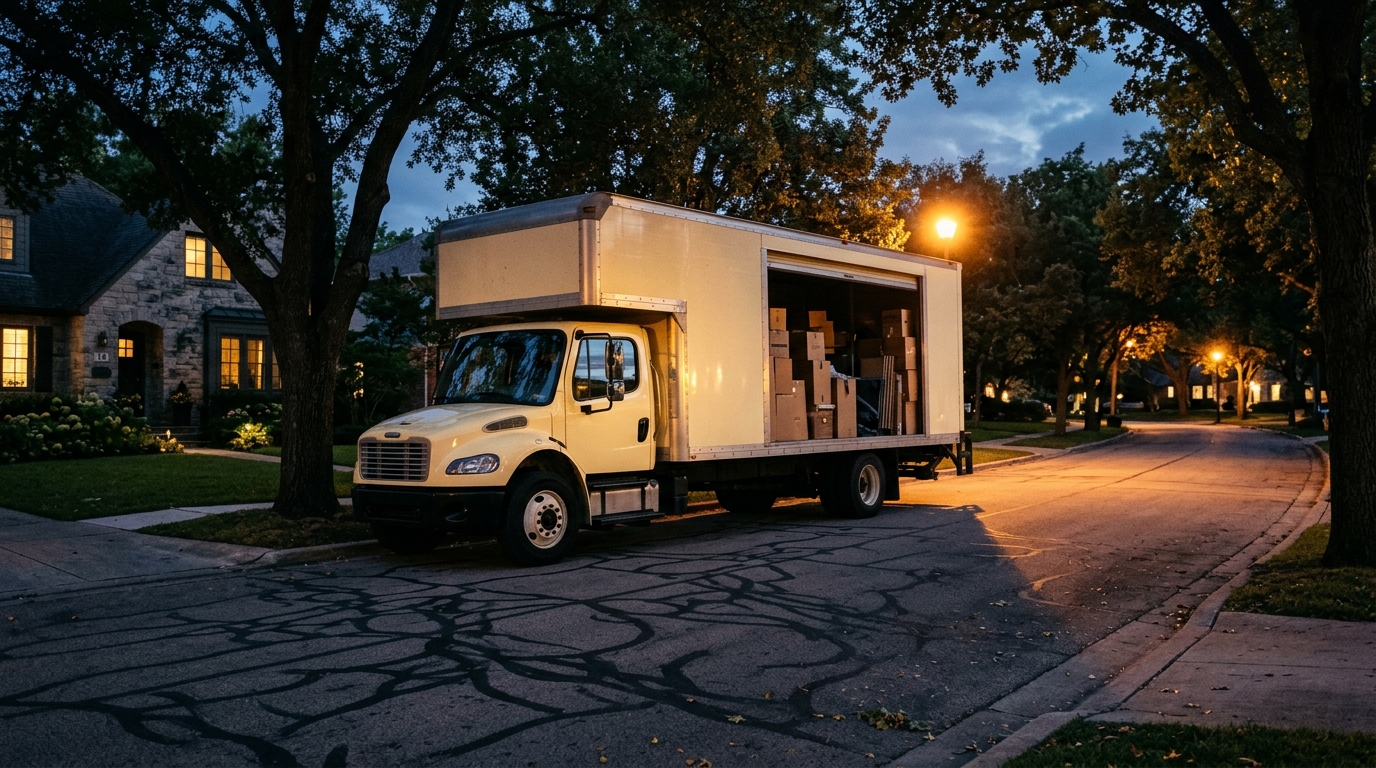
Yes — movers can legally hold your belongings overnight, and on a long-distance move they often do. Your goods may sit on the truck or in a transfer warehouse for one night or several, depending on the route, the schedule, and what your contract says. What the mover cannot do — legally — is hold your belongings hostage for more money beyond what the bill of lading authorizes. Knowing the difference between a routine hold and an actual scam is the most important thing anyone in this situation needs to understand.
Why would a mover keep my stuff overnight in the first place?
There are two very different scenarios, and they call for completely different responses.
Routine logistics (normal, expected)
Long-distance movers rarely drive a direct, single-day route from your origin to your destination. They often consolidate loads from multiple customers onto one trailer. That means your furniture may:
- Spend a night (or several) in a transfer warehouse while the truck fills up or a relay driver is assigned
- Be held at a regional terminal while a delivery crew becomes available at your destination
- Sit on a truck overnight when a same-day delivery runs past business hours or into an unsafe driving window
None of this is inherently wrong. It is, however, something you should have seen coming — because federal rules require the delivery date or delivery window to be written on your bill of lading before loading begins. If you have a signed contract with a delivery window of, say, 7–14 days for a cross-country move, overnight holds are built into that window.
For more on how those windows work in practice, see our guide on how to understand your long-distance moving delivery window.
Held for more money (a red flag — possibly a scam)
A mover refusing to deliver your goods until you pay an amount not authorized in your original contract is a federal violation. This is the moving-hostage scenario. It is distinct from a legitimate balance-due situation, and it is one of the most common moving scams in the US. Our guide on how to spot moving company red flags before you book covers this pattern in detail.
What does federal law actually say about overnight holds?
For interstate moves (origin and destination in different states), FMCSA rules under 49 CFR 375 govern what movers can and cannot do at delivery.
The delivery date
Federal rules do not set a fixed number of days for delivery. Whatever date or window is agreed upon and written on the bill of lading is the controlling document. The mover must:
- Give you 24 hours' advance notice before attempting delivery
- Tell you as soon as possible if a delay occurs
If the mover misses the agreed window, you may have grounds to request compensation — but that process starts with a written claim, not a phone call.
What you owe at delivery — and when your goods must be released
- Binding estimate: You pay the estimate amount, plus any services you added after signing, plus up to 15% for impracticable operations. Anything above that is billed later — not collected before the truck unloads.
- Non-binding estimate: At delivery, the mover must release your goods once you pay 110% of the original estimate. Any remaining balance is billed after 30 days from delivery. The 110% is what is due at delivery — it is not a cap on the total bill.
The critical point: if you have tendered the amount the mover is legally entitled to collect at delivery, the mover must release your goods. Holding them for additional, unauthorized payment is illegal under federal law.
For in-state moves, FMCSA rules do not apply — your state regulator does (Texas: TxDMV; Florida: FDACS; New York: NYSDOT; New Jersey: Division of Consumer Affairs). Check with your state regulator for the specific rules in your situation.
What should be in your contract before the truck leaves?
Before a single box goes on the truck, you should have — and have read — your bill of lading. Federal rules require you to receive it at least three days before loading, and you can cancel within three days of signing.
Your bill of lading must include:
| Item | Why it matters for overnight holds |
|---|---|
| Delivery date or window | Defines when an overnight hold becomes a delay you can act on |
| Estimate type (binding or non-binding) | Determines exactly what you owe at the door |
| Any storage-in-transit terms | Tells you if your goods can be transferred to a warehouse and who pays |
| Valuation option selected | Governs your recovery if anything is damaged during a hold |
Never sign a blank bill of lading. If any of those fields are empty when they hand it to you, do not load.
What if the overnight hold turns into several days — or longer?
Step 1: Check your written delivery window
Pull out your bill of lading. If today's date is still inside the agreed window, the hold may be frustrating but it is within the contract. The mover must notify you of any delay as soon as it knows — if it has gone silent, call and get an updated estimated delivery date in writing (email or text is fine).
Step 2: Document everything
Keep a log with dates and times of every conversation. If the mover gives you a new estimated delivery date verbally, follow up with an email confirming what was said. This paper trail matters if you later need to file a damage or delay claim.
Step 3: Ask specifically about storage-in-transit
If your goods have been transferred to a warehouse, ask for the warehouse name, address, and your inventory number. Your valuation coverage should follow your goods into storage-in-transit, but confirm this in writing with the mover.
Step 4: Know the claim window
For interstate moves, you have nine months from delivery to file a written damage or loss claim. The mover must acknowledge it within 30 days and resolve it — paying, declining, or making an offer — within 120 days. A note on the delivery receipt does not start the clock; only a formal written claim does.
While you’re reading
Skip the research — let Robert match you with movers.
Free quotes from movers in your area. Pick whichever is easiest.
When overnight becomes a hostage situation: what to do right now
If a mover is refusing to deliver your goods unless you pay an amount not authorized in your contract, take these steps immediately:
- Do not pay extra under duress if you can avoid it. Paying additional unauthorized charges can complicate a later dispute. If you must pay to recover irreplaceable items, note clearly in writing that payment is made under protest.
- File a complaint with FMCSA at protectyourmove.gov. For interstate moves, FMCSA has jurisdiction and this creates an official record.
- Contact your state attorney general's consumer protection division — especially for in-state moves where FMCSA has no authority.
- Call your credit card issuer if you paid any portion by card. A documented hostage situation is a strong basis for a dispute.
You can verify whether your mover is a licensed "Motor Carrier of Household Goods" or a "Broker of Household Goods" by looking up their USDOT number on FMCSA's search tool at protectyourmove.gov. Brokers don't own trucks and hand your move off to a carrier — worth knowing before you're in a dispute about who is actually responsible.
How to prevent overnight problems before moving day
The best protection happens weeks before the truck arrives. Our team has 35+ years of hands-on service-provider experience, including an operator who ran a moving company for 18 years, and the advice we give consistently comes back to the same things:
- Get a physical or live-video survey before any estimate. A sight-unseen phone quote is an FMCSA red flag. Any reputable mover will survey your home before pricing the job — this is not optional for an accurate number.
- Ask for a fixed price or a binding estimate. A not-to-exceed price (sometimes called a guaranteed not-to-exceed) gives you a ceiling. You won't pay more than that number at delivery, even if the truck is heavier than expected. See our full breakdown of binding vs. non-binding estimates to understand what each one means for your wallet.
- Read the delivery window carefully before you sign. If the window is wider than you're comfortable with, negotiate it or walk away.
- Check mover reviews — not just the star rating but specifically for complaints about delayed delivery or unexpected charges at drop-off. Mover reviews on our directory are a starting point; cross-reference with other sources and read the specifics in negative reviews.
- Find movers with a USDOT number you can verify yourself, and confirm their operating authority is active before signing anything.
Frequently asked questions
Can a mover legally keep my belongings overnight without telling me?
For interstate moves, no — federal rules require the mover to notify you as soon as it learns of a delay and give at least 24 hours' notice before a delivery attempt. If it went silent after loading, that is a problem worth escalating immediately.
What do I actually owe before the mover will release my stuff?
On a non-binding estimate, you must pay 110% of the original estimate at delivery, and the mover must release your goods at that point. On a binding estimate, you pay the estimate amount plus any authorized add-ons and up to 15% for impracticable operations collected at delivery. Any unauthorized amount demanded above that is not legally required.
What if my goods are being held in a warehouse overnight — is that different from staying on the truck?
Legally, your goods in storage-in-transit are still subject to the same delivery obligations. Ask the mover for the warehouse location and confirm that your valuation coverage transfers to that facility. Some movers include storage-in-transit terms in the bill of lading; others charge extra. Clarify this before you sign.
How long can a long-distance mover take to deliver?
There is no federal law setting a fixed number of days. The delivery date or window written on your bill of lading controls. Typical long-distance windows range from a few days to a few weeks depending on distance and season — always get the window in writing and make sure it is specific enough to be enforceable. For a deeper look at why windows slip and what you can do, see our guide on managing long-distance moving delivery delays.
Is overnight storage covered by my moving valuation?
It should be, but confirm it explicitly. Under Full Value Protection (which applies automatically to interstate moves unless you sign a written waiver choosing Released Value), the mover's liability for loss or damage continues through storage-in-transit it arranges. Get written confirmation that your coverage does not lapse when the goods leave the truck.
What if my mover is holding my stuff and I already paid a large deposit?
Document everything and file a complaint with FMCSA (for interstate moves) or your state regulator (for in-state moves) right away. A large cash deposit demanded upfront is itself an FMCSA red flag — if that happened, mention it in your complaint. Then connect with a mover who is actually licensed to help you understand your next steps. Browse movers by state to find licensed carriers in your area if you need to escalate to a different company.
If you're currently dealing with a hold and need to talk through your options, reach out to Robert, our moving concierge, through the directory. And if you're in the planning stage and want to make sure this never happens to you, find movers with an active USDOT number and a clear, written delivery window — that one step eliminates the majority of overnight horror stories before they start.
Tagged