Inspect your new home for bed bugs before you bring in a single box or piece of furniture. The window between the truck arriving and your belongings touching the floor is the only time you can clearly tell whether a problem belongs to the previous occupant or came with you. A methodical 30-to-45-minute walkthrough — using just a flashlight and a credit card — is enough to find the warning signs in most infestations.
Why the timing matters so much
Once your furniture is in place, any evidence you find is legally and practically ambiguous: it could have arrived with you. Landlords and sellers are far more likely to respond quickly (and bear the cost) if you document the problem before your boxes cross the threshold.
Bed bugs also hide in upholstered furniture, the spines of books, the seams of luggage, and the folds of clothing — which means a move is one of the most common ways an infestation travels. The two-part approach below covers both sides: checking the new space and not importing the problem yourself.
Part 1: Inspecting the new home — room by room
You need: a bright LED flashlight, an old credit card or putty knife, and a zip-top bag to collect any evidence.
What you're actually looking for
| Sign | What it looks like | Where you find it |
|---|---|---|
| Live bugs | Apple-seed shaped, flat, reddish-brown, 1–7 mm | Mattress seams, box-spring staples, furniture joints |
| Shed skins (casings) | Translucent hollow shells, same shape as live bug | Along seams, behind headboards, in screw holes |
| Fecal spots | Tiny dark brown or black dots that smear if dampened | Mattress tags, walls near the bed, outlet covers |
| Blood spots | Rust-colored smears | Pillowcases, mattress fabric, baseboards near sleeping areas |
| Eggs | Tiny white, cylindrical, about 1 mm, sticky | Deep in fabric folds, cracks in wood furniture |
Finding shed skins or fecal spots without live bugs still counts as a positive sign — the infestation may be dormant or low-density.
The bedroom (highest priority)
Bed bugs are sleep-feeders, so they concentrate within a few feet of where people sleep.
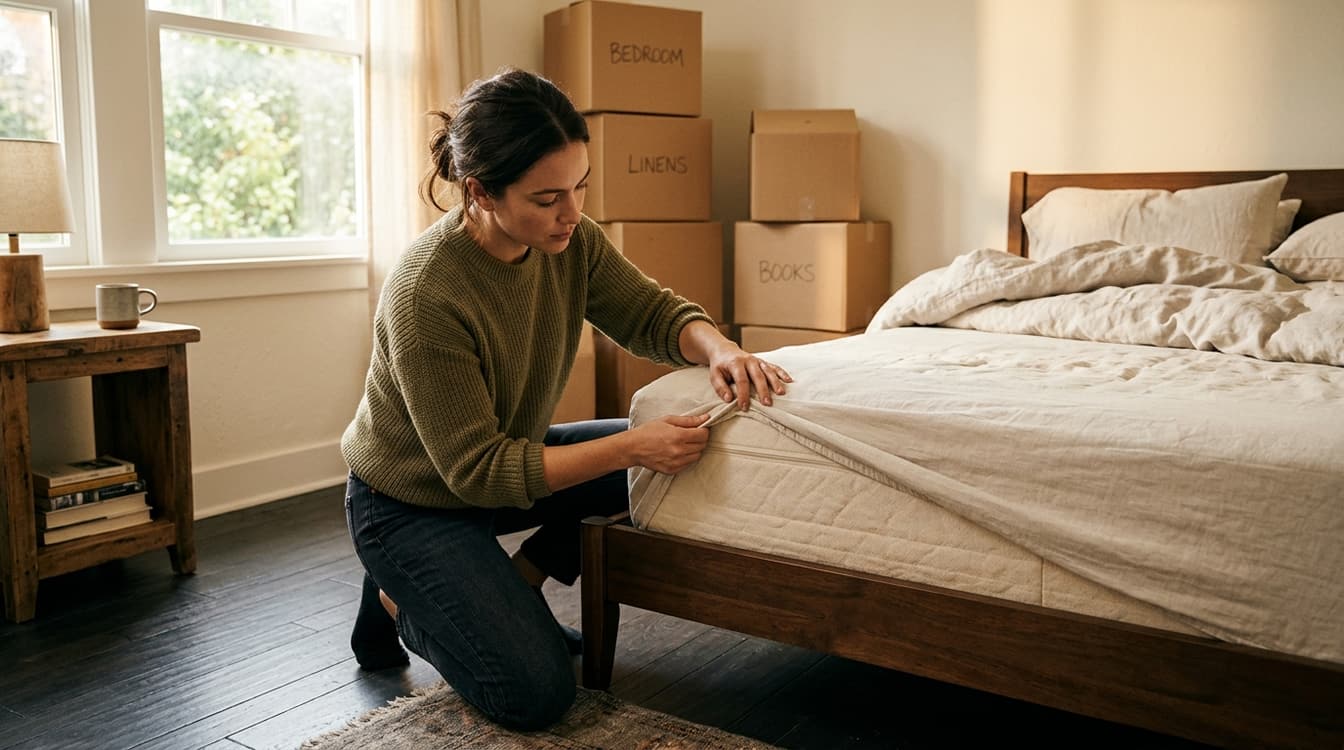
- Strip any remaining mattress or box spring left by the previous occupant. Run the credit card along every seam while the flashlight shines at a low angle — this drags out casings and eggs hiding in stitching.
- Check the bed frame in every joint, screw hole, and crack. Disassemble if possible — slats and center supports are common harborage points.
- Inspect the headboard. If it's wall-mounted, shine the light behind it and in every anchor point. Headboards are the single most-cited location in professional pest-control reports.
- Check nightstands and dressers — open every drawer and run the light along the runners and corners.
- Look behind electrical outlet covers near the bed. Unscrew the plate and shine the light into the gap — bed bugs use wall voids to travel between units in multi-family buildings.
- Inspect any carpet at the perimeter, especially where the carpet meets the baseboard tack strip.
The living room
Upholstered sofas and recliners are the second most common location. Flip every cushion, run the card along every seam and zipper, and check underneath where the fabric is stapled to the frame. Inspect the underside of the couch — shine the light into the dust cover fabric.
Other rooms
Bed bugs can survive anywhere humans spend extended time — a home office with a daybed, a nursery, a TV room with a recliner. Do a quick pass in every room: baseboards, any upholstered chair, and the perimeter carpet seam.
Multi-family buildings: check the shared walls
If you're moving into an apartment or condo, pay extra attention to outlet covers and switch plates on walls shared with neighboring units, and to any pipe penetrations in kitchen or bathroom cabinets. Our guide on moving into an apartment building covers other pre-move-in checks worth doing at the same time.
Part 2: Not bringing bed bugs from your old home
Even a home with no visible infestation can harbor a low-level problem you haven't noticed. These steps protect your new place.
Before the truck is loaded
- Inspect your mattress and upholstered furniture using the same method above before they leave your old home. If you find signs, disclose this to the building manager and consider whether to move those pieces at all.
- Wash all bedding, clothing, and soft goods on high heat (at least 120°F / 49°C) and dry on high for at least 30 minutes. Heat is the most reliable non-chemical kill method. Seal clean items in bags immediately and don't open them until they're in the new place.
- Vacuum mattress seams, box-spring fabric, and upholstered furniture before loading. Dispose of the vacuum bag in a sealed plastic bag, outside, before continuing.
- Inspect every piece of luggage you're using for transport. Check seams, pockets, and frames.
During the move
- Keep packed, sealed boxes off upholstered furniture in the truck. If bed bugs are present in a sofa, they can migrate to cardboard and reach your packed belongings in transit.
- Use mattress bags. A sealed mattress bag keeps any hitchhikers on the mattress and prevents them from spreading to the truck interior. Many movers supply them; you can also buy them for $10–$25. See our guide on mattress bags for moving for details on what to expect.
After delivery but before unpacking
This is the moment. Before the boxes come inside:
- Complete Part 1's room-by-room inspection of the new space.
- If the inspection is clean, bring boxes in and unpack directly into clean storage — don't set cardboard on upholstered furniture.
- If you find signs, photograph everything, notify your landlord or seller in writing immediately, and hold off on placing upholstered furniture until a licensed pest-control professional can inspect and treat.
While you’re reading
Skip the research — let Robert match you with movers.
Free quotes from movers in your area. Pick whichever is easiest.
What to do if you find bed bugs in your new home
Document before you disturb anything. Use your phone to photograph every sign — this is your evidence for the landlord, seller, or building management.
| Situation | First step | Who pays (typically) |
|---|---|---|
| Renter, pre-move-in infestation found | Notify landlord in writing, same day | Landlord in most states (check your lease and local tenant-rights law) |
| Home buyer, found before closing | Contact your real estate agent and attorney; request treatment as a condition | Negotiated between buyer and seller |
| Home buyer, found after closing | Consult a real estate attorney; disclosure laws vary by state | Depends on state disclosure rules |
| Renter, infestation found after move-in | Harder to prove origin; document and report immediately | Often shared or disputed |
Do not attempt to treat a confirmed infestation with over-the-counter sprays alone. Professional heat treatment or targeted pesticide application by a licensed exterminator is the standard approach. Treatment costs typically run $300–$800 for a single room and $1,500–$5,000+ for a whole-home heat treatment, depending on the size of the space and the method used.
Protecting your new home long-term
- Encase your mattress and box spring in bed-bug-proof zippered covers (fabric is woven tight enough that bugs can't penetrate). These cost $30–$100 per piece and are worth it in multi-family buildings.
- Reduce clutter near the bed — the fewer hiding spots, the easier any future problem is to catch early.
- Inspect secondhand furniture before it enters your home, using the same method above. Thrift-store upholstered pieces are a common introduction path.
- Check after guests stay over, particularly if they've been traveling.
If you haven't moved yet and you're in the middle of planning, the new-home checklist guides on this site cover the full range of tasks — from deep cleaning before the furniture arrives to what to do in the first week after unpacking.
Finding a mover you can count on
The fewer strangers' belongings that touch yours during a move, the lower your exposure risk. When you find movers through our directory, look up each company's USDOT number on the FMCSA's search tool yourself — it shows whether they're a licensed carrier or a broker who will hand your job to another company. You can also read mover reviews to get a sense of how carefully each company handles belongings in transit.
Our team has 35+ years of hands-on service-provider experience, including an operator who ran a moving company for 18 years — and the consistent advice from that side of the business is that a careful, unhurried pre-move-in inspection is far cheaper than any remediation.
For personalized guidance on what to check at your specific new home or to get matched with a carrier in your area, reach out to Robert, our moving concierge.
Frequently asked questions
How long does a bed bug inspection take before moving in?
A thorough DIY inspection of a one-bedroom apartment typically takes 20–30 minutes; a three-bedroom house, 45–60 minutes. Focus most of your time on the bedrooms — that's where the overwhelming majority of infestations are concentrated.
Can bed bugs live in an empty home?
Yes. Adult bed bugs can survive without a blood meal for several months under normal household temperatures, and even longer in cool conditions. An empty home is not a safe home — especially if the previous occupant had an infestation.
Do I need to hire a professional inspector before moving in?
It's not required, but it's worth considering for a home you're buying, or for an apartment in a building with a known history of infestations. A trained canine-assisted inspection (dogs are more reliable than human visual inspection alone) typically costs $200–$500 and can find low-level infestations a visual check would miss.
What should I do if the previous tenants didn't disclose bed bugs?
Document any evidence you find immediately — photographs with timestamps. In most states, landlords are required to disclose known pest infestations. Contact a tenant-rights organization or housing attorney in your state to understand your specific options.
Can bed bugs travel in moving boxes?
Yes. Cardboard is a preferred harborage material — the corrugation provides narrow hiding spaces. If you suspect an infestation at your old home, consider using plastic bins with tight-fitting lids instead of cardboard boxes for your most vulnerable items (bedding, clothing, books), and discard all cardboard outside after unpacking.
Is a professional exterminator required, or can I treat it myself?
Over-the-counter sprays are rarely effective against an established infestation — bed bugs have developed resistance to many common insecticides, and reaching eggs in fabric seams is difficult without professional equipment. A licensed pest control professional is strongly recommended for anything beyond a single bug found on arrival.
Tagged