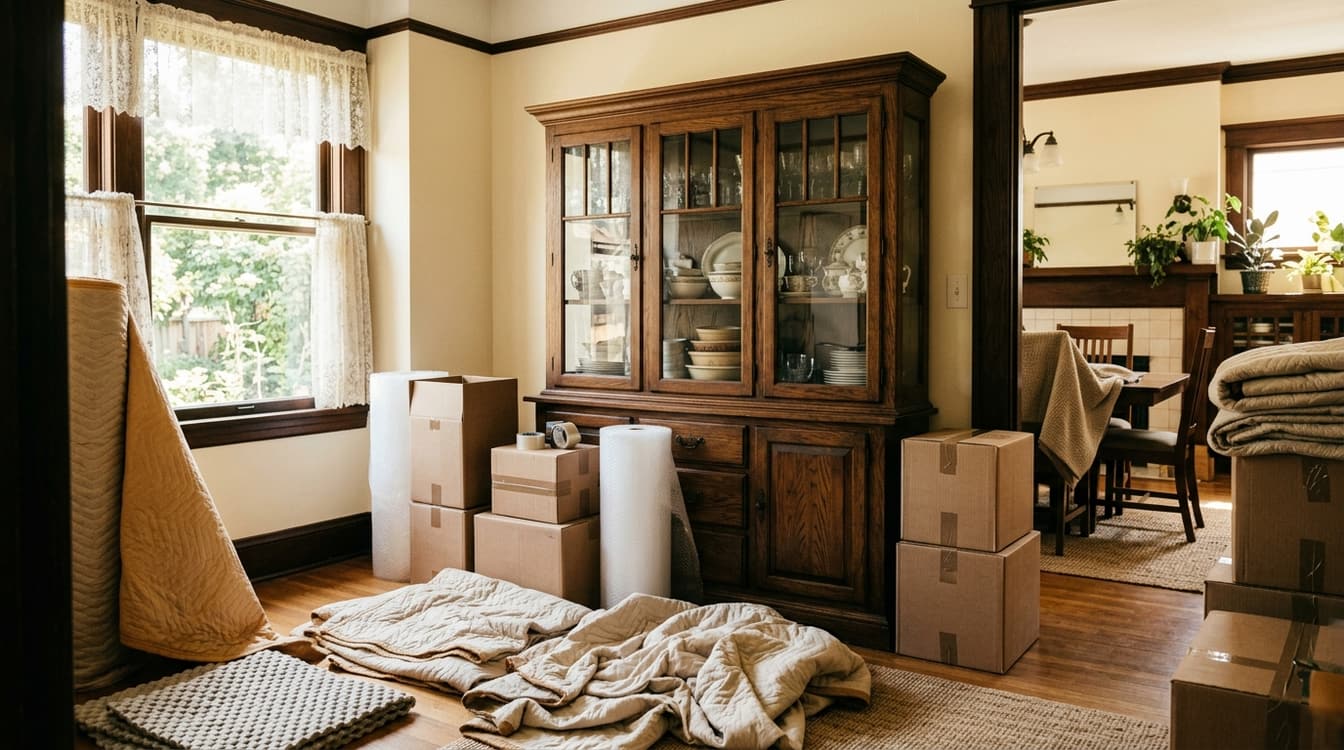
Moving a china cabinet safely comes down to three non-negotiable steps: empty every shelf completely, disassemble it into its lightest possible sections (almost always a top hutch and a lower base), and wrap every glass surface and finished wood panel before anything moves. Skip any one of those and you risk cracked glass doors, a snapped cornice, or a finish that arrives looking like it lost a fight with a truck wall.
Our team has 35+ years of hands-on service-provider experience, including an operator who ran a moving company for 18 years — and china cabinets came up constantly as the piece clients underestimated most. Here is the full method.
Why China Cabinets Are Harder to Move Than They Look
A china cabinet looks like a tall box. It moves like a tall box of glass. The problems stack up quickly:
- Weight: A solid-wood hutch-and-base combination often weighs 150–300 lbs fully assembled, with most of that weight high up — the worst possible configuration for carrying.
- Glass doors: The panes are typically single-glazed and untempered, so any flex in the frame can crack them.
- Mirrored backs: Many display cabinets have a mirror panel bonded to the inside back — impossible to replace cheaply if it cracks.
- Thin legs: The decorative legs on the base cabinet are rarely engineered to take lateral stress. Tilting the piece to clear a doorway can snap one.
- Cornice and trim: Crown molding details at the top are glued and tacked, not bolted. A bump in the right spot pops them off.
Understanding these risks is what drives every decision in the method below.
Step 1 — Empty Everything (Including the Shelves Themselves)
Before you touch the cabinet, remove:
- All china, glassware, and display items — wrap and box them separately following the same guidance in our guide to packing fragile and valuable items.
- Any removable glass shelves — wrap each one in two layers of packing paper, then slide into a padded sleeve or a dedicated dish-box standing on edge.
- Drawer contents — remove drawers entirely if they pull out; tape them shut if they don't.
- Any items stored in the lower base cabinet.
Leave nothing inside the cabinet during the move. Even a padded item banging around inside a glass-fronted cabinet can crack a door from the inside.
Step 2 — Remove the Doors
Most china cabinet doors hang on simple butt hinges and lift off with a flat-head screwdriver or by tapping the hinge pin upward. Work with a helper: one person supports the door, the other removes the pin.
Once off:
- Tape hinge pins to the door they came from using painter's tape.
- Lay each door flat on a padded surface.
- Wrap in two layers of moving blanket, then wrap the whole bundle in stretch wrap to hold the blanket tight.
- Label: "GLASS — DO NOT STACK."
If the doors do not remove — some are fixed-pane or sliding — skip to Step 3 and add extra blanket layers over the glass after the cabinet is wrapped.
Step 3 — Separate the Hutch From the Base
The vast majority of china cabinets ship in two pieces and are bolted or screwed together from underneath the hutch into the base. Look for:
- Screws through the inside top of the base cabinet into the bottom of the hutch frame.
- Corner brackets or L-bolts along the interior seam.
- On older pieces, sometimes just wooden alignment pegs — in that case the hutch simply lifts off.
With a helper, lift the hutch straight up and set it aside. You now have two manageable pieces instead of one unwieldy tower.
If your cabinet is a single-piece unit (this is rare but happens with some antique pieces and built-in styles), do not force a separation. Move it as one piece on an appliance dolly, tilted as little as possible, with two strong carriers minimum.
Step 4 — Wrap the Base and the Hutch
For the base cabinet:
- Pad the top surface first — a folded moving blanket laid flat.
- Wrap the entire exterior in at least one full moving blanket, tucking excess under the bottom.
- Secure with stretch wrap, two passes minimum.
- If the legs are decorative and spindly, cut short lengths of pool noodle or bubble wrap tubes and slip them over each leg as a bumper.
For the hutch:
- Tape a sheet of cardboard across any interior mirror panel if you cannot remove it.
- Lay a moving blanket over the front glass (or glass-and-wood panel), and fold it around to the back.
- Add a second blanket around the full perimeter.
- Secure with stretch wrap. Do not over-tighten — excessive wrap pressure on a glass-fronted frame can flex the stile enough to crack the glass.
For more on wrapping techniques — when plastic wrap helps and when it harms — see our post on what movers use to wrap and protect furniture.
Step 5 — Protect the Path and Move the Pieces
Before carrying anything, lay down floor runners or cardboard on hardwood or tile floors, and pad doorway edges with blankets or foam. Our post on what movers use to protect floors and doorways covers the full toolkit.
Carrying order and technique:
| Piece | Tool | Minimum carriers | Tilt allowed? |
|---|---|---|---|
| Base cabinet | Furniture dolly | 2 | Slight (< 30°) if legs allow |
| Hutch | Hand carry or furniture dolly | 2 | Upright only |
| Doors | Hand carry, flat | 1 per door | Flat or upright on edge |
| Glass shelves | Hand carry, flat | 1 | Flat only |
Move the base first. Get it onto the truck, position it against the wall, and strap it. Then bring the hutch. Stack the hutch on the base only on the truck — never reassemble in the driveway and try to carry the combined unit.
On the truck:
- Position against the front wall or a solid side wall.
- Strap across the base and again across the hutch independently.
- Slide a moving blanket between the cabinet and any adjacent furniture.
- Stack nothing on top of the hutch.
While you’re reading
Skip the research — let Robert match you with movers.
Free quotes from movers in your area. Pick whichever is easiest.
Step 6 — Reassemble at the Destination
- Carry the base in first; position it in its final spot before you bring the hutch.
- Set the hutch on the base and align the holes. Reinsert the screws or bolts — snug, not overtightened.
- Rehang the doors, tapping hinge pins back in with a rubber mallet or the heel of your hand.
- Replace glass shelves last, after all carrying is done.
- Remove all stretch wrap and blankets carefully; on lacquered or painted surfaces, peel tape at a low angle to avoid lifting the finish.
Should You Hire Professionals for a China Cabinet?
For most people: yes, or at minimum hire labor-only help for the carrying steps. A china cabinet sits in that awkward zone where it is too heavy and fragile for two casual helpers but not so exotic that it requires specialty movers.
What to ask any mover you're considering:
- Do they carry moving blankets and stretch wrap on the truck (most full-service movers do)?
- Will they disassemble the hutch from the base, or expect it to move as one unit?
- Do they charge extra for glass-fronted pieces? Some do; get it in writing before moving day.
You can find movers in your area and check mover reviews to compare how companies handle specialty furniture before you book. For cross-referencing a mover's license and history, look up their USDOT number on FMCSA's website yourself — that search takes under two minutes and tells you whether the carrier is authorized and whether complaints have been filed.
If your china cabinet is an antique or a high-value piece, you may also want to read our guide on moving art, antiques, and collectibles, which covers crating, valuation, and specialty carriers.
What to Do If the Cabinet Won't Fit Through the Door
Measure before moving day — not on moving day. Standard interior doorways are 32–36 inches wide; a full-size china hutch is often 48–60 inches wide at its widest point.
If the cabinet won't pass through upright:
- Tilt technique: Lay the wrapped hutch on its back on a furniture dolly and slide it through horizontally. Requires ceiling clearance and a path clear of obstacles.
- Remove the cornice: Many ornate crown-molding tops are attached with just a few finishing nails. A flat pry bar and patience can remove them without damage; label and wrap the trim separately.
- Remove the door casing: If you own the home, removing the door's trim molding and striker plate can gain you an extra inch or two.
- Bring in a pro: If none of those work, a mover who regularly handles oversized furniture will have additional rigging options. Our post on moving an armoire or wardrobe without cracking the doors covers similar doorway challenges in more detail.
Frequently Asked Questions
Do movers charge extra to move a china cabinet?
Often, yes. Many movers treat glass-fronted or antique display cabinets as specialty items and add a surcharge, typically $50–$150 depending on size, fragility, and how many flights of stairs are involved. Ask for the extra charge in writing on your estimate before moving day so it doesn't appear as a surprise on your final bill.
Can I move a china cabinet without taking it apart?
You can, but it substantially increases the risk of cracked glass, broken legs, and damage to door hinges. If the piece separates into a hutch and base — which most do — it is almost always worth the five minutes it takes to separate them. Single-piece cabinets should stay assembled and move upright on a padded appliance dolly.
How do I keep the glass doors from cracking during the move?
Remove them and wrap them separately whenever possible. If the doors cannot be removed, add extra blanket layers over the glass, avoid tilting the cabinet more than a few degrees, and strap it securely on the truck so it cannot shift. The biggest cause of in-transit glass cracks is not impact — it's flex from the cabinet rocking or twisting in an unstrapped load.
What do I wrap a china cabinet with if I don't have moving blankets?
Moving blankets are the professional standard, but in a pinch you can substitute: thick comforters or quilts (clean and dry), furniture pads from a hardware store, or multiple layers of bubble wrap. Avoid using only stretch wrap directly against finished wood — it can trap moisture and leave marks on lacquered surfaces.
Is a china cabinet considered a specialty item by movers?
Most full-service movers treat glass-fronted display cabinets the same as other large furniture. Some classify antique or particularly fragile pieces as specialty items, which may affect how they're padded, crated, or insured. If your cabinet has significant monetary or sentimental value, ask your mover specifically what valuation protection applies and whether they recommend additional third-party moving insurance.
Should I wrap the glass shelves separately or leave them inside?
Always remove and wrap glass shelves separately. Even cushioned inside a wrapped cabinet, shelves shift during transit and are very likely to crack or scratch each other — or crack a glass door from the inside. Stand wrapped shelves on edge in a padded box or sleeve, never flat-stacked without padding between them.
Ready to book movers who know how to handle glass-fronted furniture? Browse movers by state to find licensed carriers near you, then check their mover reviews before you call. If you'd like a hand narrowing down your options, reach out to Robert, our moving concierge.
Tagged