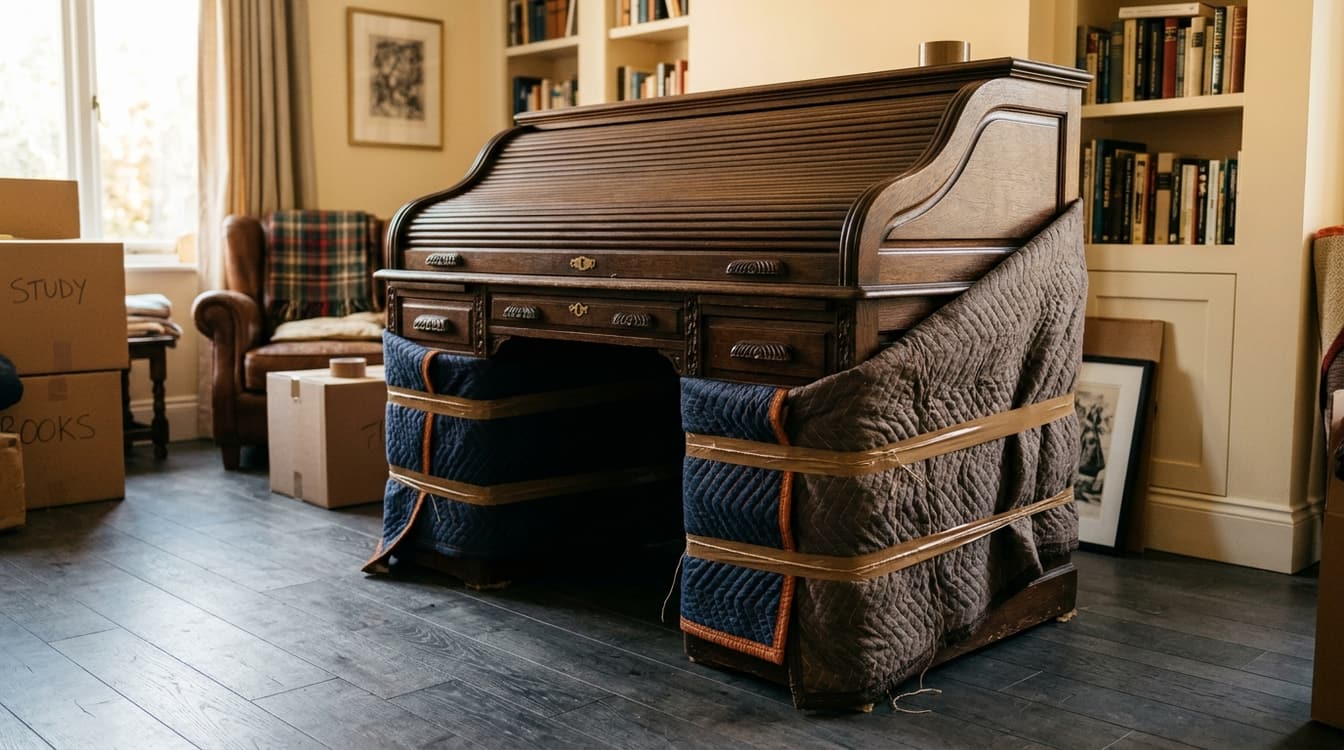
Moving a roll-top desk safely comes down to two things: locking or securing the tambour (the slatted sliding cover) so it cannot rattle open during transit, and breaking the piece into its heaviest sub-assemblies — usually the hutch top, the pedestal base, and the writing surface — before anyone tries to lift it. Skip either step and you risk a cracked tambour, broken pigeonholes, or a back injury. Our team has 35+ years of hands-on service-provider experience, including an operator who ran a moving company for 18 years, and roll-top desks rank among the most frequently damaged pieces when movers treat them like ordinary writing desks.
Why Roll-Top Desks Are Harder to Move Than They Look
A solid-wood roll-top desk can weigh anywhere from 200 to 450 pounds depending on size and construction era. That alone makes it a two- or three-person job. But weight is only part of the problem:
- The tambour is fragile. The slatted cover is made of thin wood strips glued to a canvas or fabric backing. If the cover slides open during the move and catches on a door frame, the slats shatter and the backing tears — a repair that can cost $300–$900 at a furniture restoration shop.
- The hutch top is often unbolted from the pedestal. Many desks separate into at least two pieces; moving them as one unit multiplies the tip-and-twist forces that crack joints.
- Pigeonholes and cubbies are fragile. The small vertical dividers inside are rarely glued securely. Vibration alone can loosen them.
- Antique hardware is irreplaceable. Original brass pulls, lock cylinders, and decorative inlays do not have modern equivalents; a dent is permanent.
Step 1 — Empty and Document Everything
Before touching the desk, remove every drawer, shelf insert, and item stored inside. Photograph the desk from all four sides and from above. If it is an antique or high-value piece, check whether you need separate coverage — standard moving valuation may not reflect its appraised worth. See our guide to moving art, antiques, and collectibles for more on that decision.
Pull every drawer fully out and move each one separately, wrapped in packing paper or bubble wrap. Label the back of each drawer with its position (top-left, middle-right, etc.) so reassembly is straightforward.
Step 2 — Secure the Tambour Before Anything Else
This is the single most important step. You have three options depending on the desk's design:
| Method | Best for | How to do it |
|---|---|---|
| Turn the original lock | Desks with a working lock cylinder | Insert the key, lock the tambour in the closed position, tape the key to the underside of the desk |
| Rope or moving strap across the front | Desks without a working lock | Loop a soft moving strap or cotton rope horizontally across the face of the closed tambour; tie it off at the rear of the pedestal so it cannot slip |
| Painter's tape strips | Light-use or modern reproductions only | Run three or four strips of low-tack painter's tape vertically across the tambour face; never use packing tape — the adhesive damages finish |
If the tambour is already stiff or partially stuck, do not force it closed. Move it in whatever position it rests naturally and pad around it heavily.
Step 3 — Separate the Hutch Top From the Pedestal Base
Most roll-top desks built after roughly 1890 were designed to come apart. Look for:
- Bolts through the writing surface into the pedestal sides (often accessible through the back or through the bottom of a drawer cavity)
- Dowels or alignment pins between the hutch base and the pedestal top
- A recessed bolt or bracket running underneath the writing surface on each side
Have one person support the hutch while another removes the fasteners. Lift the hutch straight up — do not tilt it, as the pigeonhole dividers can shift and fall. Set it face-down on moving blankets on the floor while you prep the base.
If you cannot find any fasteners and the desk is a true one-piece construction (common in desks made before 1870), do not force a separation. Move it intact, standing upright, on a furniture dolly.
Step 4 — Wrap and Pad Every Section
For each section — hutch, pedestal, drawers — use this sequence:
- Wrap exposed wood surfaces in furniture pads (moving blankets). Secure with stretch wrap or rubber bands, never tape directly on the wood or finish.
- Pay extra attention to corners, the tambour face, any protruding hardware, and the top of the hutch where pigeonhole dividers are exposed.
- For antique or particularly fragile desks, add a layer of bubble wrap over the pads on the hutch, especially around the top corners.
The guide on what movers use to protect your floors, doorways, and stairwells covers how professional crews protect the path out of the room as well — worth reading before move day if doorways are tight.
Step 5 — Plan the Exit Route
Measure the desk before you start. A standard large roll-top hutch is typically 60 inches wide, 50–55 inches tall, and 28–32 inches deep. Even separated into two pieces, the hutch section alone can be 24–28 inches deep.
- Doorways in older homes are often 28–30 inches wide. Know whether the hutch will clear before you lift.
- If a doorway is too narrow, the hutch may need to exit on its side — which requires padding the tambour face heavily so it does not bear load.
- Stairs require a minimum of three people: two carrying, one guiding and communicating.
A wheeled furniture dolly handles the pedestal base well on flat floors. Carry the hutch section by hand — dollies are risky under a piece with an open face.
While you’re reading
Skip the research — let Robert match you with movers.
Free quotes from movers in your area. Pick whichever is easiest.
Step 6 — Load and Secure in the Truck
Stand both sections upright in the truck if at all possible. Laying a roll-top desk on its back puts pressure on the tambour; laying it on its face risks crushing the pigeonhole dividers. If you must lay it on a side, choose the solid side panel (not the front face) and pad generously.
Secure with two moving straps — one across the pedestal, one across the hutch — anchored to the truck's wall rails. The desk should not be able to slide or tip even if the truck brakes hard.
Should You Hire Specialty Movers for a Roll-Top Desk?
For a modern reproduction in good condition: an experienced general moving crew can typically handle it. For an antique roll-top desk — especially one with a cracked or stiff tambour, original finish, inlay work, or appraised value above $2,000 — specialty furniture movers are worth the extra cost. They carry the right blankets, have experience with period construction, and can document condition before and after.
You can find movers near you, read mover reviews, or browse movers by state to compare companies. When you contact a mover about a roll-top desk, describe it specifically: approximate age, number of pieces it separates into, weight if known, and any existing damage. A sight-unseen phone quote without that detail is an FMCSA red flag for interstate moves — the mover should ask for a physical survey or a live video walkthrough before giving you a price.
If the desk is part of a larger antique collection, our guide to packing and moving fragile items you can't replace covers room-by-room strategy for high-value pieces.
What Does Moving a Roll-Top Desk Cost?
Pricing depends on the type of move, local labor rates, and whether specialty handling is needed.
| Scenario | Typical cost range |
|---|---|
| Local move, included with full household | Usually no surcharge if you flag it in advance |
| Local move, single-item specialty pickup | $150–$400 depending on distance and stairs |
| Long-distance move, added to shipment | Weight-based; a 300-lb desk adds roughly $90–$250 at typical long-distance rates |
| Specialty antique mover, local | $250–$600+ depending on complexity |
| Specialty antique mover, crating for long-distance | $400–$1,200+ including custom crate |
Always confirm whether the mover's valuation covers the appraised value of an antique. For interstate moves, Full Value Protection applies automatically, requiring the mover to repair, replace, or pay replacement value — but "replacement value" for a mass-market mover may be far below what a one-of-a-kind antique is actually worth. Separate fine-art or antique insurance, arranged through your homeowner's policy or a specialty insurer, is worth considering.
Frequently Asked Questions
Can movers move a roll-top desk without taking it apart?
It depends on the desk's construction and the exit route. A one-piece roll-top desk in good condition with a working lock can often be moved intact if doorways are wide enough. However, most post-1890 desks are designed to separate, and moving them apart is significantly safer — it reduces weight, eliminates torque on the joinery, and lowers the risk of tambour damage.
How do I keep the tambour from sliding open during the move?
Lock it with the original key if the lock works. If not, use a soft moving strap looped horizontally across the front face and tied off at the rear of the pedestal. Painter's tape strips work for lightweight modern desks. Never use packing tape — it lifts lacquer and veneer on contact.
My roll-top desk doesn't have visible bolts — is it one piece?
Not necessarily. Some desks use a French cleat system (a beveled wooden rail on the hutch that hooks over a matching rail on the pedestal) rather than bolts. Look for a gap between the hutch base and the pedestal top; if you can slide a piece of cardboard into it, the two sections are probably separate. If in doubt, have an experienced furniture mover assess it rather than guessing.
Is a roll-top desk covered under standard moving valuation?
For interstate moves, Full Value Protection (which applies automatically unless you sign a written waiver choosing Released Value at 60 cents per pound per article) would require the mover to repair, replace, or pay replacement value for damage. For an antique with high appraised value, check whether the mover's coverage reflects that value or whether you need a separate policy. For in-state moves, valuation terms are set by the mover's contract — read that section carefully and ask the mover to explain it.
Should I remove the hardware before moving a roll-top desk?
Brass pulls and decorative hardware are worth protecting, but removing them is usually not necessary if the desk is well-padded. What matters more is taping a small piece of foam or bubble wrap behind each pull so the hardware does not rattle or dig into the finish during transit. For very fragile or ornate antique hardware, removal is wise — bag each piece, label it, and pack it separately.
How many people does it take to move a roll-top desk?
Plan for three people minimum: two to lift and carry each section, one to open doors, guide through tight spaces, and communicate on stairs. The pedestal base of a large solid-wood roll-top can weigh 150–250 pounds on its own. Using a furniture dolly on flat surfaces significantly reduces injury risk.
Ready to find a mover who has handled roll-top desks before? Search our directory, browse mover reviews, or connect with Robert, our moving concierge, who can help you match your desk's specifics to the right kind of moving crew.
Tagged