Moving a golf cart comes down to three decisions: trailer it yourself behind your tow vehicle, rent a flatbed and hire day-labor loaders, or hand it to a specialty freight or auto-transport carrier. Most gas-powered carts weigh 600–900 lbs; electric carts with lead-acid batteries typically run 900–1,100 lbs — both manageable on a standard utility or car-hauler trailer rated for at least 2,000 lbs. The move gets complicated by battery voltage, brake-controller requirements, and the fact that most general-use moving companies will decline the job outright.
Our team has 35+ years of hands-on service-provider experience, including an operator who ran a moving company for 18 years — here is what that background tells us every golf cart owner needs to know before moving day.
What type of trailer do you actually need?
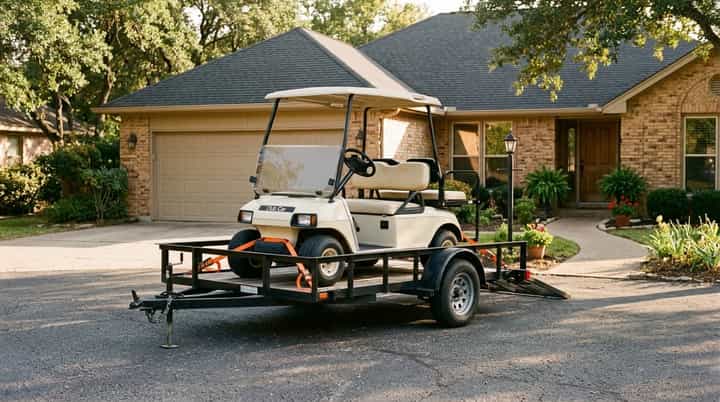
A golf cart sits low and wide. The ideal trailer is an open utility or car-hauler with:
- A usable deck length of at least 8 feet (most carts are 92–110 inches long including the rear bumper).
- A ramp or dove-tail section — golf carts have minimal ground clearance; a folding ramp or angled dove-tail prevents the front axle from dragging during loading.
- Tie-down rails or D-ring anchors at all four corners. You need a minimum of four 1-inch or 2-inch ratchet straps rated for the cart's weight.
- A tow vehicle with enough gross combined weight rating (GCWR) — confirm your truck or SUV owner's manual before you hitch anything. Electric carts with heavy battery packs add meaningful tongue weight.
A single-axle 5×10 utility trailer is usually too short. A 6×12 or 7×14 open trailer is the practical minimum. Rentals typically run $70–$130 per day from trailer-rental locations; a one-way truck rental with a tow dolly is not suitable — you need a flat deck, not a dolly.
Step-by-step: loading and securing the cart
- Clear the ramp area. Remove any debris; a golf cart will slide on a wet aluminum ramp. Place rubber ramp grips or old carpet strips if the ramp is metal.
- Drive slowly up the ramp — don't push. Use the cart's own motor if the battery is charged. For a gas cart, idle up under its own power. Have a spotter at the rear watching the rear wheels clear the ramp lip.
- Center the cart on the trailer. The tongue weight on your hitch ball should be roughly 10–15% of the trailer's loaded weight. Centering the cart (or positioning it very slightly forward) achieves this naturally.
- Set the parking brake and shift to neutral or tow mode. On electric carts, some models have a tow/maintenance switch that disengages the motor — engage it. On gas carts, turn the key off.
- Attach four ratchet straps. Hook two straps to the front frame rails (not the plastic body panels) and two to the rear frame or axle. Cross-strap front-to-rear for lateral stability. Snug each strap until there is no visible movement; do not over-crank to the point of compressing the suspension.
- Check after one mile. Pull over and re-inspect strap tension after the first mile — vibration loosens new straps quickly.
Battery prep: the step most people skip
Golf cart batteries are the single most common casualty of a move. Here is what to do before the trailer rolls:
| Cart type | Pre-move battery steps |
|---|---|
| Lead-acid (flooded) | Charge fully the night before. Check electrolyte levels — top off with distilled water if low. Secure vent caps tightly. Do NOT tip the cart more than 15–20°; acid can spill through vents. |
| AGM or gel-cell | Charge fully. No electrolyte maintenance needed, but secure any loose terminal connections. |
| Lithium-ion | Charge to 80–90% (not 100%) for transport. Many lithium packs have a disconnect switch — engage it for moves over a couple of hours. Keep away from extreme heat; do not leave in a closed trailer in direct summer sun. |
For moves under a few hours, leaving the batteries in the cart is standard. For long-distance transport, some owners remove the battery pack entirely, ship it separately, and reload at the destination — particularly worth considering for expensive lithium packs on cross-country shipments.
When to hire a professional shipper instead
Most full-service moving companies list golf carts as a prohibited item — they lack the ramps, tie-down infrastructure, and specialty experience. The two categories of professionals who routinely move golf carts are:
- Open auto-transport carriers — the same carriers that ship personal vehicles. They load golf carts on the lower deck of a multi-car hauler. This is the most common method for moves over 300–400 miles.
- Specialty enclosed transport — worth considering for custom or high-value carts (think lifted, lifted-and-lifted-again builds, or restored vintage carts where paint and bodywork matter).
Typical shipping costs in 2026:
| Distance | Open transport (estimated) | Enclosed transport (estimated) |
|---|---|---|
| Under 500 miles | $250–$500 | $500–$900 |
| 500–1,500 miles | $400–$750 | $750–$1,400 |
| 1,500+ miles (cross-country) | $600–$1,100 | $1,100–$2,000 |
These are typical ranges; actual quotes vary with fuel prices, carrier availability, and pickup/delivery location. Always get at least three written quotes. If you're already coordinating a household move, ask your moving company whether they work with an auto-transport partner — some do. You can also find movers and specialty carriers, or browse by state if you need a carrier pickup at a specific location.
For comparison, our guide on shipping your car when you move covers the open vs. enclosed transport decision in depth — the same framework applies to golf carts.
While you’re reading
Skip the research — let Robert match you with movers.
Free quotes from movers in your area. Pick whichever is easiest.
What about a local move — same neighborhood or same county?
For short hauls, many golf cart owners skip the trailer entirely and use a flatbed tow service (think roadside-assistance style flatbed truck) for moves under 10–15 miles. Rates typically run $100–$250 for a local flatbed pickup. It is simpler than renting a trailer, especially if you lack a hitch receiver or suitable tow vehicle.
The other option for truly local moves: drive it on private property or a golf cart path, if your community permits. Check with your HOA or municipality — some Florida and Sun Belt communities specifically allow golf carts on designated roads. This is the zero-cost option when it works. If you're relocating within the Tampa or Phoenix area, for instance, many communities have dedicated cart corridors.
Does it matter if the move is interstate vs. in-state?
For shipping via an auto-transport carrier, the distinction matters for your protection. Interstate auto transport falls under federal FMCSA oversight; you can verify any carrier's USDOT number at the FMCSA website and confirm they are registered as a "Motor Carrier of Household Goods" or auto transport carrier — not merely a broker. A broker will hand your cart off to a carrier you haven't evaluated yourself. See our full guide to cross-state moving rules for the federal framework.
For in-state moves, state-level transportation rules apply. Check with the state's motor carrier regulator if you have a dispute — FMCSA rules do not govern in-state transport.
What do golf carts cost to insure during transport?
Your homeowner's or renter's policy may cover a golf cart in transit on your own trailer — confirm with your insurer before the move. It is not a safe assumption. If you are using a carrier, ask what valuation coverage they offer and what the per-pound or per-unit limit is. For a custom or high-value cart, a separate inland marine or specialty recreational vehicle policy may be worth the premium. Our overview of moving valuation vs. insurance explains the difference between a carrier's liability and actual insurance coverage — the same principles apply here.
A note on community rules and registration
Golf carts are not titled vehicles in most states, but some states (Florida, Georgia, South Carolina, among others) do require registration for carts driven on public roads. If you're relocating to a new state, check the destination state's DMV before you assume the cart can be driven the way it was at your origin. This is especially relevant for moves to Florida, where street-legal golf cart rules vary by county and municipality.
Frequently asked questions
Can a regular moving company move a golf cart?
Most full-service household moving companies will not. They lack the ramp equipment and cargo-securement setup. You will typically need to arrange a separate auto-transport carrier, a local flatbed tow, or trailer it yourself. If you're browsing carriers, check mover reviews and confirm before booking that the company handles wheeled recreational vehicles.
How much does it cost to ship a golf cart across the country?
Typical open-transport rates for a cross-country golf cart shipment (1,500+ miles) run roughly $600–$1,100 in 2026. Enclosed transport — worthwhile for high-value or custom carts — typically runs $1,100–$2,000 for the same distance. Get at least three quotes; prices vary significantly with seasonal demand and fuel costs.
Do I need to remove the batteries before shipping?
For standard lead-acid batteries on a domestic trailer move of a few hours, removal is not required — but you should fully charge, check electrolyte levels, and secure vent caps. For cross-country enclosed or open-carrier transport, ask your carrier whether they require or recommend battery removal. Many carriers accept carts with batteries installed; some have restrictions on lithium-ion packs.
What size trailer do I need for a golf cart?
A minimum of a 6×12 open utility or car-hauler trailer with a folding ramp or dove-tail is the practical starting point. Most standard golf carts (without lifted suspensions or extended rear seats) fit comfortably on a 6×12 or 7×14 trailer. Confirm your trailer's weight rating exceeds the cart's weight by a comfortable margin — electric carts with lead-acid banks can exceed 1,100 lbs.
Can I strap a golf cart to a utility trailer with regular ratchet straps?
Yes, provided the straps are rated for the weight and anchored to the frame, not the plastic body panels. Use at least four straps — two forward, two rear — and cross them for lateral stability. Re-check tension after the first mile of driving.
Is moving a golf cart across state lines regulated?
If you use a professional auto-transport carrier, that carrier must be registered with the FMCSA for interstate transport. Verify their USDOT number yourself at the FMCSA website before booking. If you trailer it yourself, standard state tow-vehicle and trailer registration rules apply — no federal carrier regulation governs a private owner trailering their own property.
Ready to find a carrier or specialty mover for your golf cart? Browse movers near you or reach out to Robert, our moving concierge, for help narrowing down the right type of carrier for your specific move.
Tagged