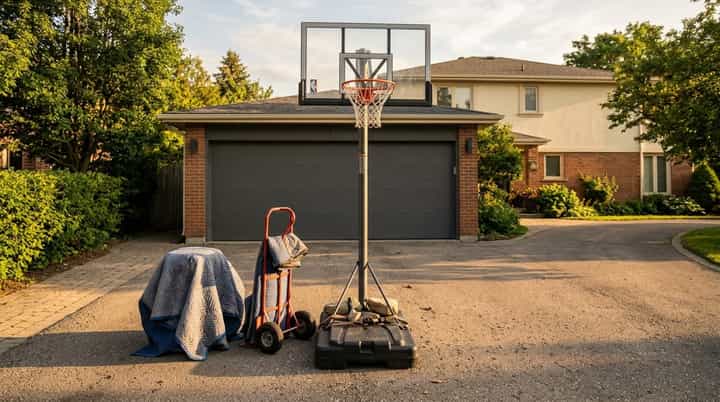
Moving a basketball hoop comes down to one decision made at the start: what type do you have? A portable hoop with a water- or sand-filled base can be moved in an afternoon if you drain it first. An in-ground hoop requires removing a cemented pole — a job that almost always calls in a professional. A wall-mounted hoop is the fastest takedown but demands careful patching and stud-finding before and after. Know your type, work through the steps below, and you'll get the whole unit to your new home intact.
What Type of Basketball Hoop Do You Have — and Why It Changes Everything
| Type | How it stays put | Difficulty to move | Typical weight (assembled) |
|---|---|---|---|
| Portable (wheeled base) | Water or sand ballast (often 35–50 gal.) | Moderate — drain first | 100–250 lb. |
| In-ground (cemented pole) | Concrete footing, usually 2–4 ft. deep | High — requires extraction | 150–400 lb. |
| Wall- or garage-mounted | Lag bolts into studs or concrete | Low-moderate | 40–100 lb. |
If you're not sure which you have, check whether the base rolls on wheels (portable) or whether the pole disappears into the ground or a sleeve (in-ground).
Portable Hoops: Drain the Base First, Then Disassemble
The number-one mistake people make with portable hoops is trying to move a full base. A base filled with 35 gallons of water weighs roughly 290 pounds — far too heavy to load safely and hard on your back, the dolly, and the truck floor.
Step 1 — Drain the base completely
- Tip the base onto its side over a drain or lawn and open the fill cap.
- Water drains in 5–10 minutes. Sand takes longer: scoop it into a bucket or pour it onto a tarp.
- Once empty, the base typically weighs 25–60 lb. depending on the model — manageable for two people.
Step 2 — Lower and remove the backboard and rim
- Lower the height adjustment all the way down before disconnecting anything.
- Most portable hoops use a tension-spring or crank mechanism. Photograph it before you touch it — you'll thank yourself at reassembly.
- Remove the backboard bolts and slide the backboard off. Set it flat, face-down on a moving blanket.
Step 3 — Collapse or disassemble the pole sections
- Many portable poles telescope. Fully collapse them before transport so the pole doesn't pivot and strike the truck wall.
- If the pole sections separate, bag the bolts and label the bag with the section number ("pole section 2 — 4 bolts, 10mm").
Step 4 — Pad and load
- Wrap the backboard (especially the corners) in moving blankets and secure with stretch wrap.
- Stand the empty base on the truck floor and strap it to the wall. Lay the pole sections flat alongside furniture, not under it.
- A 10-ft. U-Haul or cargo van can typically fit a disassembled portable hoop; the base may need to ride flat in a pickup bed.
In-Ground Hoops: When to Call a Pro
An in-ground pole is set in a concrete footing. Getting it out without breaking the pole — or leaving a tripping hazard in the driveway — is a two-person minimum job, and usually more. Our team has 35+ years of hands-on service-provider experience, including an operator who ran a moving company for 18 years, and in that time we've seen in-ground hoop extractions go wrong more often than almost any other backyard item.
Your options
- Leave it. Many sellers include the hoop in the home sale. If the buyer wants it, that's one less thing to move.
- Hire a landscaping or concrete crew. They can break the footing with a rotary hammer and jackhammer, extract the pole, and patch or cap the hole. Expect to pay $150–$400 depending on footing size and your area.
- Use a sleeve-mount system. Some in-ground hoops are set in a ground sleeve rather than solid concrete. If yours has a sleeve, you may be able to remove the pole by pulling straight up (sometimes with a come-along or truck hitch) and cap the sleeve for the new owner.
Before any extraction: Call 811 (the national Dig Safe line) at least 3 business days before anyone digs. It's free, it's the law in every state, and it prevents hitting buried utilities.
If you plan to reinstall the hoop at your new home, measure the pole diameter and footing depth now — you'll need those numbers to have a matching footing poured at the other end. A concrete footing typically needs 48–72 hours to cure before you can remount the pole.
Wall- and Garage-Mounted Hoops: Takedown Steps
Wall-mount systems bolt directly to studs, a rim joist, or a concrete block wall. The backboard usually comes off in one piece.
- Remove the backboard and rim (same process as portable — lower first if it's adjustable, then unbolt).
- Unscrew the mounting bracket. You'll typically find 4–8 lag bolts going into studs. Use the correct driver bit; stripped lags are a headache.
- Patch and prep the wall. The holes will need to be patched before you leave — especially if you're a renter. Use an appropriate filler for wood, vinyl, or concrete siding. If the bracket was mounted on stucco or brick, patch with matching material or disclose it in the sale.
- At the new home: Locate studs or use a masonry anchor system before you even bring the bracket outside. A backboard puts significant cantilever force on the mounting point; hitting studs isn't optional.
While you’re reading
Skip the research — let Robert match you with movers.
Free quotes from movers in your area. Pick whichever is easiest.
Protecting the Backboard in the Truck
Glass backboards (found on higher-end residential and commercial hoops) are the most fragile part of the whole unit. Treat them like a large mirror:
- Wrap in at least two layers of moving blankets.
- Transport standing on edge, never flat — a flat glass panel can crack under the weight of boxes placed on top.
- Tape an "X" of painter's tape across the face before wrapping; it won't stop a break but helps contain fragments if one happens.
- If the backboard is acrylic or polycarbonate, it's more forgiving, but still keep it vertical and away from sharp hardware.
For more on protecting large, fragile panel items, see our guide on how to pack and move fragile items you can't replace.
Should You Hire Movers for This?
For a portable hoop, most full-service movers will load it once it's drained and disassembled. If you leave it assembled and full of water, expect pushback — or a surcharge for the extra labor and weight. Browse movers in your area to find carriers who handle outdoor and specialty items.
For an in-ground hoop, standard movers won't extract the pole; you'll need a separate contractor for that step. The mover can then load the extracted pole and backboard alongside your household goods.
For a wall-mounted hoop, any full-service crew can handle takedown if you ask in advance — but confirm it's on your estimate in writing. Specialty takedowns sometimes get missed and added as a line item at delivery. Our post on how to read a moving estimate shows you what to look for before you sign.
If you're moving a backyard full of heavy outdoor items — swing sets, trampolines, gym equipment — coordinate them all in one conversation with your mover. See how that process works with similar gear in our guide on moving a backyard playset or swing set.
You can also read mover reviews to find carriers who've handled specialty outdoor moves before, and always verify any carrier's USDOT number yourself on the FMCSA search tool before you book.
What Does It Cost to Move a Basketball Hoop?
| Scenario | Typical cost range |
|---|---|
| Portable hoop — self-move (drain + load) | $0 extra if included with household move |
| Portable hoop — mover surcharge (specialty item fee) | $50–$150 |
| In-ground pole extraction (contractor) | $150–$400 |
| In-ground pole — new concrete footing at destination | $200–$500 (materials + labor) |
| Wall-mount takedown by movers | $50–$100 (ask in advance) |
Costs vary significantly by region and by how accessible the hoop is. A hoop at the end of a long driveway with a narrow gate is a different job than one right next to a loading zone. For a broader look at how specialty items affect your bill, see our cost breakdown by home size guide.
Frequently Asked Questions
Can I move a basketball hoop without draining the base?
Technically, yes — but you shouldn't. A fully loaded base can weigh close to 300 pounds, which makes it unsafe to tip, roll onto a truck ramp, or slide across a truck floor. Most movers will refuse to load it full, and if one does agree, you risk the base cracking under the shifting weight of transit. Drain it completely before moving day.
How do I remove an in-ground basketball pole if it's set in concrete?
You have two main paths: hire a landscaping or concrete contractor to jackhammer and extract the footing ($150–$400 is a typical range), or check whether your pole sits in a removable ground sleeve, which lets you pull the pole straight out without breaking concrete. Always call 811 to have underground utilities marked before any digging starts.
Will movers move a basketball hoop?
Most full-service movers will move a disassembled portable hoop. In-ground pole extraction is outside the scope of standard household moving services — you'll need a separate contractor for that step. Wall-mounted takedowns are possible if you ask in advance and confirm it's listed on your estimate. Check with any mover you're considering to confirm what their scope includes.
How do I transport a glass backboard safely?
Wrap it in at least two moving blankets, secure the wrap with stretch wrap, and transport it on edge — never flat. A glass panel lying flat is vulnerable to cracking if any weight is placed on it during transit. Painter's tape in an "X" pattern across the face can help contain fragments in a worst case. Acrylic and polycarbonate backboards are more durable but should still be transported vertically.
Should I reinstall the same in-ground hoop at my new home, or buy a new one?
If the hoop is a quality unit and the pole is in good condition, reinstalling it is often worth it. Plan for a new concrete footing ($200–$500 for materials and labor), confirm the footing depth matches the pole's minimum requirements (check the manufacturer spec sheet), and allow 48–72 hours for the concrete to cure before mounting. If the pole is old or corroded, a new portable unit often makes more practical sense.
Is it worth taking an in-ground hoop if the buyer of my home wants it?
Often, no — unless it's a premium unit you paid $1,000 or more for. Extraction costs, footing at the new home, and the hassle of transport can easily exceed what a comparable portable hoop would cost new. Many sellers include the in-ground hoop in the sale or leave it as a negotiating point. If you do want to take it, get extraction quotes before moving day so the timeline fits your move schedule.
Ready to find a carrier who handles outdoor and specialty items? Find movers near you, compare options by state at browse movers by state, or reach out to Robert, our moving concierge, for help thinking through your specific setup.
Tagged