The fastest way to pack a closet is to sort before you box — not after. Clothes that stay on hangers go directly into wardrobe boxes; folded items pack flat into medium boxes by category; shoes, bags, and accessories each get their own clearly labeled container. Done right, a full master closet takes about two to three hours and unpacks in under an hour at the other end.
The closet is the room customers almost universally underestimate — both in time and in box count. Here's the system we use.
Why the Closet Is the Move's Biggest Wildcard
Closets look manageable until you open them. A standard reach-in holds the equivalent of 10–15 medium boxes worth of goods once you factor in shoes, linens stored on top shelves, bags, seasonal gear, and everything shoved in the back. A walk-in can easily double that.
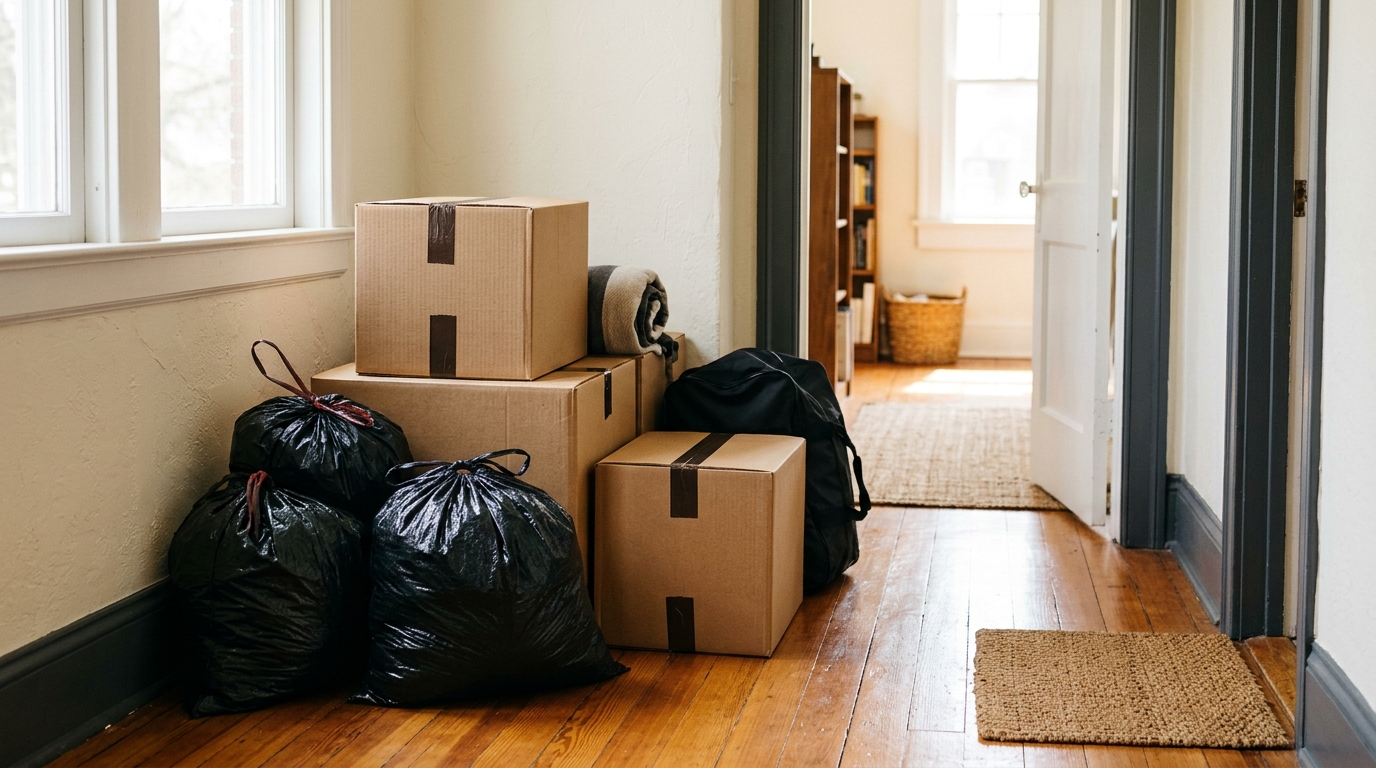
The actual problem isn't volume — it's variety. Clothes need different packing methods than shoes, which need different handling than fragile accessories or bulky bedding. Throwing it all into garbage bags (the most common DIY shortcut) creates a chaotic, wrinkled pile that takes hours to sort at the new place.
A labeled, category-based system solves this. It also pays off at the new address: when every box has a room destination and a content summary, unpacking after a move becomes a room-by-room sprint instead of a full-day scavenger hunt.
What Supplies Do You Need Before You Start?
Get these before you open the closet door:
- Wardrobe boxes (1 per 2–3 linear feet of hanging clothes) — typically $15–$25 each new, or often free from moving companies
- Medium boxes (1.5 cu ft, ~18"×12"×12") for folded clothes, shoes in their boxes, and linens
- Small boxes for heavy accessories, belts, jewelry, and items you'll need first
- Packing paper (not newspaper — it transfers ink) for shoes and fragile accessories
- Stretch wrap or rubber bands for keeping folded piles together
- Colored label tape or markers — one color per room or per person in a household
- A permanent marker for writing contents on every side of every box
For a typical master closet in a 3-bedroom home, budget for 2–3 wardrobe boxes, 8–12 medium boxes, and 2–3 small boxes. If you're working on how to choose moving boxes and packing supplies ahead of the whole move, the closet alone accounts for roughly 20–25% of your total box count.
Step-by-Step: How to Pack a Closet Efficiently
Step 1: Declutter Before You Pack Anything
This step pays for itself. Every item you don't pack saves you labor on both ends. Sort everything into four piles:
- Keep (moving with you)
- Donate or sell (in good condition, just not worth moving)
- Discard (worn out, expired, damaged)
- Undecided (handle last — don't let this pile stop you)
Shoes, in particular, accumulate. A rule of thumb: if you haven't worn a pair in 18 months, it probably doesn't make the trip. For a deeper pre-move sorting process, see our guide on how to declutter before a move and cut your moving bill.
Step 2: Pack Hanging Clothes First — Into Wardrobe Boxes
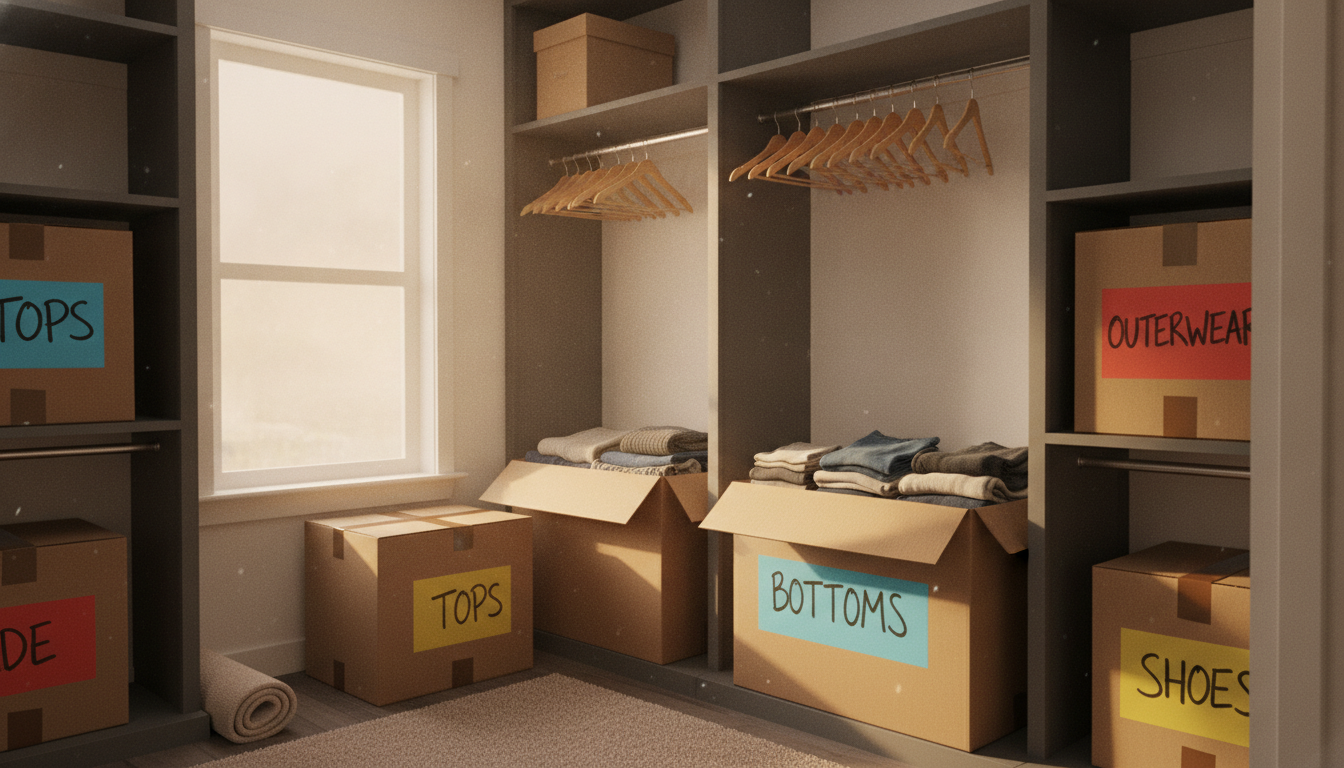
Wardrobe boxes are one of the most useful items in professional moving. They have a metal hanging bar across the top; clothes transfer directly from your closet rod without being removed from hangers. This prevents wrinkles, eliminates folding and refolding, and makes the unpack nearly instant.
How to use them:
- Keep clothes on their hangers.
- Group by type or by person (his/hers, formal/casual, seasonal).
- Bundle 15–20 hangers together with a rubber band at the hook.
- Hang bundles on the wardrobe bar and close the box.
- Label the outside: room, whose clothes, general type (e.g., "Master BR — J's work clothes").
One wardrobe box typically handles about 2 linear feet of hanging items. Don't overstuff — overfull wardrobe boxes are heavy and items wrinkle badly.
Step 3: Pack Folded Clothes in Medium Boxes by Category
Folded items — t-shirts, jeans, sweaters, activewear — pack flat and dense. Use medium boxes, not large ones. Large boxes stuffed with clothes become back-breaking and movers sometimes refuse to lift them over 50 lbs.
Packing order (heaviest on bottom):
- Jeans, thick sweaters, folded pants
- T-shirts, polos, light layers
- Delicates, lingerie, lightweight knits on top
Keep categories together. A box labeled "Master BR — casual folded, T-shirts & jeans" is something a mover can place in the right spot and you can open first when you need it.
Step 4: Pack Shoes Carefully — They're Heavier Than You Think
Shoes are dense. A box of 8–10 pairs can weigh 25–35 lbs. Pack them in medium boxes, soles-to-uppers to save space. Stuff toe boxes with packing paper to hold shape. If you kept original boxes, use them — they stack cleanly and protect better than packing everything loose.
Label: "Master BR — shoes, casual" or "Master BR — shoes, formal/seasonal."
Step 5: Handle Bags, Accessories, and Jewelry Separately
Handbags pack best stuffed with packing paper (to hold shape) inside medium boxes with crumpled paper around them. Jewelry and small accessories go into small boxes — ideally in their original pouches or zip-lock bags, labeled by type. Never put loose jewelry into a larger box where it can shift and tangle or get lost.
Critical note: Keep high-value items (fine jewelry, watches, heirlooms) off the truck entirely. Move those yourself in a carry-on bag. Movers' released-value liability under FMCSA rules is $0.60 per pound — a $1,200 watch weighs almost nothing and would be compensated at pennies if you sign the waiver choosing that coverage instead of the Full Value Protection that applies automatically.
Step 6: Pack Linens and Seasonal Items From Top Shelves
Bedding and seasonal items stored on upper shelves can go into large boxes because they're light. Compress blankets and comforters with vacuum storage bags to cut bulk dramatically — one vacuum bag can shrink a king-size comforter to about a quarter of its original size.
Label clearly: "Master BR — top shelf, winter comforter + extra pillows."
While you’re reading
Skip the research — let Robert match you with movers.
Free quotes from movers in your area. Pick whichever is easiest.
Closet Packing: At-a-Glance Reference
| Closet Item | Box Type | Special Notes |
|---|---|---|
| Hanging clothes | Wardrobe box | Stay on hangers; group by type/person |
| Folded clothes | Medium box (1.5 cu ft) | Heaviest items on bottom; max ~40 lbs |
| Shoes | Medium box | Stuff toe boxes; soles-to-uppers |
| Handbags | Medium box | Stuff bags with paper to hold shape |
| Jewelry/accessories | Small box | Keep with you if high-value |
| Bedding/comforters | Large box or vacuum bag | Vacuum bags cut bulk 60–75% |
| Seasonal gear | Large box | Label season + intended room |
How Should You Label Closet Boxes?
Every box needs three things on the outside — on at least two sides — so labels are visible no matter how boxes get stacked:
- Destination room (e.g., "Master Bedroom")
- Contents summary (e.g., "folded clothes — T-shirts, jeans")
- Priority number (1 = open first; 3 = can wait a week)
Use a color-coding system if you're moving multiple people's belongings. Pick one color of tape per person or per room and apply it to every box from that category. When the truck is unloaded, anyone helping — movers, family, friends — can route boxes to the right place without asking.
For a complete household labeling system that covers every room, see our guide on how to label moving boxes so you can find everything on day one.
Common Mistakes That Cost You Time and Money
- Mixing people's clothes in the same box. Saves five minutes packing; costs 45 minutes at the other end.
- Overfilling wardrobe boxes. Clothes wrinkle and the bottom can tear out. Fill to about 80% capacity.
- Using garbage bags for anything. They're impossible to stack, movers can't label them, and they get confused with trash.
- Forgetting to inventory high-value items. Before anything goes on the truck, photograph the closet. If you need to file a moving damage claim, photos of original condition are the single most useful thing you can have.
- Packing "open first" items last. Your next-day outfit, toiletries, and phone chargers should be in a clearly labeled personal bag that rides in your car — never on the truck.
How Do Wardrobe Boxes Affect Your Moving Cost?
Wardrobe boxes are bulky and add to your truck's cubic footage on long-distance moves — which matters if you're billed by weight or space. On interstate moves regulated by FMCSA, most full-service movers charge by weight; a wardrobe box with 25 lbs of clothes adds a small but actual line item.
On local hourly moves, wardrobe boxes are a net time-saver — movers load and unload them in seconds versus folded boxes that need to be carefully stacked. The time savings typically outweigh any added material cost.
If cost is a concern, you can cut wardrobe box use in half by transferring clothes from hangers into large flat boxes (folded loosely), then re-hanging at the other end. It works fine for casual and seasonal clothes; we wouldn't recommend it for anything that wrinkles easily.
To keep your total move bill in check, our guide on how to save money on your move with the tricks we use with our own crews covers timing, truck size, and supply decisions that add up.
Ready to Find a Mover Who Handles the Details Right?
If you want movers who treat your closet — and everything in it — the way you'd handle it yourself, start your search on our find movers directory or browse movers by state to find licensed, reviewed companies near you. You can also check mover reviews to see how companies actually perform on residential moves before you book.
Our moving concierge Robert is on-site and ready to help you match your move details to the right crew. Don't wait until moving week — the best crews book out 3–4 weeks in advance, especially in peak season (May through September).
Frequently Asked Questions
How many wardrobe boxes do I need for a full master closet?
For a standard double-rod reach-in closet (about 6 linear feet of hanging clothes), plan on 2–3 wardrobe boxes. A walk-in closet with 10–15 feet of hanging space typically needs 4–6. One wardrobe box handles roughly 2 feet of hanging items comfortably without overstuffing. Most moving companies can supply wardrobe boxes for a rental fee, or include them at no charge — ask when you book.
Is it okay to leave clothes in dresser drawers during a move?
For local moves (same city, short drive), movers will often move a dresser with lightweight clothing still in the drawers, as long as the piece isn't too heavy and the drawers don't shift. On long-distance moves, most professional movers ask that drawers be emptied — the added weight strains joints, and drawers can open mid-transit and damage the piece. When in doubt, remove clothes and pack them separately.
What's the best way to pack shoes for moving?
Pack shoes in pairs, soles touching uppers to save space. Stuff toe boxes with crumpled packing paper to hold shape. Use medium boxes — not large ones, which get too heavy. If you still have original shoe boxes, use them: they're sized perfectly and stack cleanly inside a medium moving box. Label the outside with "shoes" and a priority number so you can find a pair for your first day at work without opening every box.
How do I handle closet items I'm not sure I want to keep?
Box the "undecided" pile last and label those boxes clearly as "undecided — open after 30 days." If you haven't needed anything in the box after a month in your new home, it's a strong signal to donate or discard. This method lets you keep moving pace without forcing a decision on every item in the moment.
Should high-value jewelry and accessories go on the moving truck?
No. Move fine jewelry, watches, heirlooms, and irreplaceable accessories in a personal bag that travels with you — in your car or carry-on, not on the truck. Under federal FMCSA rules, Full Value Protection applies automatically, but if you sign a written waiver choosing released-value protection, movers are liable for only $0.60 per pound of lost or damaged goods. A piece of fine jewelry that weighs two ounces would be compensated at less than $0.10. Full-value protection or a separate insurance rider can cover higher-value items, but the easiest solution is to keep them off the truck entirely.
How far in advance should I start packing the closet?
Start 1–2 weeks before your move date. Begin with out-of-season clothes, rarely-worn items, and anything stored on upper shelves — these can be boxed early without disrupting daily life. Pack everyday clothes and shoes in the final 2–3 days. Leave out one complete outfit per person plus work or school clothes needed right up to moving day.
Tagged