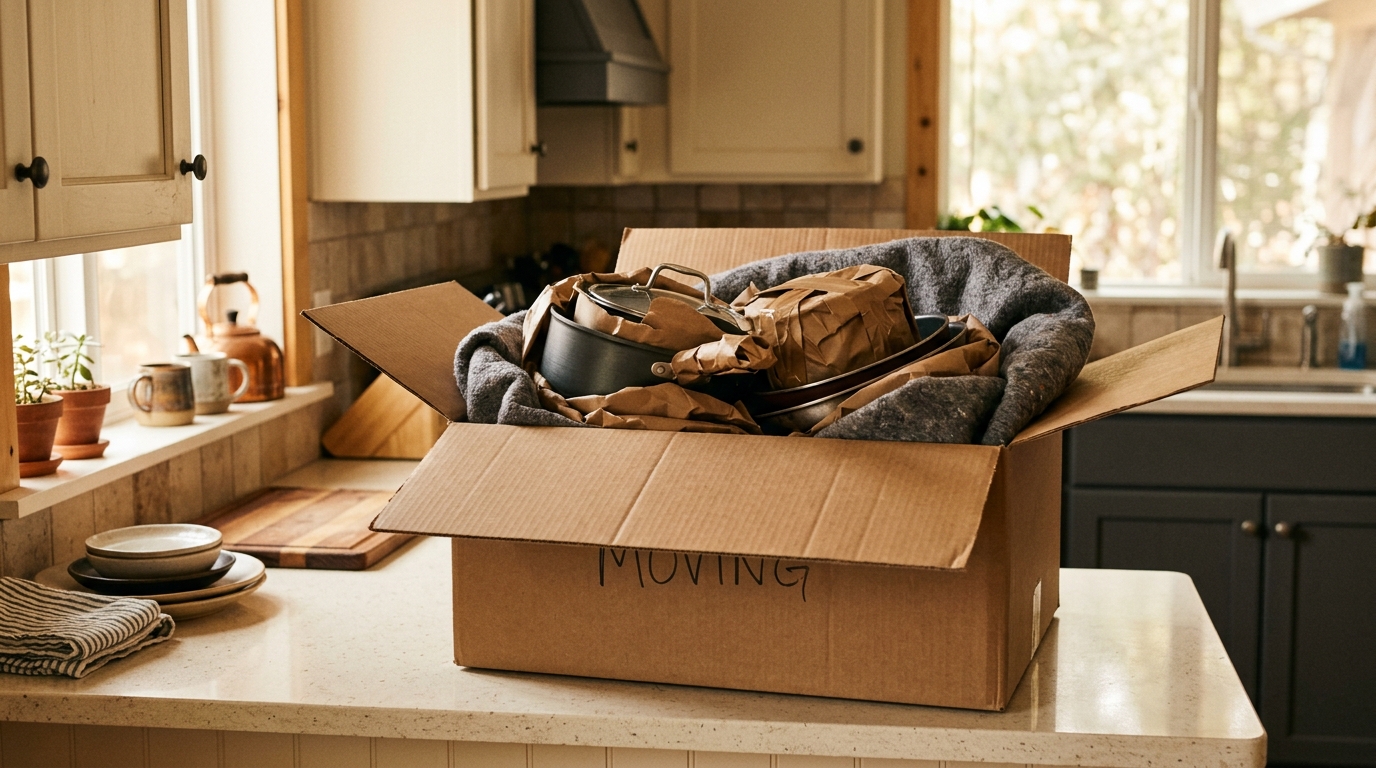
Pots and pans pack best when you wrap each piece individually in packing paper, nest them smallest-inside-largest with a paper layer between every surface, and box them in medium or dish-pack boxes with the heaviest pieces on the bottom. Done right, your cookware arrives scratch-free, non-stick coatings intact, and ready to use the night you move in.
Why cookware is trickier to pack than it looks
Pots and pans seem sturdy — and they are — but they cause each other damage during transit. Cast iron scuffs enameled Dutch ovens. Bare aluminum scratches non-stick coatings. Lids rattle and chip rims. The fix isn't padding everything into oblivion; it's a systematic nesting method that keeps surfaces separated and weight distributed evenly.
Our team has 35+ years of hands-on service-provider experience, including an operator who ran a moving company for 18 years. The kitchen packing mistakes we saw most often: lids dropped loose into pots, boxes overloaded until the bottom gives out, and non-stick pans stacked metal-on-metal with nothing between them.
What supplies do you actually need?
You don't need specialty cookware boxes. Here's what works:
| Supply | Purpose | Notes |
|---|---|---|
| Unprinted packing paper | Wrap individual pieces | Newsprint leaves ink on light interiors |
| Bubble wrap (small roll) | Extra padding for lids and non-stick pans | One layer is enough |
| Medium moving boxes (18×18×16) | Main cookware box | Holds 30–40 lbs comfortably |
| Dish-pack / cell boxes | Lids standing upright | Dividers prevent chipping |
| Packing tape | Seal and reinforce bottoms | Double-tape box bottoms for heavy loads |
| Markers | Label "HEAVY" and "THIS SIDE UP" | Non-negotiable on cookware boxes |
For supply choices overall, the guide How to Choose Moving Boxes and Packing Supplies covers sizes and quantities by room — useful before you start boxing the whole kitchen.
Step-by-step: how to pack pots and pans
1. Separate lids from pots immediately
Lids packed inside pots shift in transit and crack handles or chip rims. Set all lids aside — they get their own section of the box or their own box entirely.
2. Sort pots by size and material
Group pieces: cast iron together, non-stick together, stainless and aluminum together. Cast iron goes in its own box or at the very bottom of a reinforced box — a single 12-inch cast iron skillet can weigh 8–10 lbs. Never put it on top of non-stick cookware.
3. Wrap every piece individually
Lay a sheet of packing paper flat. Set the pot in the center, fold the sides up and over, then tuck the remaining paper inside the pot. Use a second sheet for anything with a non-stick interior — the coating scratches more easily than you'd expect. For a cast iron skillet, two sheets minimum, with the paper tucked tight around the handle.
Non-stick pans specifically: lay a sheet of packing paper (or a foam plate, which works well) directly against the cooking surface before you stack anything on top. Non-stick coatings are vulnerable to metal-on-metal contact even when lightly padded.
4. Nest pots smallest-to-largest, paper between every layer
Once each piece is wrapped, you can nest them the way you store them — but keep the paper in place as you go. Every surface that touches another surface needs a paper buffer. A medium pot nested inside a large pot is fine; a bare pan resting against a bare pan is not.
5. Pack the box: heaviest on the bottom, lightest on top
| Layer | What goes here |
|---|---|
| Bottom | Largest, heaviest pot (cast iron, large stockpot) — wrapped |
| Middle | Medium pots, nested pairs |
| Top | Lightweight saucepans, small sauté pans |
| Fill gaps | Crumpled packing paper — no empty space |
A medium box of cookware should weigh no more than 40 lbs. If you pick it up and it feels like it might give out, split it into two boxes.
6. Pack lids
Lids are the most frequently damaged item in a kitchen move. Three options:
- Stand them upright in a dish-pack box with cardboard dividers between each one — the same way you'd pack plates. This is the safest method.
- Wrap individually and layer flat in a shallow box with crumpled paper between each lid.
- Keep glass lids separate from metal lids — glass is heavier and more fragile; pack it as you'd pack fragile items you can't replace.
7. Handle specialty cookware differently
- Woks and paella pans (wide, shallow): wrap and lay flat as the bottom layer of a box; nothing goes on top of a wok with a thin carbon-steel bottom.
- Pressure cookers and Instant Pots: remove the lid, gasket, and any accessories; pack the base like a pot, wrap the lid separately, and tape the cord to the body with painter's tape so it doesn't snag.
- Enameled cast iron (Le Creuset, Staub, etc.): wrap in at least three sheets of packing paper and add a layer of bubble wrap around the outside — the enamel chips at corners. Pack upright if possible, never inverted. These pieces are heavy enough to warrant their own box.
8. Label every box clearly
Mark each box: KITCHEN – COOKWARE | HEAVY | THIS SIDE UP. If a box holds cast iron, write the weight estimate on the side so movers know before they lift it. A labeling system that works across every room is covered in detail in How to Label Moving Boxes Like a Pro.
While you’re reading
Skip the research — let Robert match you with movers.
Free quotes from movers in your area. Pick whichever is easiest.
What about packing pots and pans if movers are packing for you?
If you've hired a full-service mover to pack the kitchen, walk them through anything that needs special attention before they start: the non-stick pans, the enameled Dutch oven, the pressure cooker with removable parts. Movers pack quickly and professionally, but they don't always know your cookware's quirks. A two-minute conversation prevents an avoidable scratch. You can see what professional packing services typically include — and what they cost — in How Much Do Movers Charge to Pack for You?
Should you pack pots and pans with other kitchen items?
Keep cookware in its own box or boxes. Mixing cookware with dry goods, small appliances, or utensils creates uneven weight and unpredictable shifting. The one exception: lightweight kitchen linens (dish towels, pot holders) make excellent gap-fillers and padding between pots — they're soft, they're going to the same room, and they save you packing paper.
For the rest of the kitchen, the guide How to Pack a Kitchen in 48 Hours Without Losing Your Mind covers the full room sequence, including how to prioritize what gets packed first.
Pots and pans you're moving long distance
If your move crosses a state line and you're using a professional mover, your cookware is covered under the valuation terms on your bill of lading. Under Full Value Protection, if a mover damages your enameled Dutch oven, they must repair it, replace it, or pay its replacement value. If you've chosen Released Value (60 cents per pound per article) by signing a written waiver, a 5-lb pot would be covered for $3 — which is why it's worth understanding valuation before you sign anything. The full breakdown is at How to Protect Your Move: What You Need to Know About Moving Valuation Before You Sign.
Ready to find a mover for your kitchen and everything in it? Browse movers in our directory or check mover reviews to read what other customers say about packing quality and care.
Frequently asked questions
Can I leave things inside pots when packing them for a move?
Small, lightweight, non-breakable items — a silicone spatula, a few pot holders — can ride inside a large pot if they're not shifting around. Never put breakable items, bottles, or anything heavy inside a pot; the pot's walls are not reinforced, and if the box shifts, contents inside a pot have nowhere to go but into the pot's interior surface.
Do pots and pans need bubble wrap, or is packing paper enough?
Packing paper is sufficient for most stainless, aluminum, and cast iron cookware. Add bubble wrap for enameled cast iron, glass lids, and non-stick pans — any surface where a scrape causes cosmetic or functional damage. A single layer of bubble wrap around the outside of the wrapped piece is enough; you don't need to double-wrap everything.
Can I stack non-stick pans directly on top of each other?
No. Always put a sheet of packing paper, a foam plate, or a folded dish towel between non-stick surfaces. Even light contact during transit can drag across the coating and leave scratches that degrade performance over time.
What size moving box is best for pots and pans?
A medium box (typically 18×18×16 inches) is the standard choice. It holds enough cookware to be efficient but stays light enough to lift safely when loaded with heavy pots. Dish-pack boxes (18×18×28 inches) work well for lids stood upright. Avoid large boxes for cookware — they're too easy to overload.
How do I pack a cast iron skillet for moving?
Wrap it in at least two sheets of packing paper — one sheet inside the cooking surface folded over, one sheet around the entire exterior — then place it flat at the bottom of a reinforced medium box. Double-tape the box bottom before loading. Label it "HEAVY." Don't place anything fragile above or below it without substantial padding.
Is it worth decluttering pots and pans before a move?
Almost always. Duplicate pots, worn non-stick pans, and pieces you haven't used in a year add weight, take up box space, and drive up the cost of a weight-based long-distance move. Moving is a natural checkpoint to donate what you're not cooking with. If you want a method for the full kitchen and beyond, How to Declutter Before a Move walks through it room by room.
Have questions about packing the kitchen or finding the right mover for your move? Reach out to Robert, our moving concierge, or find movers near you to get started.
Tagged