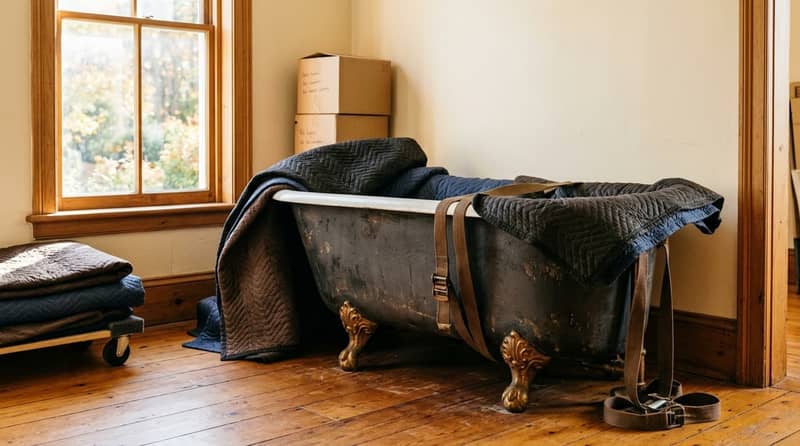
Moving a clawfoot tub means controlling a 200–500-pound cast-iron or acrylic shell with no handles, no flat bottom, and legs that catch on every doorframe. The job is doable — but only with the right crew, the right equipment, and a clear plan before anyone touches a wrench. Most specialty movers charge $300–$800 to move a clawfoot tub locally, and costs climb with stairs, tight hallways, and long-distance hauls.
How much does a clawfoot tub weigh — and why does it matter so much?
Weight is the first thing to settle, because it determines crew size, equipment, and cost.
| Tub Material | Typical Weight Range | Notes |
|---|---|---|
| Cast iron (original antique) | 300–500 lbs | Most common; heavy even when empty |
| Cast iron (reproduction) | 250–400 lbs | Slightly thinner walls than antiques |
| Acrylic or fiberglass | 60–125 lbs | Much lighter; still awkward to carry |
| Steel enameled | 150–250 lbs | Mid-range; slippery surface |
A standard cast-iron clawfoot tips the scale at around 350–400 lbs without water. That is heavier than a typical gun safe entry-level model and heavier than most large appliances like a refrigerator or dryer. No healthy adult should attempt to move one without at minimum three people and a heavy-duty appliance dolly with straps.
What do you need to do before the tub can move?
Step 1 — Disconnect plumbing properly
A clawfoot tub sits on exposed legs, so the supply lines and drain connections are visible and accessible. That is the good news. The necessary steps:
- Turn off the water supply at the shutoff valves behind or below the tub.
- Disconnect the faucet supply lines (usually 3/8-inch compression fittings). Have a bucket ready — there is always residual water.
- Unscrew the drain assembly at the tub's floor drain. The drain shoe and overflow plate typically unscrew by hand or with a drain wrench.
- Cap the drain and supply lines in the floor or wall so nothing leaks while the tub is out.
If you are not comfortable with basic plumbing, budget $75–$200 for a licensed plumber to disconnect and reconnect. That is money well spent — a hairline crack in a copper supply line found after the tub is reinstalled is far more expensive.
Step 2 — Remove the legs (sometimes)
Clawfoot legs are typically bolted to the tub body from inside the tub with nuts. Removing them:
- Reduces the overall footprint for doorway clearance
- Drops total height by 6–8 inches, which helps on stair landings
- Makes the tub easier to set on a dolly
Keep all hardware in a labeled zip-lock bag taped to the inside of the tub. Replacement Victorian-era leg hardware can be expensive and hard to source. Store the legs separately, wrapped in moving blankets, to avoid chipping the enamel.
Step 3 — Measure every doorway, hallway, and stairwell
A standard clawfoot tub is 54–72 inches long and 27–32 inches wide. Standard interior doorframes are 32–36 inches wide. That means clearance is often measured in inches, not feet.
Measure:
- The tub at its widest point (rim to rim, not just the base)
- Each doorframe from jamb to jamb
- Stairwell width and landing depth
- Any 90-degree turns in hallways
If the tub cannot clear a doorframe upright, it may need to be tilted — which requires ceiling height clearance as well. Document everything and share the measurements with your mover before booking.
What equipment do movers use to move a clawfoot tub?
Professional specialty movers typically rely on:
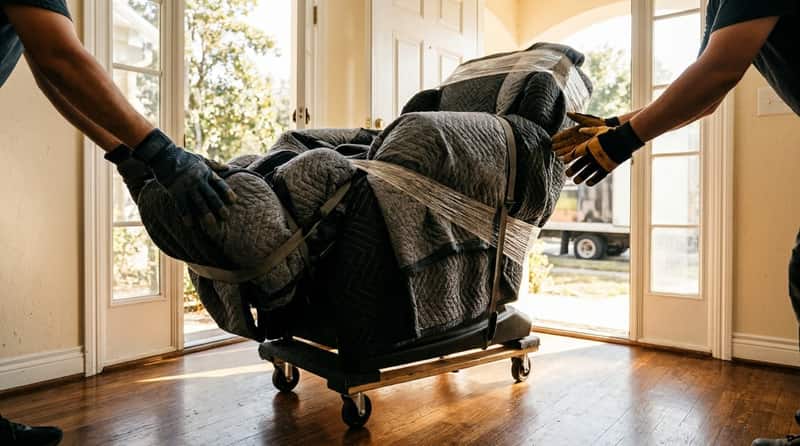
- Heavy-duty appliance dolly (capacity 800+ lbs) with rubber straps
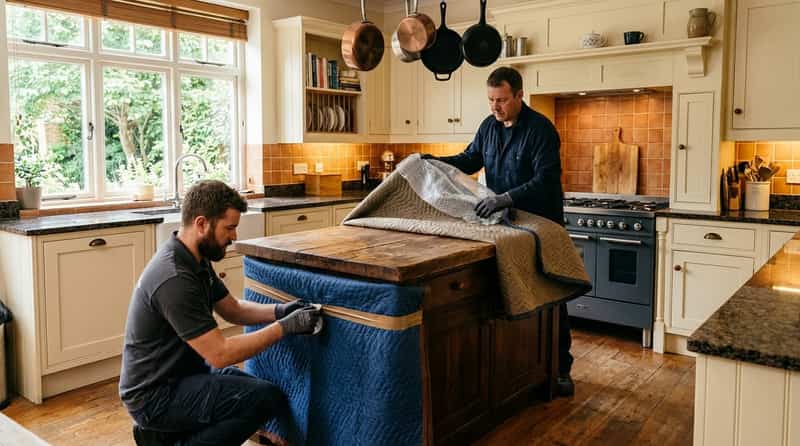
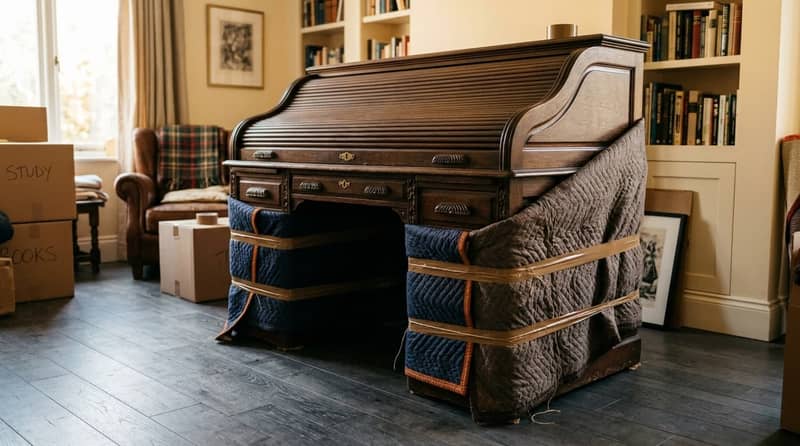
- Moving blankets wrapped around the entire tub exterior to protect enamel
- Forearm forklifts or lifting straps for stair carries — see our full breakdown of the gear movers use to move furniture
- Floor runners to protect hardwood and tile from dolly wheels
- A third (or fourth) person for any stair or tight-turn situation
Acrylic tubs also need foam padding beneath the strap points; nylon straps can dent or crack the shell under pressure.
How much do movers charge to move a clawfoot tub?
Costs vary by tub weight, access difficulty, and distance. These are typical ranges — confirm specifics with any mover you contact.
| Scenario | Typical Cost Range |
|---|---|
| Local move, ground floor, easy access | $300–$450 |
| Local move, stairs or tight hallways | $450–$650 |
| Local move, stairs + plumbing disconnect | $550–$800 |
| Long-distance (interstate) specialty freight | $800–$2,000+ depending on distance |
| White-glove service with crating | $1,200–$3,000+ |
For interstate moves, the mover is governed by FMCSA rules under 49 CFR 375. Your estimate must be in writing and must state whether it is binding or non-binding — there is no other federal category. A binding estimate means you pay that amount at delivery (plus any services you added after signing, plus up to 15% for impracticable operations collected at delivery). A non-binding estimate is based on actual weight; at delivery you owe 110% of the estimate, with any remaining balance billed within 30 days. If you are unsure which type you are being offered, read a moving estimate line by line before signing anything.
For local (in-state) moves, state rules apply — not FMCSA. Check with your state's regulator for the specifics in your area.
While you’re reading
Skip the research — let Robert match you with movers.
Free quotes from movers in your area. Pick whichever is easiest.
Should you hire a specialty mover or a general mover?
Not every full-service moving company is equipped for a 400-pound cast-iron tub. Ask directly:
- Do you have an appliance dolly rated for 400+ lbs?
- Have you moved clawfoot or freestanding tubs before?
- How many crew members will you send?
- Do you carry cargo liability coverage for antique or enameled fixtures?
A general mover who says "sure, we can handle it" without specific answers to those questions is a risk. Chipped enamel on an antique clawfoot is a cosmetic loss that can cost $500–$2,000 to refinish professionally — and that damage claim will only be as good as the valuation coverage you arranged before the move.
For interstate moves, Full Value Protection means the mover must repair, replace, or pay replacement value for damaged items. The free alternative — Released Value at 60 cents per pound per article — would pay roughly $240 on a 400-pound tub regardless of its actual worth. Many customers choose Released Value by signing a written waiver; make sure you understand what you are waiving before you sign. See the category overview on protecting belongings for more on how valuation works in practice.
You can browse movers and check their USDOT numbers yourself at majesticmovingcompanies.com. Every carrier's operating authority is publicly searchable on FMCSA's website — confirm that the company you hire is listed as a "Motor Carrier of Household Goods," not just a "Broker of Household Goods." A broker does not own trucks and will hand your job off to another company.
What about moving a clawfoot tub you just bought — not one being relocated?
Antique and salvage clawfoot tubs are bought and sold constantly. If you are transporting a tub you purchased from an architectural salvage yard or a private seller, the logistics are essentially the same — but a few extra considerations apply:
- Inspect the enamel before it loads. Document any existing chips, cracks, or rust spots with photos. This protects you if a dispute arises over damage that was pre-existing.
- Consider crating for long-distance transport. A wooden crate built around the tub — with the legs removed and stored inside — dramatically reduces transit damage risk.
- Check the drain plug. Old tubs sometimes have missing or corroded drain assemblies. Order replacement parts before the tub arrives so you are not waiting weeks for a specialty part after moving day.
For single-item moves like this, see our guide on small and single-item moves, which covers how specialty freight billing works differently from full household moves.
Frequently asked questions
Can two people move a clawfoot tub?
Only if it is an acrylic or fiberglass model under 125 lbs and there are no stairs. A cast-iron clawfoot requires a minimum of three people — four if there are stairs or tight turns. Attempting it with fewer is a back-injury and property-damage risk.
Do movers need to remove the legs before moving a clawfoot tub?
Not always, but usually yes for doorway clearance. Legs add 6–8 inches of height and widen the footprint at the base. If measurements are tight, removing the legs first is standard practice. Keep all hardware in a labeled bag.
Will a clawfoot tub fit through a standard doorframe?
It depends on the tub's width and the door's rough opening. Tubs range from 27–32 inches wide; standard interior doors are 32–36 inches. That is often just enough — but measure first. Some older homes have 28- or 30-inch doors that will require the tub to be angled or the door trim temporarily removed.
How do I protect the enamel during a move?
Wrap the entire exterior in moving blankets — at minimum two layers — secured with stretch wrap or rope (not tape directly on enamel). Pad the claw feet individually with foam or rags to prevent floor scratching and to protect the feet themselves from impact. Never rest the tub on its rim.
What does it cost to refinish a chipped clawfoot tub if it gets damaged?
Professional enamel refinishing (also called reglazing) typically costs $450–$1,000 depending on the number of chips, the refinisher's region, and whether the tub is in place or at a shop. That range is why valuation coverage matters before you move.
Do I need a plumber to disconnect my clawfoot tub?
If you are comfortable with basic plumbing — shutting off supply valves, disconnecting compression fittings, unscrewing a drain assembly — you can do it yourself. If you are not confident, budget $75–$200 for a licensed plumber. It is a one-hour job for a pro.
Ready to find a mover with the right equipment for a heavy, awkward fixture? Browse movers by state to find carriers near you, check their USDOT numbers, and read what other customers say at mover reviews. Still have questions about what your specific tub will cost or which type of mover to call? Reach out to Robert, our moving concierge, for a straight answer before you book.
Tagged