Moving a massage chair safely requires knowing its actual weight (most run 150–300 lbs), whether it can be partially disassembled, and whether it will clear your doorways in its reclined position — because reclined is often the only way a full-size chair will pass through a standard 32–36-inch opening. Plan those three things before anything else, and the move becomes manageable. Miss one, and you risk damaging a chair that may have cost $1,000–$8,000.
How much does a massage chair actually weigh?
Weight varies dramatically by feature set:
| Chair type | Typical weight range |
|---|---|
| Entry-level (single motor, basic rollers) | 100–150 lbs |
| Mid-range zero-gravity | 150–220 lbs |
| Full-body L-track / 3D roller | 200–280 lbs |
| Commercial-grade or 4D air-compression | 250–320 lbs |
Check your owner's manual or the manufacturer's website for the exact figure — it matters for choosing the right dolly and crew size. A chair over 200 lbs typically needs at least two people and a heavy-duty appliance dolly rated for that load.
Will it fit through the door? The recline trick
Most massage chairs are 50–60 inches tall when upright. Standard interior doorways are 80 inches tall, so height isn't usually the issue — width is. A full-size massage chair is typically 30–36 inches wide at the shoulders; many are 34–36 inches wide, which makes a 32-inch doorway a problem.
The fix: recline the chair fully (or to the flat "zero-gravity" position). This drops the height to roughly 36–42 inches and shifts the width profile, letting it pass horizontally through most doorways on a low-profile furniture dolly. Measure your narrowest doorway and the chair's reclined profile before moving day — not after.
If the chair still won't fit reclined, check whether the headrest, armrests, or footrest section can be removed. Many models allow this with basic tools (usually a Phillips-head screwdriver or a hex key). Consult the manual; some chairs have a locking track mechanism under the seat that releases the leg rest as a separate piece.
Step-by-step: how to move a massage chair
- Gather the manual and check disassembly options. Note which parts detach without voiding the warranty. Common removable sections: headrest, armrests, footrest/leg-rest assembly.
- Measure every doorway, hallway, and stair landing between the chair's current location and the truck. Write the numbers down. Measure the chair in its reclined position.
- Unplug and coil the power cord. Zip-tie or tape it to the underside of the chair so it doesn't catch on a doorframe or dolly wheel.
- Remove detachable sections (headrest first, then armrests if applicable). Wrap each piece in moving blankets or bubble wrap and box or bag them separately.
- Recline the chair fully before attempting to move it. Lock the recline position if your model has a travel lock (some do — check the manual).
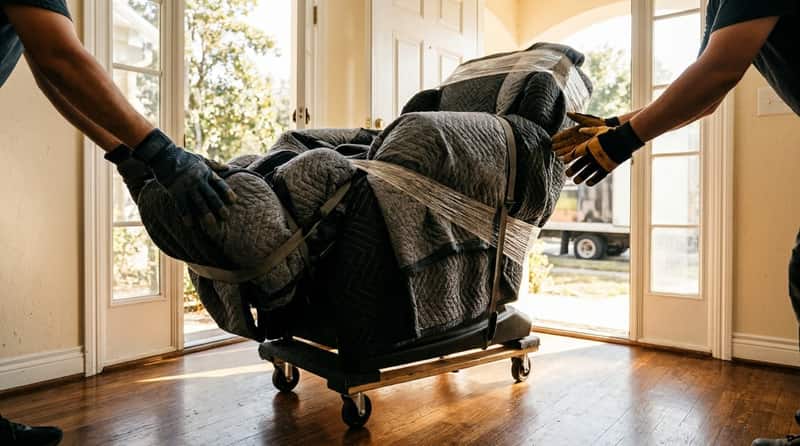
- Slide a heavy-duty appliance dolly under the base. The base of most massage chairs has a solid steel frame; tip the chair back toward the dolly using two people — one controlling the tilt, one guiding the dolly underneath.
- Strap the chair to the dolly using two ratchet straps: one across the seat, one across the back. Test that it's secure before moving.
- Navigate doorways slowly, tilting as needed. One person guides the dolly handle, the other steadies the top. Take corners wide.
- On stairs: use a stair-climbing dolly if available, or recruit a third person. Never attempt stairs with a 200+ lb chair and only two people.
- In the truck, stand the chair upright or lay it on its back (check the manual — some models should not be transported on their side because the air compressor or roller mechanism can be damaged). Secure with moving straps anchored to the truck wall.
What can movers do with a massage chair?
Most full-service moving companies will move a massage chair as part of a standard household move — it's heavy furniture, not a specialty item in the same category as a piano or a gun safe. However, a few things to confirm before moving day:
- Disassembly: Ask whether the crew will remove detachable sections. Many movers will handle basic disassembly; some charge extra for it. Get it in writing on the estimate.
- Stairs and long carries: Movers typically add a stair carry fee (often $50–$150 per flight) and may charge a long-carry fee if the truck can't park close to your door. These are legitimate charges — just make sure they appear on the estimate before you sign, not on the final bill. Our guide to hidden moving fees explains what to look for line by line.
- Liability: If the chair is valuable, ask the mover about their valuation coverage before they load it. For interstate moves, Full Value Protection means the mover must repair, replace, or pay replacement value for items they damage — but you need to confirm that coverage is in place and understand any declared-value caps. See our valuation vs. insurance guide for a plain-English breakdown.
If you're doing a DIY move, a furniture rental dolly from a truck rental company typically handles up to 600–800 lbs and costs $10–$20/day — money well spent for a chair this heavy.
While you’re reading
Skip the research — let Robert match you with movers.
Free quotes from movers in your area. Pick whichever is easiest.
Can you move a massage chair by yourself?
For a chair under 150 lbs with no stairs involved: possibly, with a proper appliance dolly and a second person. For anything heavier, or any move involving stairs, narrow hallways, or multiple doorways — no. The risk of injury (to you) and damage (to the chair's roller mechanism, which sits in the backrest and is not impact-resistant) is too high. This is one of those items where hiring even a two-person labor-only crew for a couple of hours is worth the cost. You can find movers near you, compare options, and read mover reviews before you book.
The Gear Movers Use to Move Furniture post is worth a read if you want to understand what equipment a good crew brings — and what to ask about before they arrive.
What does it cost to have movers handle a massage chair?
There's no single line-item price for moving a massage chair — it's typically absorbed into the hourly rate or the overall job estimate. That said, here's what affects the total:
| Factor | Typical impact on cost |
|---|---|
| Stair carries (per flight) | +$50–$150 |
| Long carry (over 75 ft from door to truck) | +$50–$100 |
| Disassembly / reassembly labor | +$50–$150 depending on complexity |
| White-glove or specialty moving service | Full-job premium of 20–40% |
For a local move where the chair is the hardest item, two movers for two hours at $100–$150/hour works out to $200–$300 in labor — often the most cost-effective option. For a long-distance move, the chair's weight is a factor in the total shipment weight, which affects your final bill under a non-binding estimate. Worth discussing with your mover upfront.
Protecting the massage chair during transport
The roller mechanism and air-compression bladders are the two most damage-prone components:
- Don't transport the chair on its side unless the manufacturer explicitly says it's safe. Many roller systems use guide rails that can be bent or knocked out of alignment if the chair shifts.
- Wrap the entire backrest in at least two layers of moving blankets, secured with stretch wrap. The roller housing is usually behind a vinyl or fabric panel that tears easily against truck walls.
- Pad the armrests individually — they're often hollow and crack under lateral pressure.
- Secure to the truck wall with ratchet straps so the chair cannot shift. Even gentle braking can tip a 200+ lb chair if it's not strapped.
If you're moving other large items alongside it, our guide to moving a recliner covers similar mechanism-protection concerns and pairs well with this one.
Frequently asked questions
Can a massage chair be transported lying flat?
It depends on the model. Some manufacturers explicitly prohibit laying the chair on its back or side because the air compressor or roller carriage can be damaged by gravity-shifted fluids or misaligned rails. Check the owner's manual under "storage" or "shipping" instructions — that section typically covers transport orientation. When in doubt, keep it upright or reclined at no more than 45 degrees and strap it securely.
Do I need to drain or disconnect anything before moving a massage chair?
Most home massage chairs don't have water components, so draining isn't typically necessary. However, if your chair has a heat element, make sure it's fully powered off and cooled before wrapping it. Unplug the chair at least 30 minutes before moving to let any residual heat dissipate from the heating pads.
Will movers disassemble a massage chair for me?
Many full-service movers will handle basic disassembly — removing the headrest, footrest, and armrests — especially if the pieces need to come off to clear a doorway. Confirm this before booking and ask that it be noted on your estimate. Some movers charge a separate disassembly fee; others include it in the hourly rate. It's worth asking what services moving companies offer so you know what's standard and what costs extra.
What if the massage chair won't fit through any door in the new place?
Measure before you commit. If neither the upright nor the fully reclined position clears the narrowest doorway or hallway, your options are: (1) remove a door from its hinges to gain another inch or two, (2) have a mover attempt a window entry if the window is large enough, or (3) accept that the chair cannot go where you planned and find an alternate room. This is a situation worth solving with a tape measure before moving day, not during it.
Is a massage chair a specialty item that needs a special mover?
Not usually. Unlike a piano, organ, or large safe, a massage chair doesn't require specialized rigging equipment or a licensed specialty crew in most cases. A standard moving crew with an appliance dolly and ratchet straps can handle the job. If your chair is extremely high-end (over $5,000) or has complex disassembly requirements, it's worth asking whether the mover has moved massage chairs before — just as you'd ask about any item with an expensive mechanism. You can browse movers by state to find companies in your area and ask that question directly.
How do I find a mover for a single heavy item like a massage chair?
Look for movers that offer labor-only or single-item moving services — many do. Use the directory to find companies near you, check their licensing (look up the USDOT number on FMCSA's search tool yourself), and read reviews before booking. For a single-item local job, two movers for two to three hours is typically all you need. If you have questions about how to compare quotes or what to watch out for, Robert, our moving concierge, can help you think through it.
Tagged