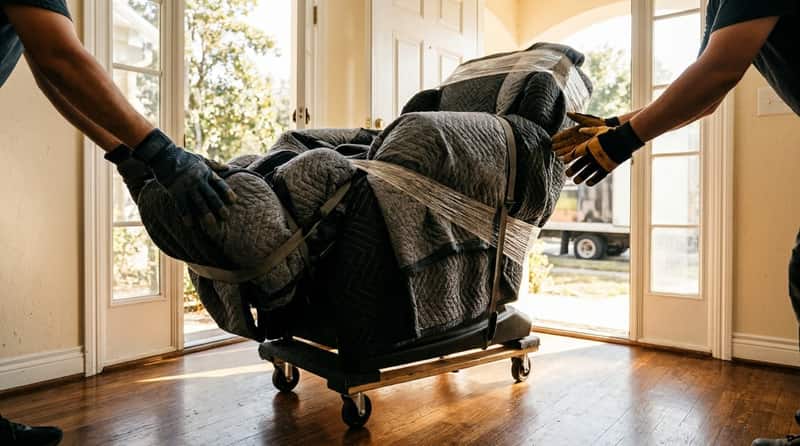
To move a recliner chair, remove the detachable back if the model has one, measure the door opening before you try to carry it through, and wrap the reclining mechanism in moving blankets before the chair leaves the room.
Moving a recliner safely comes down to three things: knowing whether the back detaches, measuring the door before you try to push the chair through it, and protecting the reclining mechanism during transit. Most recliners can be broken into two pieces in under five minutes — and that single step resolves the vast majority of tight-doorway problems.
Why Recliners Are Harder to Move Than They Look
A standard recliner weighs between 75 and 150 pounds depending on frame material and padding. That weight alone is manageable for two people. The problem is the shape: in the closed position, a recliner is deeper front-to-back (typically 32–40 inches) than it is wide, and the footrest housing adds awkward bulk at the base. That depth is what gets people stuck in doorways — not the weight.
The reclining mechanism (the steel linkage that extends the footrest and drops the back) is the most expensive part of the chair to repair. Dropping the chair on its side or transporting it on the footrest housing puts direct stress on that linkage and can bend or crack it. A repair or replacement mechanism typically costs $80–$250 in parts alone, plus labor.
Step 1 — Measure Before You Move Anything
Standard interior doorways are 32–36 inches wide. Before you move the chair an inch, measure:
- Door width (the actual opening, not the frame): use a tape measure at the narrowest point.
- Chair width at the widest point (usually the outside of the armrests).
- Chair depth with the footrest closed.
- Chair height — relevant for low doorframes, especially in older homes.
If the chair width clears the door width by at least 1–2 inches, you may be able to walk it through upright. If not, go to Step 2.
Step 2 — Remove the Back (Most Recliners Have This Feature)
The majority of modern recliners — including most Lazy Boy, Ashley, and similar styles — have a detachable back. This reduces the chair's height by 12–18 inches and often drops 30–40 pounds from the piece you're maneuvering through the door.
How to detach a recliner back:
- Open the recliner fully so the back tilts slightly forward.
- Look along the lower sides of the back where it meets the seat frame — you'll find either a locking lever (flip or pull it) or a pair of release tabs on a metal bracket.
- Lift the back straight up and off the bracket. It should slide free cleanly.
- If you see bolts instead of levers, the back is bolted on — grab the right socket wrench size (usually 3/8" or 7/16") and remove them.
Not all recliners have detachable backs. Older rocker-recliners and many wall-hugger models are single-piece units. If yours won't come apart, skip to Step 4.
For more context on the gear movers use to handle large, awkward pieces, see The Gear Movers Use to Move Furniture: Dollies, Straps, Sliders, and Why It Matters.
Step 3 — Handle Power Recliners Differently
Power recliners have a motor, wiring harness, and sometimes USB ports or heat/massage elements built in. Before moving:
- Disconnect from the wall at least 30 minutes before moving to let any residual charge dissipate.
- Secure the power cord with a zip tie or rubber band so it doesn't drag or snag.
- Do not tilt a power recliner onto its motor housing — the motor is usually mounted at the base and can be damaged by direct impact.
- If the chair has a built-in battery pack, check the manufacturer's guide; most can be transported normally, but some lithium packs have airline-style restrictions that also apply to enclosed moving trucks in extreme heat.
Step 4 — Protect the Mechanism and the Upholstery
Once the chair is in two pieces (or if it's a single unit), wrap it before it moves an inch toward the truck.
What to use:
| Material | What It Protects | Notes |
|---|---|---|
| Moving blankets | Fabric, frame edges | Drape over the entire piece and secure with stretch wrap |
| Stretch/shrink wrap | Blankets in place, mechanism | 2–3 layers over the underside keeps the footrest housing covered |
| Furniture pads (foam) | Corners, armrests | Tape or wrap in place; don't use tape directly on fabric |
| Cardboard sheets | Footrest housing bottom | Prevents scraping if the chair is set down on concrete |
The footrest housing is the most vulnerable point. Wrap the underside with two layers of moving blanket before anything else. For a deeper look at how professional movers approach furniture wrapping, Do Movers Wrap Furniture in Plastic? covers what gets wrapped, what gets padded, and when plastic causes harm.
While you’re reading
Skip the research — let Robert match you with movers.
Free quotes from movers in your area. Pick whichever is easiest.
Step 5 — Navigate the Doorway
With the back removed and the chair wrapped, here's the standard technique for getting a recliner through a standard doorway:
- Tilt the seat forward slightly so the bottom of the chair clears the door threshold.
- Lead with the top of the seat (the open back bracket side) through the door at an angle.
- Pivot once the seat is halfway through so the base follows.
- If the chair still won't fit, try removing the door itself by tapping out the hinge pins — that recovers another 1.5–2 inches of width at no cost.
If you're moving into or out of an apartment building, check elevator dimensions before moving day — many elevator cabs are shallower than 60 inches, which makes single-piece recliners a genuine problem. Reserve the elevator and have a plan before you get there.
Protect floors during the move. Furniture sliders under the base let you slide a recliner across hardwood without scratching; moving blankets laid flat protect tile. Our guide on sliding heavy furniture without scratching floors has room-by-room tips.
Step 6 — Load It Correctly in the Truck
How you position a recliner in the truck matters as much as how you got it through the door.
- Load upright whenever possible — never lay a recliner on the footrest housing.
- If you must lay it on its side, rest it on the back side (the fabric back panel), not the base.
- Strap it in place: one strap around the mid-section, one near the base. The chair should not rock during transit.
- Place the detached back behind the seat, leaning against a wall or mattress, padded on both sides.
- Nothing heavy should be stacked on top of a recliner — the frame can flex and damage the mechanism under load.
Find movers experienced with large furniture if you'd prefer to hand this off to professionals who carry the right dollies and straps for the job.
Should You Hire a Pro for a Recliner?
For most single recliners, two fit adults with a dolly, moving blankets, and 20 minutes of prep can handle the move themselves. Hire a pro if:
- The recliner is a large power or massage chair (some exceed 200 lbs.)
- Access is difficult — narrow stairs, multi-story walkup, long carry distance
- The chair is a high-value piece and you want it covered under a mover's liability
- You're already hiring movers for the rest of the home — just add it to the inventory
When comparing movers, check mover reviews to find companies that specifically mention furniture handling. A mover who has handled pianos and safes will have no trouble with a recliner. You can also browse movers by state to find licensed carriers in your area.
Frequently Asked Questions
Can I move a recliner by myself?
A standard recliner weighing 75–100 lbs. can be moved solo if the doorways are wide and the path is clear — but it's awkward and the risk of injury or mechanism damage is high. Two people with a furniture dolly is a much safer approach for most recliners.
Does a recliner back always come off?
Most recliners made in the last 15–20 years have detachable backs with lever or bracket releases. Older rocker-recliners, some wall-hugger models, and certain imported styles are single-piece units. Check along the lower rear sides of the back for a release lever or bracket before assuming yours doesn't come apart.
Can I lay a recliner on its side in a moving truck?
Yes, but only on the back panel side — never on the footrest housing or mechanism side. Pad it heavily and make sure nothing rests on top of it during the move.
How do I protect the reclining mechanism during a move?
Wrap the entire underside and footrest housing with moving blankets secured by stretch wrap. Load the chair upright in the truck and strap it so it can't shift. Avoid laying it on the base or dropping it — the linkage that drives the footrest is the most fragile component.
Will movers charge extra to move a recliner?
Many local movers include standard furniture in their hourly rate. However, a very heavy power recliner, a difficult access point (narrow stairs, long carry), or disassembly/reassembly service may add a surcharge. Ask specifically when you get your quote. For details on how hourly charges work, see How Movers Charge by the Hour.
What if my recliner won't fit through any door even disassembled?
If the seat unit itself won't clear the doorway even after removing the back, try removing the door from its hinges (tap out the hinge pins) to recover an extra 1.5–2 inches. If it still won't fit, a professional mover may use a furniture sling to bring it through a large window or balcony opening — not common, but not unheard of for oversized pieces.
How do you move a recliner chair by yourself?
Removing the back first is the most important solo preparation — it cuts the chair's height by 12–18 inches and often drops 30–40 pounds from the piece you need to control through the doorway. With the back off, most recliners can be carried by one person if the path is clear and the floors are flat. A furniture dolly under the base makes it easier to roll rather than carry. For anything heavier or through tight stairs, a second person prevents both injury and mechanism damage.
Still figuring out the logistics? Browse our directory to find movers near you, or connect with Robert, our moving concierge, for personalized help matching you with the right carrier for your move.
Tagged