Books are among the heaviest things in any home — a standard 1.5-cubic-foot "small" box packed solid with hardcovers can weigh 60–70 pounds, which is enough to blow out the bottom seam on a medium or large box and guarantee a back injury. The right method is straightforward: use small boxes only, pack spines flat or upright (never resting on the spine's edge), fill every gap so pages don't shift, and keep each box under 30–35 pounds. Everything below builds on those four principles.
What Size Box Should You Use for Books?
Always use small boxes — roughly 1.5 cubic feet (typically 16" × 12" × 12"). This is the single most important rule. A small box packed with books hits 30–35 pounds, which is manageable and unlikely to fail structurally. A medium box (3 cubic feet) packed the same way reaches 60–80 pounds — difficult to lift safely and hard on box seams.
If you're buying supplies, our guide to choosing moving boxes and packing supplies covers exactly which box types hold up under weight.
Box quality matters more for books than almost anything else. Double-wall (or "double-ply") cardboard is worth the extra cost for a full library. If you're reusing grocery or liquor store boxes, inspect every seam before loading — a broken seam mid-carry is how books end up on the floor.
How to Pack Books Step by Step
1. Sort and cull before you pack a single box
Books are heavy and bulky. Every volume you don't move saves weight, box cost, and labor time. Go shelf by shelf and set aside anything you haven't opened in three years, duplicates, and books you finished once and won't reread. Donate, sell, or leave them — your future self will thank you. If you need a system for making those calls, see how to declutter before a move.
2. Tape the box bottom thoroughly
Run packing tape in a "+" pattern across the bottom flap, then add a second pass around the perimeter edge. Books stress box seams from the inside; a single strip of tape is not enough.
3. Add a layer of crumpled packing paper or bubble wrap on the bottom
An inch of cushioning on the bottom protects covers from the hard cardboard and absorbs impact if the box is set down firmly.
4. Pack books using one of three orientations — and know when to use each
| Orientation | When to use it | What to avoid |
|---|---|---|
| Flat (stacked horizontally) | Large hardcovers, coffee table books, oversized art books | Don't stack more than 3–4 high; pages can bend under weight |
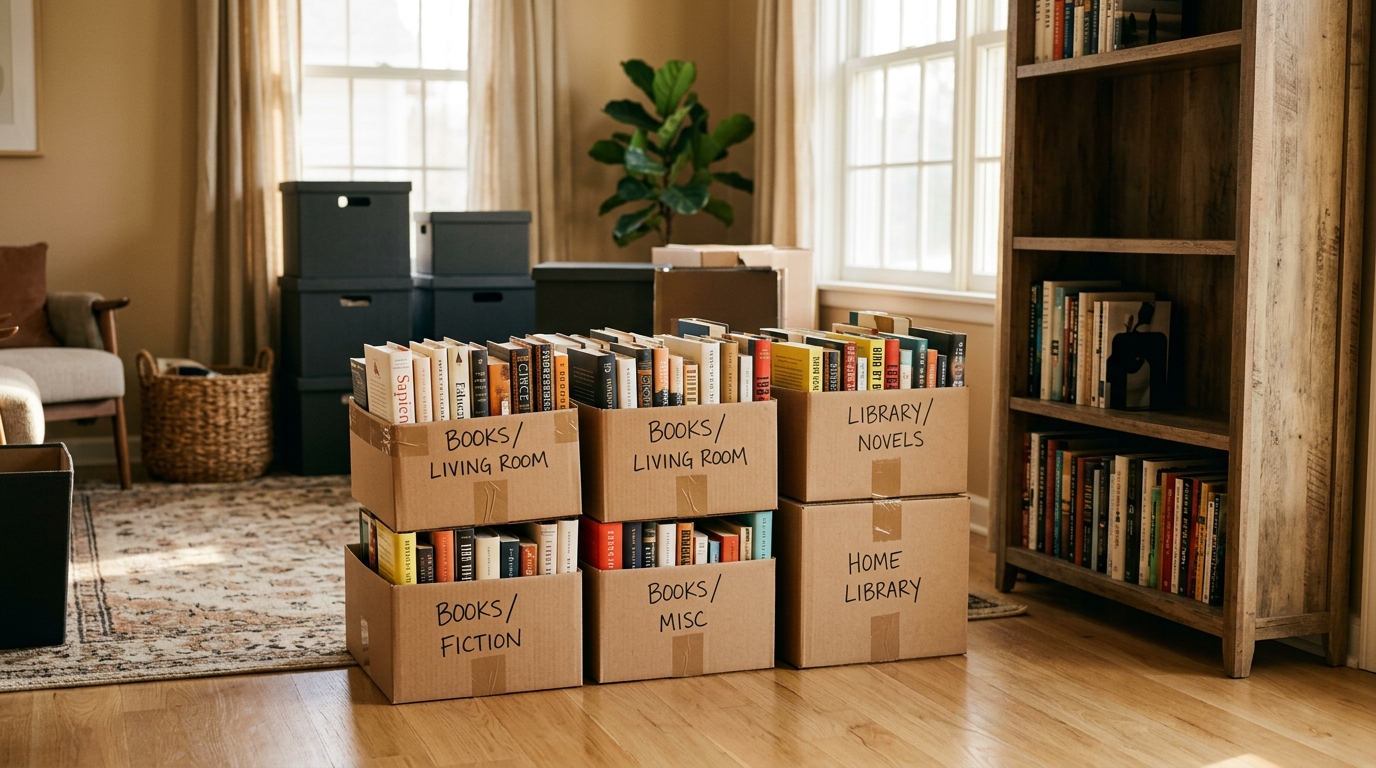
| Upright (standing vertically, like on a shelf) | Paperbacks, standard hardcovers | Keep spines flush against the box wall so books don't lean and warp |
| Spine down (pages up) | Older or fragile bindings | Good for books with cracked spines; relieves stress on the binding |
The one orientation you should never use: resting books on the open-page edges (spine facing up, pages down). This splays the binding and can permanently warp the spine.
5. Mix sizes strategically
Pack the heaviest hardcovers at the bottom of each layer, lighter paperbacks on top. Alternate horizontal and vertical layers if you need to fill odd gaps — just make sure nothing is resting on a spine's top edge.
6. Fill every gap
Empty space is where damage happens. Crumpled packing paper, foam peanuts, or rolled dish towels work well. The contents should not shift when you tip the box side to side.
7. Keep each box under 30–35 pounds
Weigh boxes with a handheld luggage scale as you pack. If a box hits 35 pounds before it's full, top it off with packing paper and seal it. Don't try to finish the shelf — start a new box.
8. Seal and label correctly
Write "BOOKS — HEAVY" on the top and both long sides. Add a destination room and a rough genre or shelf label (e.g., "Books — Living Room — Fiction A–M") so unpacking doesn't mean opening every box. For a full labeling method that works across every room, see how to label moving boxes like a pro.
Special Cases: Rare Books, First Editions, and Oversized Volumes
Rare, signed, or high-value books deserve individual attention:
- Wrap each book individually in acid-free tissue or clean packing paper before boxing. This prevents cover abrasion and moisture transfer.
- First editions and collectibles should be placed in archival book boxes if possible, then packed inside a moving box. Think of it as double-boxing, the same principle used for fragile collectibles. Our guide to moving art, antiques, and collectibles goes deeper on protecting high-value items.
- Oversized or coffee table books should always be packed flat, one or two per layer, with packing paper between each one. Never stand them vertically — their weight distribution makes them prone to spine stress.
- For books with a combined replacement value over a few thousand dollars, ask your mover about declared value and check what your homeowner's or renter's policy covers in transit. Mover valuation has limits; what moving insurance actually covers explains the difference.
While you’re reading
Skip the research — let Robert match you with movers.
Free quotes from movers in your area. Pick whichever is easiest.
How Many Boxes Will You Need?
A rough planning guide:
| Library size | Estimated small boxes needed |
|---|---|
| 1 standard bookshelf (~50–75 books) | 4–6 boxes |
| 2–3 shelves / home office (~150–200 books) | 10–14 boxes |
| Dedicated book room / 500+ volumes | 30–40+ boxes |
These are estimates — actual count depends on book size and how tightly you pack. Budget a few extra; running out of boxes on moving day costs time.
Should You Pack Books Yourself or Let Movers Do It?
Most people pack books themselves to save money, and it's one of the tasks that genuinely rewards DIY effort — books are predictable shapes, they don't require special wrapping techniques, and the work is methodical. The main risk is underestimating weight and using boxes that are too large.
If you're hiring full-service movers who include packing, confirm in advance that they'll use small boxes for books. A good mover will already know this; a mover who packs books into large boxes without asking is worth questioning. You can find movers in our directory and filter by packing services.
One thing to know if you're doing a long-distance move: whatever goes into the boxes affects your weight — and your bill on a non-binding estimate. A full library adds up fast. If you're on a budget, consider shipping some books via USPS Media Mail, which is significantly cheaper than moving weight for books and printed material.
Transporting Books Without a Moving Company
If you're doing a hybrid or DIY move, a few extra rules apply:
- Load book boxes first, directly against the truck cab wall. This keeps weight at the front and low, which is better for truck stability and means they won't shift onto lighter items.
- Never stack book boxes more than two high unless the top box is extremely light and the stack is braced by surrounding furniture.
- In a personal vehicle, distribute box weight evenly across the trunk and back seat floor rather than piling everything on one side.
For everything else that goes into a rental truck, how to pack boxes for moving covers the full loading sequence.
Frequently Asked Questions
Is it okay to pack books in a large moving box?
No — large boxes packed with books routinely exceed 60–70 pounds, which is both a back-injury risk and a structural failure waiting to happen. Use small boxes (around 1.5 cubic feet) and keep each one under 30–35 pounds. If a box isn't full at that weight, top it off with packing paper.
Should books be packed flat or standing up?
Both work, with caveats. Flat (horizontal) stacking is best for oversized hardcovers and coffee table books. Standing upright (vertical, like on a shelf) works well for standard hardcovers and paperbacks — just keep them snug so they don't lean. Never rest books on the open page edges with spines facing up; that's the one position that reliably damages bindings.
Can I use grocery or liquor store boxes for books?
Yes, if the boxes are in good condition and you inspect every seam before loading. Liquor store boxes are often double-wall and sized similarly to small moving boxes, which makes them genuinely useful for books. Reject any box with soft spots, moisture damage, or a compromised bottom seam.
How do I protect a rare or signed book during a move?
Wrap it individually in acid-free tissue paper, then plain packing paper. Place it flat at the top of a book box (never at the bottom where it bears weight), or double-box it in an archival book box inside a moving box. Photograph the cover and interior page before packing for documentation purposes.
What is USPS Media Mail and is it really cheaper for books?
Media Mail is a USPS shipping class for books, DVDs, CDs, and similar educational media. As of 2026, rates start around $4–5 for the first pound and increase incrementally — significantly less per pound than what movers charge based on shipment weight. It's slower (typically 2–8 business days) and USPS can open packages to verify contents, but for a large book collection it can cut costs meaningfully. It's worth calculating if you're on a tight moving budget.
Do movers charge extra to move heavy boxes of books?
On a binding or not-to-exceed estimate, extra weight from books is already baked into the price if the mover did a proper survey. On a non-binding (weight-based) estimate, more books directly increase your final bill. Either way, culling your collection before the move is one of the most cost-effective things you can do — fewer books means lighter shipment or fewer hours on a local move billed by the hour.
Ready to find a mover who handles your library with care? Browse movers in the Majestic Moving Companies directory, or chat with Robert, our moving concierge, to get matched with licensed movers in your area. Check each company's USDOT number before you book, so you're starting from a solid foundation before you pack the first box.
Tagged