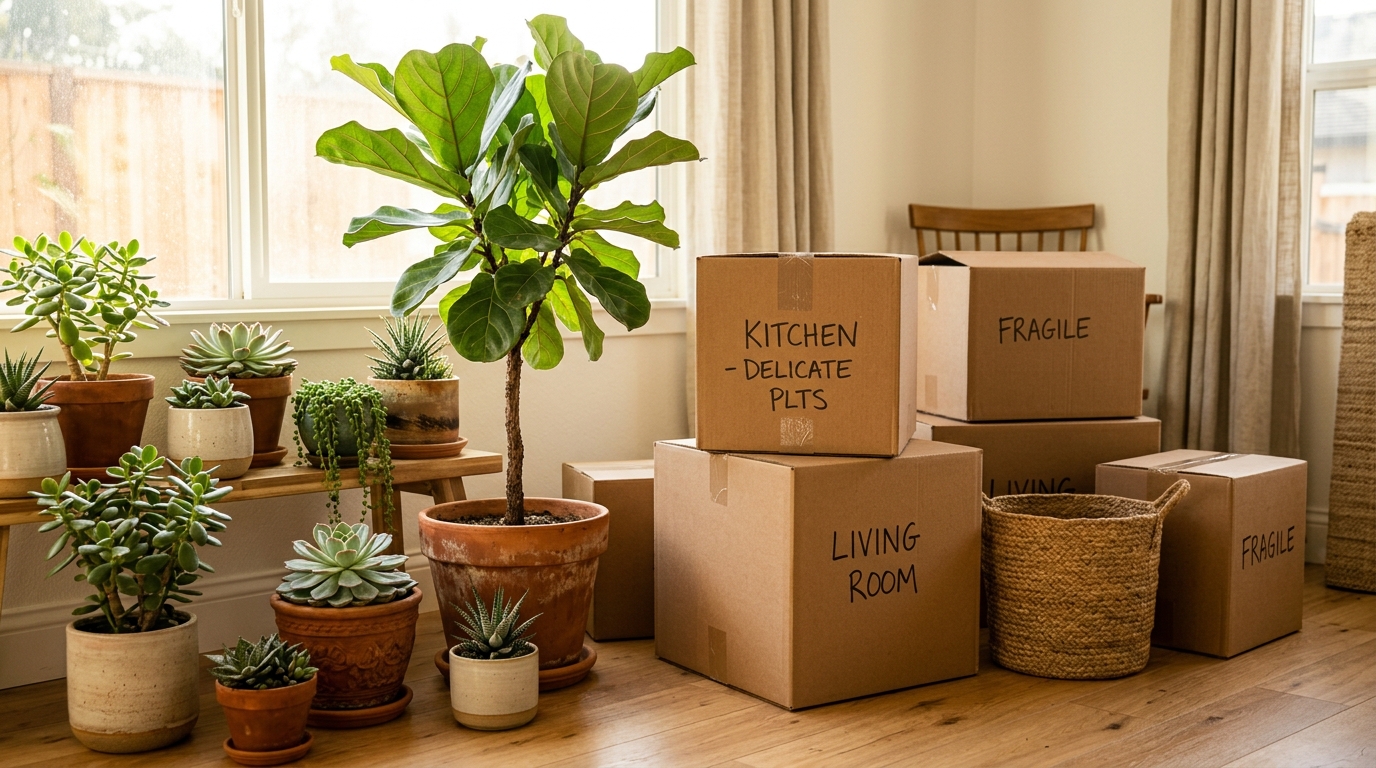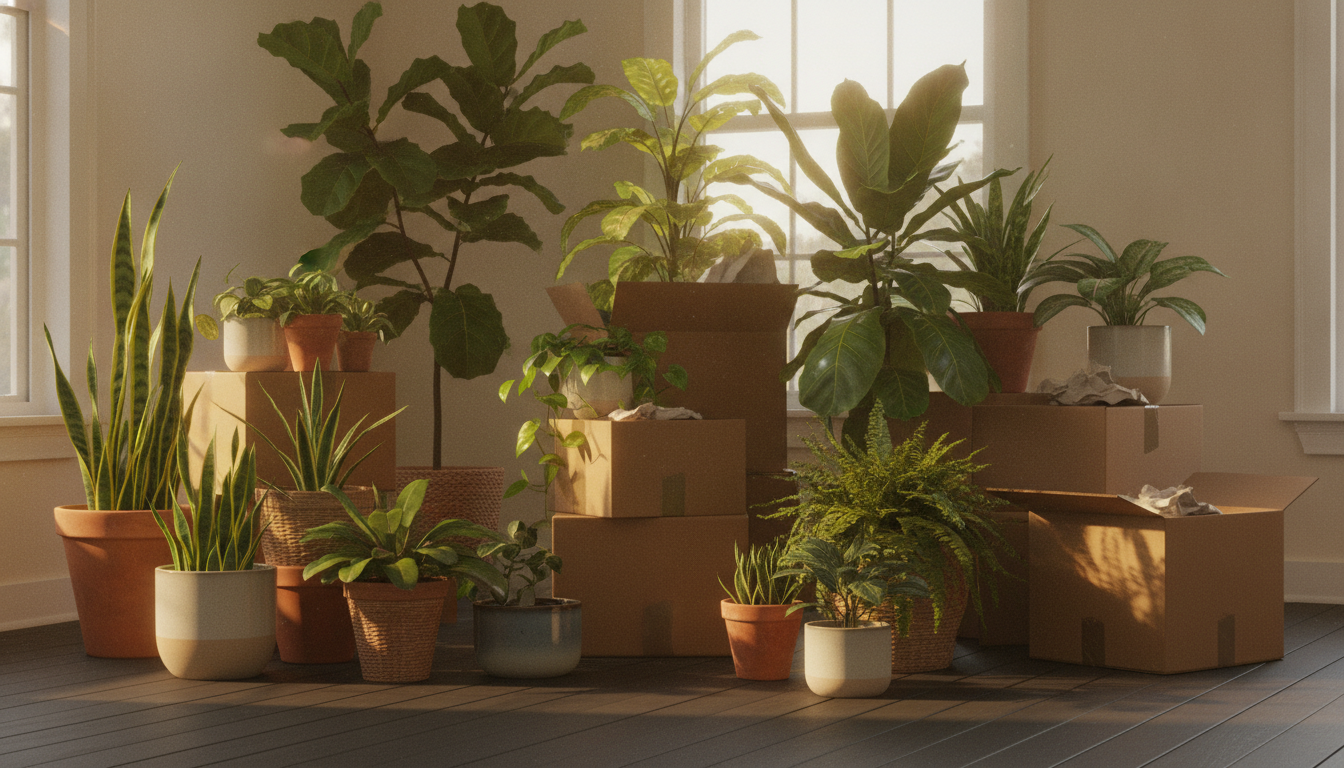
Moving houseplants successfully comes down to three things: timing your prep right, packing them so they don't tip, dry out, or suffocate, and knowing which states have agricultural rules that could stop your plants at the border. Do those three things and the vast majority of plants — from a fiddle-leaf fig to a cactus collection — will arrive at your new home in solid shape.
Why plants are harder to move than they look
Plants are consistently the category people underestimate. They're living things with specific temperature, light, and moisture needs. A sealed moving truck on a hot day can reach 130 °F inside. A cross-country trip that takes four days in a dark box can cause root rot, leaf drop, and permanent stress damage. And most professional movers — us included — will not be liable for plant damage, because live goods are excluded from standard valuation coverage under FMCSA regulations.
That means plants are almost always your responsibility to transport, not the movers'. Plan accordingly.
Step 1: Decide which plants are worth moving
Start by being honest. Some plants are cheaper to replace than to move safely. Others are irreplaceable — that 20-year-old monstera your mother gave you isn't getting left behind.
Factors that make a plant worth moving:
- Sentimental value or years of growth that can't be replaced
- High retail value (rare cultivars, mature specimens)
- Easily transported — compact, sturdy, not in a fragile pot
Factors that make a plant worth donating or selling:
- Very large, heavy, or planted in a ceramic pot that would need extra packaging
- Species that don't travel well (orchids mid-bloom, succulents in wet soil)
- You're moving to a state with restrictions on that plant type (see Step 3)
If you're already thinking about decluttering before the move, plants are a natural part of that process — pass the ones you can't take on to neighbors, plant swaps, or local buy-nothing groups.
Step 2: Prep your plants 2–3 weeks before move day
The earlier you start, the better the outcome.
- Repot into plastic nursery pots. Ceramic and terracotta pots are heavy and break easily in a truck. Transfer plants to lightweight plastic containers 2–3 weeks out so they have time to settle before the stress of moving.
- Prune and treat. Trim back leggy growth to reduce water demand during transit. Treat any pest issues now — moving stressed plants across state lines with pests is a bad combination.
- Stop fertilizing. Two weeks before the move, stop fertilizing entirely. New growth is fragile and more likely to suffer in low-light, temperature-variable conditions.
- Water strategically. Water thoroughly 2–3 days before loading. You want moist (not wet) soil — wet soil is heavier, can breed mold in a sealed box, and may trigger root rot during a long transit.
- Acclimatize to lower light. If you're moving plants from a bright window, gradually move them to slightly lower light a week out. A sudden change from bright sun to a dark truck is a shock they don't need.
Step 3: Know the state agricultural rules — this is the one most people skip
Several US states have strict regulations on what plants (and soil) can cross their borders. These rules exist to prevent invasive species and agricultural pests from spreading.
| State | Key plant/soil restrictions |
|---|---|
| California | Strict — prohibits many fruits, vegetables, and some ornamental plants; soil-borne pests are a major concern; CDFA checkpoints at borders |
| Florida | Prohibits certain citrus and tropical plants from other states; FDACS inspects incoming shipments |
| Arizona | Restricts citrus and some ornamentals; USDA-regulated noxious weed list applies |
| Hawaii | Among the strictest in the US — nearly all soil and many plant species require inspection or are prohibited outright |
| Texas | Regulates movement of certain plants, especially from citrus-producing states |
What to do: Before your move, check the destination state's Department of Agriculture website for current restrictions. For interstate moves, the USDA APHIS (Animal and Plant Health Inspection Service) also maintains a federal noxious weed list that applies nationally. If you're moving to California, Florida, or Texas, take this step seriously — plants can be confiscated at checkpoints with no compensation.
Step 4: Pack plants properly for the truck or your car
For local moves (same day, under 3 hours):
- Transport in your personal vehicle whenever possible
- Line the floor of your car with plastic sheeting
- Use cardboard boxes cut to fit around pot bases to prevent tipping
- Crack a window — plants need air circulation
For long-distance moves:
- Pack each plant in its own box, sized so the pot fits snugly at the bottom
- Crumple newspaper or packing paper around the pot base to prevent shifting
- Wrap trailing or delicate branches loosely with tissue paper or soft cloth — don't pack tightly
- Punch or cut ventilation holes in the top and sides of each box
- Label boxes: LIVE PLANTS — THIS SIDE UP — DO NOT SEAL AIRTIGHT
- Do not put plants in the moving truck for trips longer than 1–2 days if temperatures will be extreme
Temperature rule of thumb: Most tropical houseplants are damaged below 50 °F and stressed above 95 °F. If you're moving in winter or summer, your car's climate-controlled interior is almost always the right call.
For more on protecting delicate items during transit, our guide on how to pack and move fragile items covers wrapping and padding techniques that apply equally well to plant pots.
While you’re reading
Skip the research — let Robert match you with movers.
Free quotes from movers in your area. Pick whichever is easiest.
Step 5: Load and unload in the right order
Plants should be the last things loaded and the first things unloaded. Every extra minute in a dark, hot, or cold truck costs you.
- Load plants after all furniture and boxes are secured
- Keep them away from exterior walls of the truck (hottest in summer, coldest in winter)
- Never stack boxes on top of plant boxes
- At the destination, bring plants inside first, before you start directing furniture placement
Step 6: Help your plants recover after the move
Even well-packed plants will show some stress — yellowing leaves, drooping, or minor leaf drop in the first 1–2 weeks. This is normal.
- Place them near their original light conditions first. Don't immediately move a sun-lover to a north-facing window because that's what's available. Find the closest match and adjust slowly.
- Wait a week before watering again. Check soil moisture with your finger two inches down. If it's still moist, wait.
- Don't fertilize for 4–6 weeks. Give roots time to settle before pushing new growth.
- Mist tropical plants. If humidity in your new home is lower, a daily mist helps while plants adjust.
- Isolate new-to-home plants from existing plants for 2 weeks. If you picked up any pests in transit, you don't want them spreading.
If you're settling into a new home and working through a longer after-move to-do list, our room-by-room after-move checklist is a good companion to this guide.
What about movers transporting your plants?
Most professional movers will transport plants on local moves as a courtesy, but this comes with caveats:
- Long-distance movers typically refuse plants outright. FMCSA regulations for interstate carriers don't require them to accept live goods, and most carriers exclude plants in their tariffs.
- No liability coverage applies. Even if a mover agrees to transport plants, damage is not covered under standard Released Value (60 cents per pound) or Full Value Protection — live goods are excluded.
- Always confirm in writing. If a mover says they'll take your plants, get it in the written estimate. See our guide on binding vs. non-binding moving estimates to understand what your written agreement actually protects.
Bottom line: assume you're transporting plants yourself, and treat that as a planning item from day one.
Finding the right mover for your overall move
While plants are usually your job, everything else — your furniture, boxes, and appliances — benefits from a mover you can actually trust. You can find movers near you in our directory, or browse movers by state if you're planning a long-distance move and want to compare options along your route. Our mover reviews are a good place to see how actual customers describe their experiences.
If you have questions as you're planning, Robert — our moving concierge — is available on every page to help you think through logistics, timing, and what to ask a mover before you book.
Frequently asked questions
Can movers legally refuse to transport my houseplants?
Yes. For interstate (long-distance) moves, most carriers are not required to transport live plants under FMCSA regulations, and most tariffs explicitly exclude them. For local moves, movers often will transport plants, but they're not liable for damage. Always ask your specific mover in advance and get the answer in writing.
Which states have the strictest rules about moving plants across state lines?
California, Hawaii, Florida, Arizona, and Texas are the most commonly cited for plant and soil restrictions. Hawaii is the most restrictive — nearly all soil and many plant species require inspection or are prohibited. California's CDFA operates border checkpoints that may inspect vehicles. Always check with the destination state's Department of Agriculture before your move.
How do I keep my plants alive in a moving truck?
For short local moves, transport plants in your climate-controlled car instead of the truck whenever possible. If they must go in the truck, load them last, unload them first, pack them in ventilated boxes, and keep them away from exterior walls. For moves longer than 24 hours, the truck environment is generally too extreme for most tropical houseplants.
How long can houseplants survive in a box?
Most tropical houseplants can survive 1–2 days in a ventilated box if temperatures stay between 50–90 °F and the soil is properly moist (not wet) at packing. Succulents and cacti can tolerate longer periods. Orchids, ferns, and air plants are the most sensitive and should be transported in your car on any move longer than a few hours.
Should I water my plants right before the move?
Water 2–3 days before the move, not the night before. You want the soil moist but not saturated — wet soil is heavier, can cause root rot in a sealed box, and increases the risk of mold during transit. Check moisture with your finger two inches into the soil; if it's still damp on move day, don't water again until you arrive.
What do I do if my plants look terrible after the move?
Give them 2–4 weeks before panicking. Some yellowing, drooping, and leaf drop is normal stress response. Place them in appropriate light, hold off on fertilizing for 4–6 weeks, water only when the top two inches of soil are dry, and mist humidity-loving tropicals if your new home is drier. Most plants that were healthy before the move will recover with patience.
Tagged