Moving a bookcase safely comes down to three things: strip it completely bare, tip it onto its long side before carrying it, and protect the case with moving blankets throughout. A fully loaded six-foot bookcase can weigh 150–300 lbs and become dangerously top-heavy the moment you try to walk it upright through a doorway. Done in the right order — empty, disassemble what you can, tip, slide, load — the same piece moves without drama.
Why bookcases tip over during moves (and how to prevent it)
Tall, narrow shelving units have a high center of gravity. The moment the base lifts off the floor even slightly, gravity does the rest. This is the most common cause of bookcase damage during DIY moves, and it injures more than a few people every year.
The rule: Never carry a bookcase upright unless it is under 36 inches tall, rock-solid, and your doorways are wide enough to pass it face-on. Anything taller goes on its side — full stop.
Step 1 — Empty every shelf completely
Remove every single item before you move the piece an inch. That includes:
- All books (box them separately; a sturdy small box method keeps your back safe)
- Decorative objects, photo frames, and anything stored behind doors or in drawers
- Loose shelf pegs — bag them in a labeled zip-lock and tape the bag to the back of the unit
If your bookcase has glass doors, treat the glass panels as fragile items. Tape a large X across each pane with painter's tape (not packing tape) to hold shards if the glass cracks, and pad both sides with bubble wrap before moving.
Step 2 — Remove adjustable shelves and drawers
Adjustable shelves slide out in seconds and prevent the most common damage: a shelf shifting mid-carry and cracking the side panel from the inside.
- Lift each shelf straight up, then pull it toward you.
- Stack shelves together and wrap with stretch wrap or a moving blanket.
- Remove any drawers and move them separately — drawers that rattle loose damage the drawer slides and the frame.
- If the bookcase has a back panel made of thin hardboard, handle the whole unit gently; that panel is structural and cracks under twisting force.
Step 3 — Decide whether to disassemble the frame
| Bookcase type | Disassemble? | Why |
|---|---|---|
| Flat-pack (cam locks, wooden dowels) | Yes, strongly recommended | Easiest to reassemble; avoids stress on joints during carry |
| Solid-wood heirloom piece | No — keep it together | Disassembly risks splitting mortise-and-tenon joints |
| Modular wall unit (multiple sections) | Yes — section by section | Sections are lighter and fit through doorways face-on |
| Budget particleboard, full size | Yes if possible | Particleboard edges chip badly when knocked |
If you do disassemble, photograph every joint and hardware cluster before you remove a single bolt. Your future self will be grateful.
Step 4 — Pad and protect the case
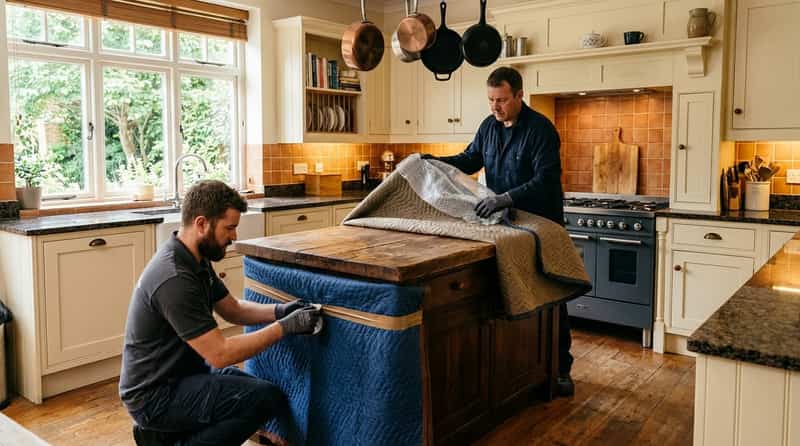
Before you move the bookcase an inch, wrap it:
- Lay two moving blankets on the floor in an L-shape.
- Tip the bookcase onto the blankets (see Step 5 for the tipping method).
- Fold the blankets over the face and secure with stretch wrap — do not let stretch wrap touch raw wood directly on antique or finished pieces.
- Pay extra attention to corners, which are the first things to chip on doorframes.
The gear professional movers use — furniture pads, stretch wrap, corner guards — is worth mimicking on a DIY move. Moving blankets can be rented from most truck-rental locations for a few dollars each.
Step 5 — The tipping technique (do this correctly)
This is the step most people skip, and skipping it is how bookcases get damaged and people get hurt.
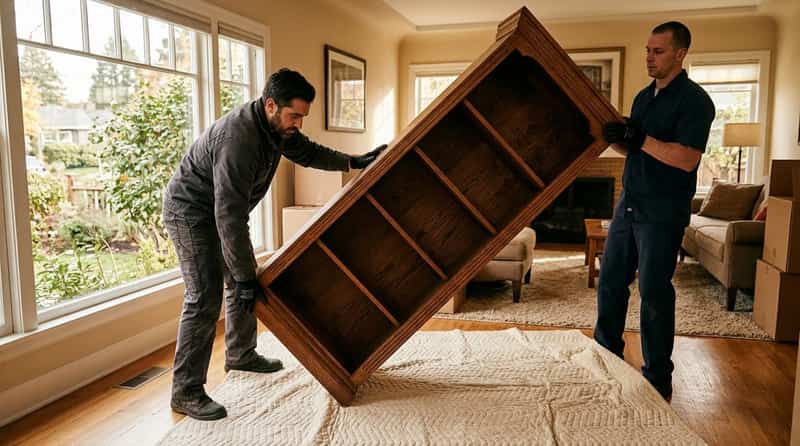
You need at least two people for anything over 48 inches tall.
- Stand the bookcase away from the wall with enough room behind it.
- Person A: grip the top corners firmly.
- Person B: kneel beside the base and prepare to guide it down slowly.
- Person A leans the top toward Person B, who controls the descent with both hands.
- Lower it gently onto the padded blankets on the floor.
- Once horizontal, slide it on the blankets — do not drag it on bare floor.
If you need to slide heavy furniture across hardwood or tile without scratching the surface, furniture sliders under the blanket work extremely well for repositioning before the tip.
While you’re reading
Skip the research — let Robert match you with movers.
Free quotes from movers in your area. Pick whichever is easiest.
Step 6 — Getting it through doorways and down stairs
Doorways: A bookcase on its side is now essentially a wide, flat panel. Measure the height of the unit against your doorway width before you tip it. Most interior doorways are 32–36 inches wide; a standard bookcase is 24–36 inches wide and will pass through on its side.
If it won't fit horizontally, try standing it at a diagonal — "the furniture shuffle." Tilt the top through first, then pivot the base. This works best with two people and no loose back panel.
Stairs: Go feet-first down the stairs (base of the bookcase leading). One person at the top controls speed; one person at the bottom guides. Count steps aloud. Never rush.
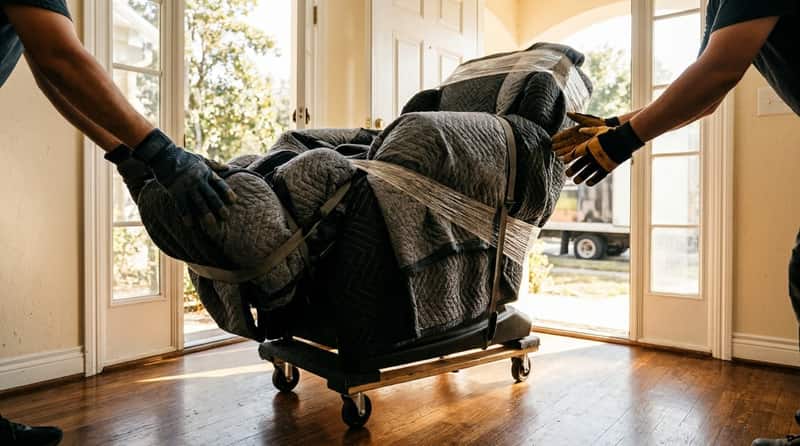
Tight hallways: Moving straps looped under the unit give the bottom person something to grip without stooping. See our guide on what moving straps can and can't do before you buy a set.
Step 7 — Loading onto the truck
Bookcases ride best standing upright against the truck wall — not stacked flat — because the frame is designed to bear vertical load. Strap it to the truck's wall anchors so it cannot tip during transit.
If you're hiring movers, let them direct the loading order. Movers typically load heavy furniture against the front wall of the truck first; a tall bookcase placed early provides a stable anchor for boxes packed in front of it. For more on how movers sequence a truck load, that full breakdown is worth reading before moving day.
Step 8 — Reassembly at the new home
- Carry the bookcase in on its side, reverse the tipping process, and stand it upright before anything else goes in the room.
- If you disassembled it, reassemble the frame before placing shelves — it needs to be square before it's loaded.
- Check that it sits level (use a small spirit level on a shelf peg hole row). Adjust feet if the unit has them.
- Re-insert shelf pegs, replace adjustable shelves, and reload from the bottom shelf up — heaviest books on the lowest shelf.
- If the bookcase will be near a wall in earthquake-prone areas or in a home with young children, attach an anti-tip strap to the wall stud. These cost under $15 and take five minutes.
When to hire a mover for a bookcase
A solid-wood bookcase over 7 feet tall, a built-in unit you're pulling from the wall, or a valuable antique warrants professional handling. When you find movers, share the dimensions and weight so the crew brings the right equipment — appliance dollies, furniture dollies, and enough pads.
For built-ins, make sure you're clear with the mover about whether removal from the wall is included in the job scope. That's carpentry, and most movers will note it separately on the estimate. Confirm in writing before moving day. You can also read mover reviews to get a sense of how local companies handle specialty furniture before you book.
Frequently asked questions
Do I have to take all the books out before the movers arrive?
Yes — in almost every case. Movers will refuse to carry a loaded bookcase because the shifting weight creates an injury risk and the unit's joints aren't designed for dynamic lateral load. Empty shelves and boxed books are non-negotiable before moving day.
Can a bookcase be moved upright?
Short, low bookcases (under 36 inches) can often be carried upright by two people if the doorways are wide enough. Anything taller should be tipped horizontal for the carry, then stood upright again once it's in position.
What is the safest way to move a tall, heavy bookcase downstairs?
Tip it onto its long side, pad it, and carry it face-down down the stairs with one person at each end. The person at the top controls the descent; the person at the bottom guides. Furniture straps improve grip and reduce stooping.
Will movers disassemble my bookcase for me?
Many full-service movers will disassemble flat-pack furniture as part of packing services — confirm this when you get your estimate, because it's not always included in the base rate. Solid-wood or antique pieces are typically moved intact; ask the mover's opinion before the job starts.
How do I protect the bookcase's finish during a move?
Wrap the entire unit in moving blankets before tipping it. Keep stretch wrap away from raw wood or high-gloss lacquer finishes — the plastic can transfer to the surface and dull it. Use paper padding between the blanket and the finish on especially delicate pieces.
I have a modular wall unit that spans an entire wall. How do I move it?
Modular systems — the kind with multiple vertical columns and horizontal connectors — should be broken down column by column. Remove all shelves and doors first, then detach the columns from each other. Photograph connections before disassembly, bag every connector type separately, and label each bag. Moving a modular unit as a single piece almost always results in damage to the connector hardware.
Whether you're moving a single IKEA shelf or a solid mahogany library unit, the principles above will get it to your new home in one piece. If the size or weight of your bookcase is making you hesitate, that's a good signal to bring in professionals. Browse movers by state to find licensed carriers near you, or connect with Robert, our moving concierge, for help narrowing down the right fit for your move.
Tagged